- HPLC-assayed purity of ≥99%
- Certificate of analysis tied to your lot number
- Tracked EU delivery, dispatched the next working day
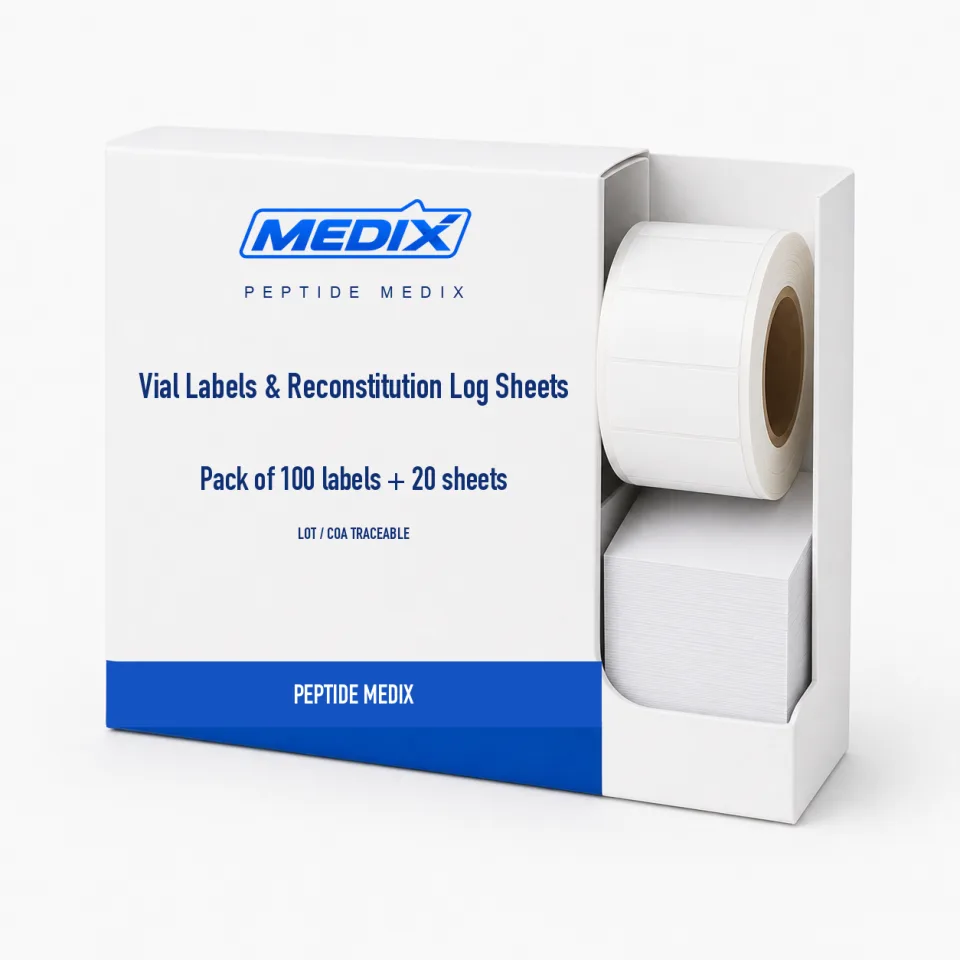
Vial Labels & Reconstitution Log Sheets
Documentation pack: write-on labels for 100 vials and 20 log sheets for recording reconstitutions
In stock1 format available
€12
This listing is currently unavailable. Contact us and we will tell you when it is back or suggest an equivalent.
Ask about this listing or request its COAFor laboratory research use only. Sold exclusively for in-vitro laboratory research by qualified professionals. Not for human or veterinary use, and not a medicine, food, cosmetic or dietary supplement. Terms and Conditions
Overview
Key facts
Think of this pack as the record-keeping half of reconstitution.
- Storage
- Room temperature, dry and flat; keep unused labels on the backing sheet
- Available size
- Pack of 100 labels · 20-pack
For research use only. Not for human consumption.
Think of this pack as the record-keeping half of reconstitution. Inside are labels for 100 vials, all writable, and 20 pre-printed logs — nothing chemical at all, no peptide, no diluent. Why it matters: a dissolved vial without a label is a solution nobody can identify, and an unidentifiable solution is an experiment you'll have to throw away.
Each label is made of synthetic film that shrugs off water and alcohol, backed by permanent acrylic glue that holds firmly on chilled glass — so once applied, it stays attached and readable in the fridge or freezer. Printed prompts remind you to note the compound, its concentration and diluent, when you reconstituted it, the lot, your initials and a discard date, and there is room left for comments. The matt surface can be written on with ballpoint, a fine permanent marker or pencil without smearing.
The logs record the same details on paper that is filed with the study, not stuck on the vial. Each is a grid on a letter-size sheet, with a column for the date, compound, lot and vial size, the volume of diluent added and the concentration that gives, where the vial is stored, and who prepared it — precisely what an auditor, or anyone repeating the experiment, will want to see. For use in the laboratory.
Questions about Vial Labels & Reconstitution Log Sheets
What's included in the pack?
Labels for a hundred vials plus twenty letter-size logs for recording reconstitutions. There's nothing else — no peptide, diluent, syringe or chemical. It is simply stationery for documentation, to use with vials and supplies you already have.
Do the labels stay stuck in the freezer?
The labels are synthetic film coated with a permanent acrylic glue chosen because it grips cold glass. Application is what counts: put them on a clean, dry vial while it is still at room temperature, press down firmly and allow the glue a moment to bond before the vial goes into the cold — avoid labelling a vial that has already been chilled.
What information belongs on each label?
Which compound it is and its original lot; which diluent you used and how much; the concentration that gives; when it was reconstituted; who did it; and the date after which it should be discarded. All of these are printed on the label as prompts so none is forgotten.
Why bother with a separate log sheet?
The label only tells you what a vial is while that vial is still around; the log is the permanent record. It has space for details that won't fit on a label, and it lets you work out — long after the vial has been binned — which lot and which reconstitution a set of results came from.
Do the labels survive alcohol swabbing?
Yes. Both the film and the glue cope with occasional contact with isopropyl alcohol, which is important because you swab the stopper every time you pierce it. Writing done in ballpoint or with a fine permanent marker won't run; avoid water-based pens, which can smudge.
Related