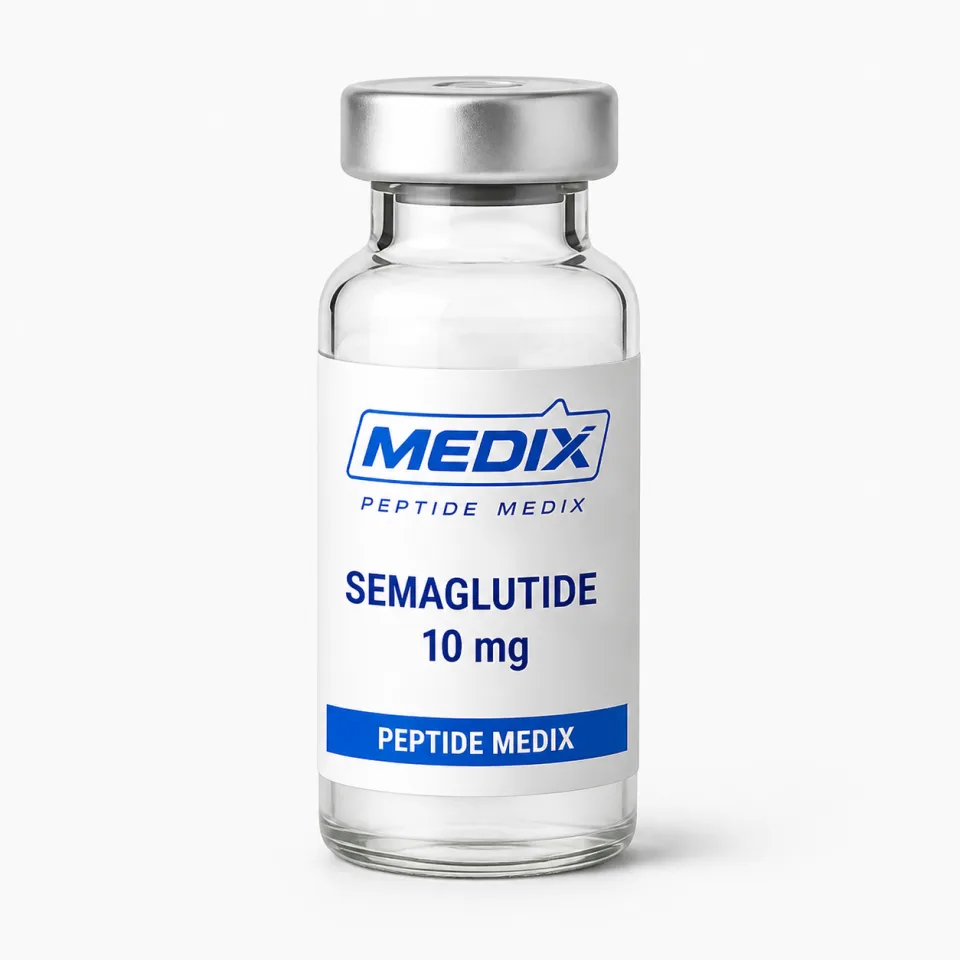
- HPLC purity ≥99%, with a COA for each lot on request
- Certificate of analysis tied to your lot number
- Tracked EU delivery, dispatched the next working day
Semaglutide
Research-grade acylated GLP-1 receptor agonist analogue of 31 residues
In stock8 formats availableCAS 910463-68-2
€38Range €38 – €522
This listing is currently unavailable. Contact us and we will tell you when it is back or suggest an equivalent.
Ask about this listing or request its COA- FormLyophilized powder, sealed glass vial with flip-off seal
- Mol. weight4113.58 g/mol
- Research areasGLP-1 receptor pharmacology, incretin signaling, appetite and glucose-handling models
For laboratory research use only. Sold exclusively for in-vitro laboratory research by qualified professionals. Not for human or veterinary use, and not a medicine, food, cosmetic or dietary supplement. Terms and Conditions
Overview
Key facts
Semaglutide is a synthetic 31-amino-acid analogue of glucagon-like peptide-1 (GLP-1), the incretin that intestinal L-cells release after a meal.
- CAS number
- 910463-68-2
- Molecular formula
- C187H291N45O59
- Molecular weight
- 4113.58 g/mol
- Purity
- ≥99% by HPLC; lot-matched COA available
- Form
- Lyophilized powder, sealed glass vial with flip-off seal
- Storage
- −20 °C, sealed and protected from light and moisture
- Available sizes
- 2 mg · 5 mg · 10 mg · 15 mg · 20 mg · 30 mg · 50 mg · 10-vial kit · 10 x 5 mg
For research use only. Not for human consumption.
Semaglutide is a synthetic 31-amino-acid analogue of glucagon-like peptide-1 (GLP-1), the incretin that intestinal L-cells release after a meal. Two engineered features set it apart from the native hormone: an alpha-aminoisobutyric acid near the N-terminus that greatly reduces cleavage by dipeptidyl peptidase-4, and a gamma-glutamyl linker on a lysine carrying a C18 fatty diacid, which promotes reversible binding to albumin. In published pharmacokinetic studies these changes stretch its persistence in circulation from minutes to days.
That stability has made semaglutide one of the most cited tool compounds in incretin research. Labs use it to study GLP-1 receptor binding kinetics, cAMP accumulation and beta-arrestin recruitment in receptor-transfected cells, and downstream signalling in islet, hypothalamic and vagal-afferent preparations. It is also a standard positive control when new GLP-1, dual and triple agonists are profiled head to head.
What sets this listing apart
Semaglutide – vial, 2/5/10/15/20/30/50 mg. Lyophilized powder, sealed glass vial with flip-off seal. Other Semaglutide listings differ in format, fill or combination partners; the specification and COA always refer to the listing you order.
Same compound, other listings
Specifications
Identity
- CAS number
- 910463-68-2
- Molecular formula
- C187H291N45O59
- Molecular weight
- 4113.58 g/mol
- Peptide class
- Acylated GLP-1 receptor agonist analog (incretin mimetic)
Supply & purity
- Form
- Lyophilized powder, sealed glass vial with flip-off seal
- Purity
- ≥99% by HPLC; lot-matched COA available
- Available sizes
- 2 mg, 5 mg, 10 mg, 15 mg, 20 mg, 30 mg, 50 mg
- Solubility
- Bacteriostatic water; also soluble in dilute alkaline or phosphate buffers
Handling & storage
- Storage (lyophilized)
- −20 °C, sealed and protected from light and moisture
- Storage (reconstituted)
- 2–8 °C, protected from light; use within the study window
Additional detail
- Backbone length
- 31 amino acids
- Key modifications
- Aib at position 2; Lys26 conjugated to gamma-Glu-(AEEA)2-C18 diacid
- Research areas
- GLP-1 receptor pharmacology, incretin signaling, appetite and glucose-handling models
Questions about Semaglutide
How pure is the semaglutide, and is the COA available?
At least 99% by HPLC for every lot, with mass spectrometry confirming identity. The lot's certificate is available on request and refers to the precise vial number you receive, making results traceable to your delivery.
Which vial sizes do you offer?
5 mg, 10 mg, 20 mg, 30 mg and 50 mg lyophilised vials. Bigger vials cost less per milligram, which helps longer assay programmes; smaller ones shorten how long a reconstituted stock has to wait in the fridge.
What is the correct storage?
Unopened lyophilised vials: −20 °C, away from light and humidity. After reconstitution: 2–8 °C, used within your documented study period. Make single-use aliquots so the stock isn't frozen and thawed over and over.
How does semaglutide compare with tirzepatide and retatrutide?
Semaglutide activates only the GLP-1 receptor. Tirzepatide acts on both GIP and GLP-1 receptors, and retatrutide adds glucagon-receptor activity on top. Labs often test all three together to compare receptor selectivity and downstream signalling.
Which solvent is used to reconstitute it?
Research labs typically use bacteriostatic water, or dilute alkaline or phosphate buffers when an assay needs a particular pH. Add the solvent slowly, swirl instead of shaking, and check the solution is clear before using it.
Related