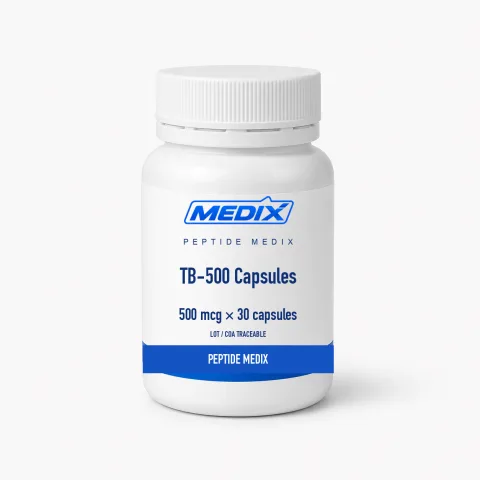
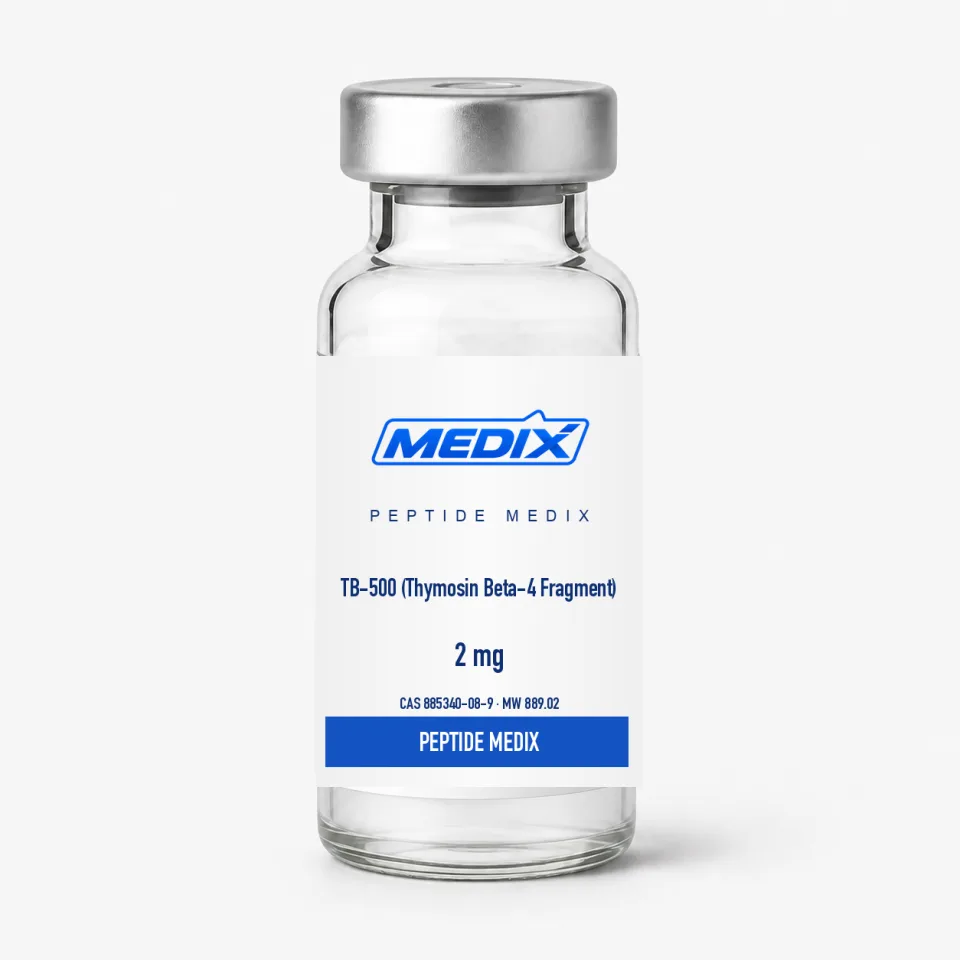
- HPLC purity ≥99%, with a COA for each lot on request
- Certificate of analysis tied to your lot number
- Tracked EU delivery, dispatched the next working day
Tissue Repair & Healing Peptides
TB-500 (Thymosin Beta-4 Fragment)
Acetylated LKKTETQ fragment (also called ABP-7) in research vials
In stock5 formats availableCAS 885340-08-9
€34Range €34 – €522
This listing is currently unavailable. Contact us and we will tell you when it is back or suggest an equivalent.
Ask about this listing or request its COA- FormLyophilized powder, sealed glass vial with crimped stopper
- Mol. weight889.02 g/mol
- Research areasCell migration, wound closure, angiogenesis, cardiac and corneal repair models
For laboratory research use only. Sold exclusively for in-vitro laboratory research by qualified professionals. Not for human or veterinary use, and not a medicine, food, cosmetic or dietary supplement. Terms and Conditions
Overview
Key facts
TB-500 is the acetylated heptapeptide Ac-Leu-Lys-Lys-Thr-Glu-Thr-Gln, which matches positions 17–23 of thymosin beta-4.
- CAS number
- 885340-08-9
- Molecular formula
- C38H68N10O14
- Molecular weight
- 889.02 g/mol
- Amino acid sequence
- Ac-Leu-Lys-Lys-Thr-Glu-Thr-Gln (thymosin beta-4 residues 17–23)
- Purity
- ≥99% by HPLC; lot-matched COA available
- Form
- Lyophilized powder, sealed glass vial with crimped stopper
- Storage
- −20 °C, sealed and protected from light and moisture
- Available sizes
- 2 mg · 5 mg · 10 mg · 20 mg · 10-vial kit · 10 x 5 mg
For research use only. Not for human consumption.
TB-500 is the acetylated heptapeptide Ac-Leu-Lys-Lys-Thr-Glu-Thr-Gln, which matches positions 17–23 of thymosin beta-4. You may also see this exact molecule listed as ABP-7, a name referring to its length as an actin-binding peptide — ABP-7 is simply another name for this product, not a different peptide or an extra SKU.
This fragment isolates the LKKTETQ actin-binding motif from the complete 43-residue protein. We supply it as lyophilised powder in sealed vials of 2 mg, 5 mg, 10 mg and 20 mg, as well as a research kit of 10 vials. Every lot is assayed by reversed-phase HPLC to ≥99% purity with identity confirmed by mass, and the certificate of analysis for your lot is available.
What sets this listing apart
TB-500 (Thymosin Beta-4 Fragment) – vial, 2/5/10/20 mg. Lyophilized powder, sealed glass vial with crimped stopper. Other TB-500 listings differ in format, fill or combination partners; the specification and COA always refer to the listing you order.
Same compound, other listings
Specifications
Identity
- CAS number
- 885340-08-9
- Molecular formula
- C38H68N10O14
- Molecular weight
- 889.02 g/mol
- Amino acid sequence
- Ac-Leu-Lys-Lys-Thr-Glu-Thr-Gln (thymosin beta-4 residues 17–23)
- Chain length
- 7 amino acids, N-terminally acetylated
- Peptide class
- Thymosin beta-4 fragment; actin-binding domain peptide
Supply & purity
- Form
- Lyophilized powder, sealed glass vial with crimped stopper
- Purity
- ≥99% by HPLC; lot-matched COA available
- Available sizes
- 2 mg, 5 mg, 10 mg, 20 mg; 10-vial kit (10 × 5 mg)
Handling & storage
- Storage (lyophilized)
- −20 °C, sealed and protected from light and moisture
- Storage (reconstituted)
- 2–8 °C, protected from light, used within the study window
Additional detail
- Also known as
- ABP-7, Ac-LKKTETQ, thymosin beta-4 fragment 17–23
- Parent protein
- Thymosin beta-4, a 43-residue G-actin sequestering protein
- Research areas
- Cell migration, wound closure, angiogenesis, cardiac and corneal repair models
Questions about TB-500 (Thymosin Beta-4 Fragment)
What is TB-500, precisely?
A synthetic peptide of seven amino acids, acetylated at the N-terminus, reproducing residues 17 to 23 of thymosin beta-4. Its exact sequence is Ac-LKKTETQ, and it is also sold as ABP-7.
Are ABP-7 and TB-500 different products?
No — both names refer to the same acetylated heptapeptide, Ac-Leu-Lys-Lys-Thr-Glu-Thr-Gln. That's why we don't keep a separate ABP-7 listing alongside this TB-500 product.
Is TB-500 identical to thymosin beta-4?
No. Thymosin beta-4 is the full protein of 43 residues, while TB-500 is a seven-residue piece of it — far smaller, cheaper to make and easier to handle, but chemically different, and the two don't always behave the same in published studies.
How do you verify purity, and is there a COA?
Reversed-phase HPLC confirms ≥99% purity for each lot and mass spectrometry verifies the expected molecular mass of 889.02 g/mol. The certificate matching the lot number on your vial can be requested at any time, before or after purchase.
Which vial size suits my lab?
5 mg fits method development or a single plate experiment; 10 mg covers most short in-vivo pilots; 20 mg is sensible for multi-arm or repeated studies, where opening several small vials would add avoidable handling variability.
How should I store and reconstitute TB-500?
Keep the powder in its sealed vial at −20 °C. Labs usually dissolve it in bacteriostatic or sterile water — swirl, don't shake — and then keep the solution at 2–8 °C away from light. Aliquot before any freezing so the material isn't thawed repeatedly.
Related