- HPLC purity ≥99%, documented per lot
- Certificate of analysis tied to your lot number
- Tracked EU delivery, dispatched the next working day
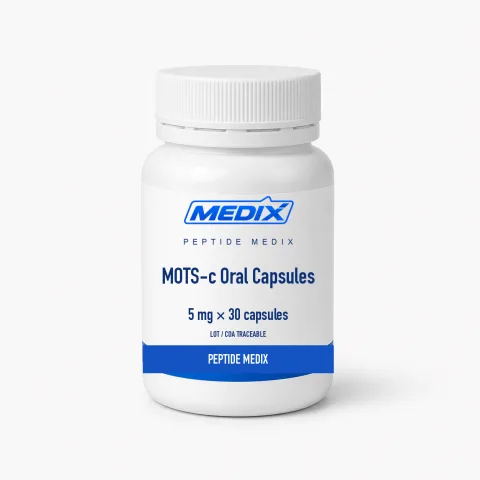
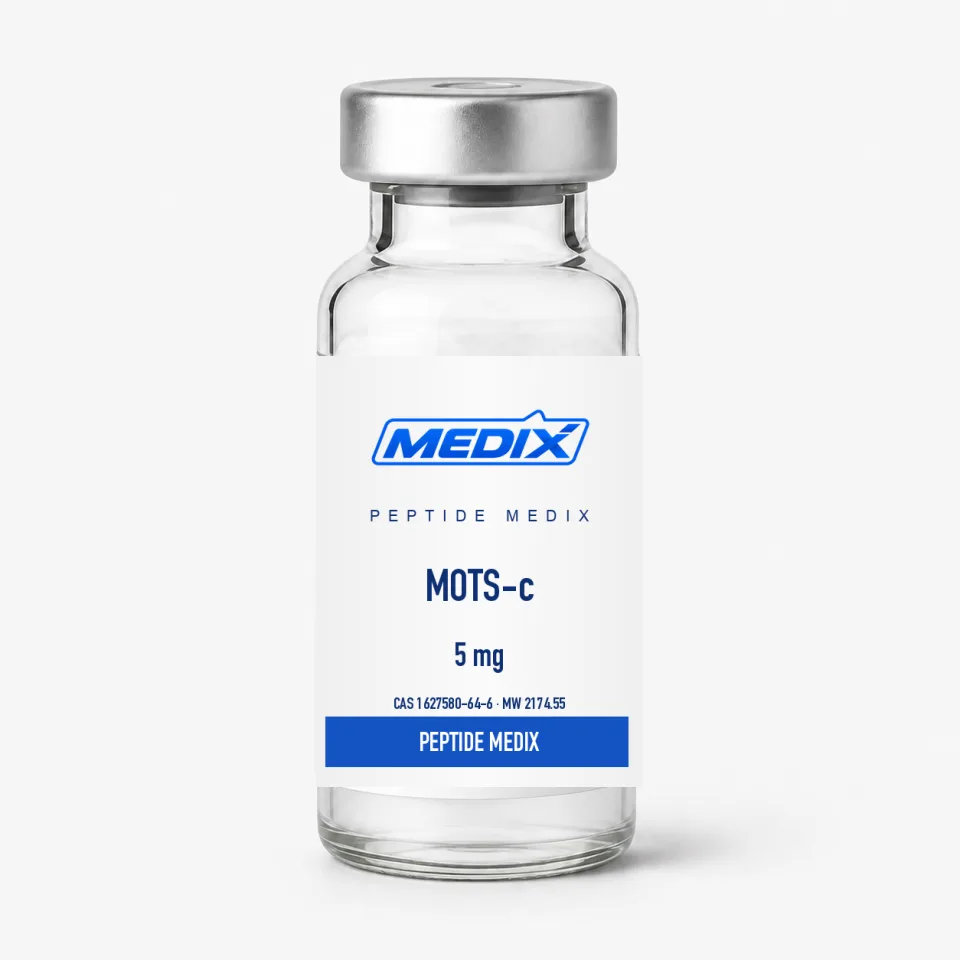
MOTS-c
Mitochondrial-derived 16-residue peptide for metabolic-signalling research
In stock4 formats availableCAS 1627580-64-6
€55Range €55 – €263
This listing is currently unavailable. Contact us and we will tell you when it is back or suggest an equivalent.
Ask about this listing or request its COA- FormLyophilized powder, sealed glass vial
- Mol. weight2174.55 g/mol
- Research areasAMPK signaling, glucose and lipid metabolism, mitochondrial stress response, exercise physiology
For laboratory research use only. Sold exclusively for in-vitro laboratory research by qualified professionals. Not for human or veterinary use, and not a medicine, food, cosmetic or dietary supplement. Terms and Conditions
Overview
Key facts
MOTS-c — short for mitochondrial open reading frame of the twelve S rRNA type-c — is a 16-amino-acid peptide whose gene lies in the mitochondrial 12S rRNA, not in nuclear DNA.
- CAS number
- 1627580-64-6
- Molecular formula
- C101H152N28O22S2
- Molecular weight
- 2174.55 g/mol
- Amino acid sequence
- Met-Arg-Trp-Gln-Glu-Met-Gly-Tyr-Ile-Phe-Tyr-Pro-Arg-Lys-Leu-Arg
- Purity
- ≥99% by HPLC; lot-matched COA
- Form
- Lyophilized powder, sealed glass vial
- Storage
- −20 °C, protected from light and moisture
- Available sizes
- 5 mg · 10 mg · 20 mg · 40 mg
For research use only. Not for human consumption.
MOTS-c — short for mitochondrial open reading frame of the twelve S rRNA type-c — is a 16-amino-acid peptide whose gene lies in the mitochondrial 12S rRNA, not in nuclear DNA. Together with humanin and the SHLP series it forms the small family of mitochondrial-derived peptides (MDPs), and when it was first reported in 2015 it was described as a message mitochondria send to the rest of the cell about their metabolic condition.
Because its reading frame is in mitochondrial DNA, it is translated using the mitochondrial genetic code, where AGA and AGG mean “stop” instead of arginine — a point that matters if you express the sequence recombinantly rather than synthesising it. Its reported biology revolves around AMPK activation and, in the original work, folate and methionine one-carbon metabolism, with downstream readouts such as glucose uptake, fatty-acid oxidation and mitochondrial stress responses; exercise physiology has proved a fruitful field for it. The sequence contains two methionines and one tryptophan, all easily oxidised, so shield solutions from light and use them within a set period. Fills range from 5 mg for pilots up to 40 mg for long series on one lot.
What sets this listing apart
MOTS-c – vial, 5/10/20/40 mg. Lyophilized powder, sealed glass vial. Other MOTS-c listings differ in format, fill or combination partners; the specification and COA always refer to the listing you order.
Same compound, other listings
Specifications
Identity
- CAS number
- 1627580-64-6
- Molecular formula
- C101H152N28O22S2
- Molecular weight
- 2174.55 g/mol
- Amino acid sequence
- Met-Arg-Trp-Gln-Glu-Met-Gly-Tyr-Ile-Phe-Tyr-Pro-Arg-Lys-Leu-Arg
- Chain length
- 16 amino acids
- Peptide class
- Mitochondrial-derived peptide (MDP)
Supply & purity
- Form
- Lyophilized powder, sealed glass vial
- Purity
- ≥99% by HPLC; lot-matched COA
- Available sizes
- 5 mg, 10 mg, 20 mg, 40 mg
- Solubility
- Bacteriostatic or sterile water; aqueous buffers
Handling & storage
- Storage (lyophilized)
- −20 °C, protected from light and moisture
- Storage (reconstituted)
- 2–8 °C, used within the study window
Additional detail
- Research areas
- AMPK signaling, glucose and lipid metabolism, mitochondrial stress response, exercise physiology
Questions about MOTS-c
What exactly is MOTS-c?
A 16-residue peptide encoded in the mitochondrial 12S rRNA gene instead of the nucleus. It is classed as a mitochondrial-derived peptide and investigated in lab models of energy metabolism, AMPK signalling and mitochondrial stress.
Is the peptide checked by an independent laboratory?
Yes. HPLC determines purity and mass spectrometry identity for every lot, and you can view the lot's Certificate of Analysis on the product page before ordering; it records purity, mass confirmation and the methods used.
Which vial sizes are sold?
Lyophilised vials of 10 mg, 20 mg and 40 mg. The bigger vials lower the cost per milligram for long studies; 10 mg is suited to pilots and assay development.
What storage conditions does it need?
Keep the lyophilised powder at −20 °C, away from light and moisture, where it stays stable for a long time. Once dissolved, refrigerate at 2–8 °C, divide into aliquots and keep freeze–thaw cycles to a minimum.
Which diluent is used?
Bacteriostatic water is the usual choice in research workflows, although sterile water or standard aqueous buffers are used depending on the assay. Add the diluent slowly down the vial wall and swirl instead of shaking.
How does MOTS-c relate to humanin?
Both are encoded in mitochondrial DNA, yet they are different molecules with distinct sequences, lengths and reported signalling. Humanin (24 residues) comes from the 16S rRNA region; MOTS-c (16 residues) from the 12S region.