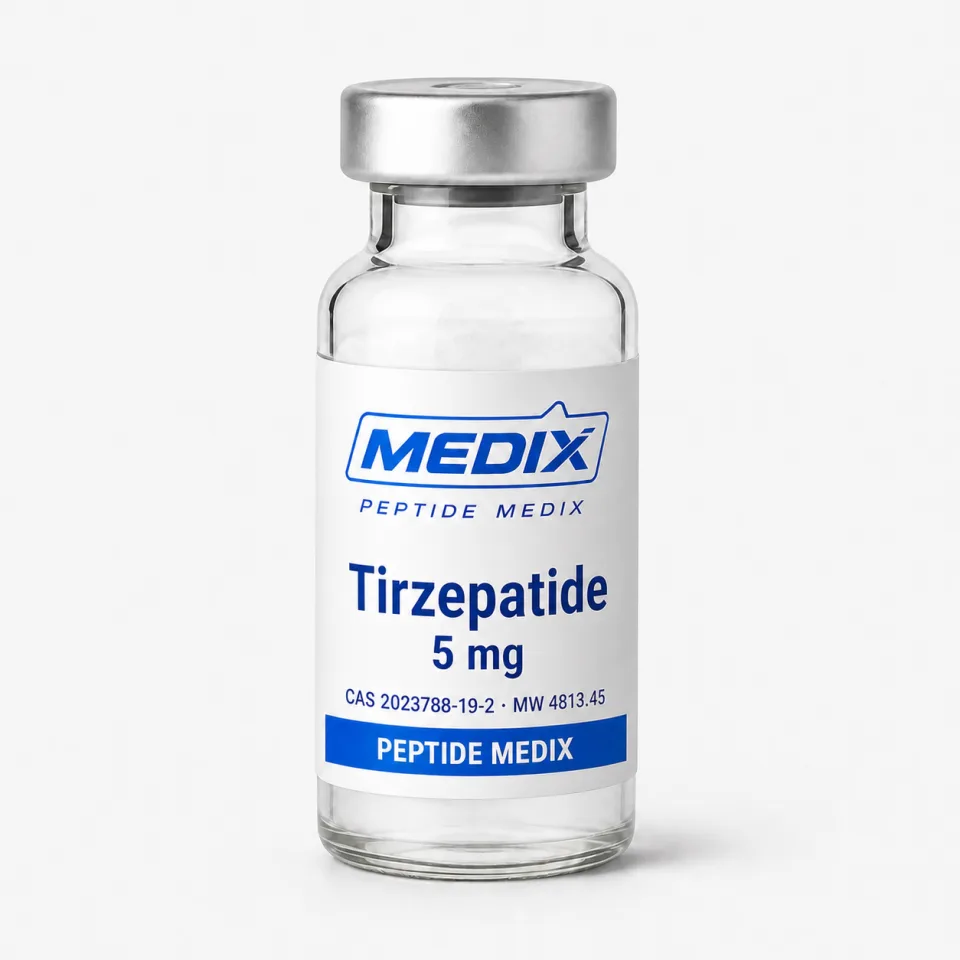
- HPLC purity ≥99%, with a COA for each lot on request
- Certificate of analysis tied to your lot number
- Tracked EU delivery, dispatched the next working day
Tirzepatide
Research-grade 39-amino-acid peptide agonist of both GIP and GLP-1 receptors
In stock8 formats availableCAS 2023788-19-2
€63Range €63 – €884
This listing is currently unavailable. Contact us and we will tell you when it is back or suggest an equivalent.
Ask about this listing or request its COA- FormLyophilized powder, sealed glass vial with flip-off seal
- Mol. weight4813.45 g/mol
- Research areasIncretin receptor crosstalk, insulin secretion, adipose and energy-balance models
For laboratory research use only. Sold exclusively for in-vitro laboratory research by qualified professionals. Not for human or veterinary use, and not a medicine, food, cosmetic or dietary supplement. Terms and Conditions
Overview
Key facts
Tirzepatide is a synthetic peptide of 39 residues whose backbone derives from glucose-dependent insulinotropic polypeptide (GIP) and which was designed to activate two incretin receptors simultaneously.
- CAS number
- 2023788-19-2
- Molecular formula
- C225H348N48O68
- Molecular weight
- 4813.45 g/mol
- Purity
- ≥99% by HPLC; lot-matched COA available
- Form
- Lyophilized powder, sealed glass vial with flip-off seal
- Storage
- −20 °C, sealed and protected from light and moisture
- Available sizes
- 5 mg · 10 mg · 15 mg · 20 mg · 30 mg · 60 mg · 100 mg · 10-vial kit · 10 x 10 mg
For research use only. Not for human consumption.
Tirzepatide is a synthetic peptide of 39 residues whose backbone derives from glucose-dependent insulinotropic polypeptide (GIP) and which was designed to activate two incretin receptors simultaneously. Alpha-aminoisobutyric acid residues stop dipeptidyl peptidase-4 from cutting it, and one lysine carries a gamma-glutamyl/AEEA linker attached to a C20 fatty diacid; the resulting reversible albumin binding explains why published pharmacokinetic studies find it so long-lived. Its C-terminus is amidated.
This dual-agonist design is what makes it valuable in the lab. Instead of looking at GLP-1 signalling alone, researchers use tirzepatide to explore how engaging GIP and GLP-1 receptors together alters cAMP kinetics, receptor trafficking and beta-arrestin recruitment, and how biased signalling at the GLP-1 receptor compares with balanced agonists. It features routinely as the comparator in studies of newer dual and triple agonists.
What sets this listing apart
Tirzepatide – vial. Lyophilized powder, sealed glass vial with flip-off seal. Other Tirzepatide listings differ in format, fill or combination partners; the specification and COA always refer to the listing you order.
Same compound, other listings
Specifications
Identity
- CAS number
- 2023788-19-2
- Molecular formula
- C225H348N48O68
- Molecular weight
- 4813.45 g/mol
- Peptide class
- Acylated dual GIP/GLP-1 receptor agonist (twincretin)
Supply & purity
- Form
- Lyophilized powder, sealed glass vial with flip-off seal
- Purity
- ≥99% by HPLC; lot-matched COA available
- Available sizes
- 5 mg, 10 mg, 15 mg, 20 mg, 30 mg, 60 mg, 100 mg
- Solubility
- Bacteriostatic water; also soluble in dilute alkaline or phosphate buffers
Handling & storage
- Storage (lyophilized)
- −20 °C, sealed and protected from light and moisture
- Storage (reconstituted)
- 2–8 °C, protected from light; use within the study window
Additional detail
- Backbone length
- 39 amino acids, GIP-based sequence
- Key modifications
- Aib substitutions, Lys20 conjugated to gamma-Glu-(AEEA)2-C20 diacid, C-terminal amide
- Research areas
- Incretin receptor crosstalk, insulin secretion, adipose and energy-balance models
Questions about Tirzepatide
How does tirzepatide differ from semaglutide?
Semaglutide is an analogue acting only at the GLP-1 receptor. Tirzepatide is built on a GIP backbone and activates both GIP and GLP-1 receptors, so labs use it to see how combined incretin-receptor engagement changes signalling compared with a single-receptor agonist.
Which purity data and documents come with it?
Every lot is HPLC-tested to ≥99%, with identity confirmed by mass spectrometry, and its certificate is available — referenced to the vial number shipped so your results can be traced to your order.
How is it stored before and after reconstitution?
Before: sealed at −20 °C, away from light and humidity. After: refrigerated at 2–8 °C in the dark and used within your documented study period. Aliquot so the stock isn't frozen and thawed repeatedly.
Does it come sterile and ready to use?
It comes as lyophilised powder in a sealed vial, not as a finished solution. Your lab reconstitutes it under its own aseptic procedures and validates the solution for the assay or model you intend to use.
Related