- HPLC purity ≥99%, documented per lot
- Certificate of analysis tied to your lot number
- Tracked EU delivery, dispatched the next working day
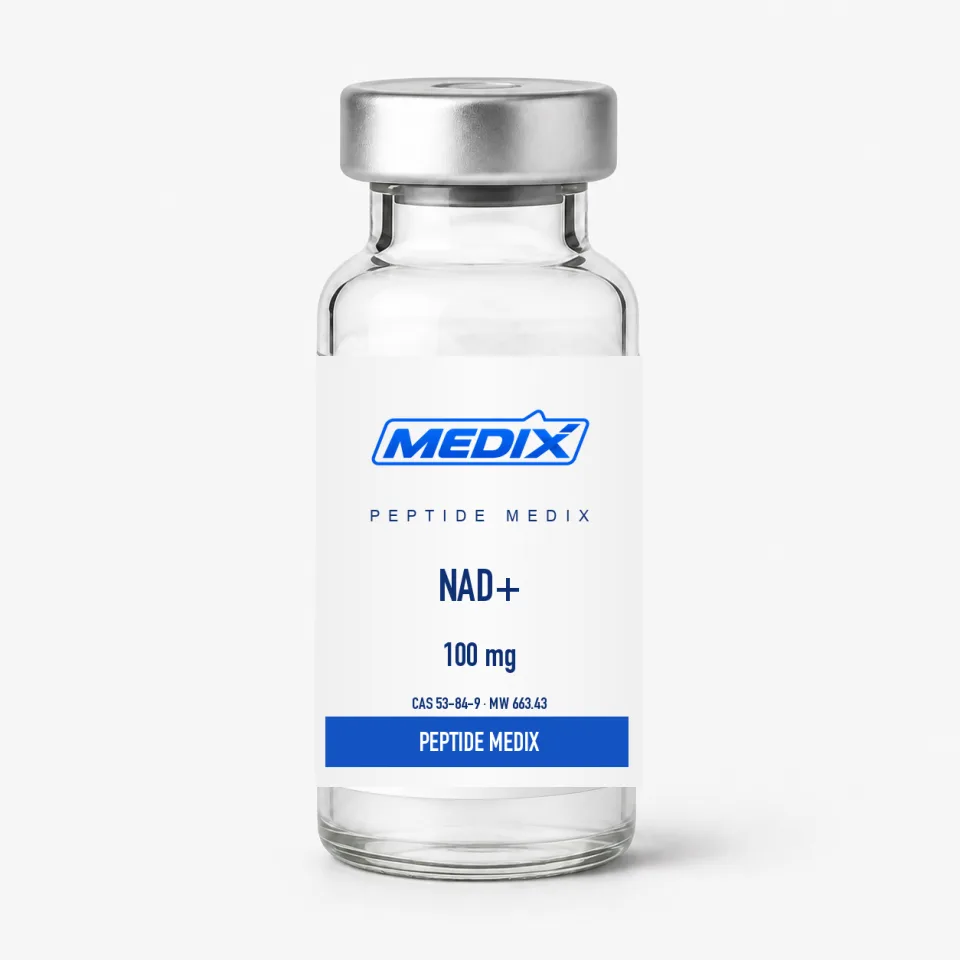
NAD+
NAD+ coenzyme (nicotinamide adenine dinucleotide) in 500 mg and 1000 mg vials
In stock4 formats availableCAS 53-84-9
€38Range €38 – €450
This listing is currently unavailable. Contact us and we will tell you when it is back or suggest an equivalent.
Ask about this listing or request its COA- FormLyophilized powder, sealed glass vial
- Mol. weight663.43 g/mol
- Research areasCellular redox state, DNA repair signaling, mitochondrial metabolism, aging biology
For laboratory research use only. Sold exclusively for in-vitro laboratory research by qualified professionals. Not for human or veterinary use, and not a medicine, food, cosmetic or dietary supplement. Terms and Conditions
Overview
Key facts
NAD+ — nicotinamide adenine dinucleotide in its oxidised form — is a dinucleotide coenzyme, not a peptide.
- CAS number
- 53-84-9
- Molecular formula
- C21H27N7O14P2
- Molecular weight
- 663.43 g/mol
- Purity
- ≥99% by HPLC; lot-matched COA
- Form
- Lyophilized powder, sealed glass vial
- Storage
- −20 °C, protected from light and moisture
- Available sizes
- 100 mg · 500 mg · 1000 mg · 5-vial kit · 5 x 500 mg
For research use only. Not for human consumption.
NAD+ — nicotinamide adenine dinucleotide in its oxidised form — is a dinucleotide coenzyme, not a peptide. Nicotinamide mononucleotide and adenosine monophosphate are linked through a pyrophosphate bridge, and the resulting molecule is present in every living cell as the main electron carrier of catabolism. Oxidised NAD+ picks up a hydride and becomes NADH; the balance between the two is one of the most frequently measured markers of a cell's redox status.
Our fills are ten to a hundred times larger than a typical peptide vial — 100 mg, 500 mg and 1000 mg, plus a kit of five 500 mg vials — because the relevant enzymes consume the coenzyme rather than just using it catalytically. Sirtuins, PARPs and the CD38 ectoenzymes cleave NAD+ at its glycosidic bond and release nicotinamide, destroying one molecule per turnover. At 663.43 g/mol, 500 mg equals about 754 micromoles, well matched to assays at the micromolar-to-millimolar levels these enzymes need. NAD+ dissolves freely in water, but its solutions are acidic and hydrolyse easily above neutral pH, so buffer them, keep them cold and use them promptly instead of storing them.
What sets this listing apart
NAD+ – vial, 100/500/1000 mg. Lyophilized powder, sealed glass vial. Other NAD+ listings differ in format, fill or combination partners; the specification and COA always refer to the listing you order.
Same compound, other listings
Specifications
Identity
- CAS number
- 53-84-9
- Molecular formula
- C21H27N7O14P2
- Molecular weight
- 663.43 g/mol
Supply & purity
- Form
- Lyophilized powder, sealed glass vial
- Purity
- ≥99% by HPLC; lot-matched COA
- Available sizes
- 100 mg, 500 mg, 1000 mg
- Solubility
- Freely soluble in water; solutions are acidic and best buffered
Handling & storage
- Storage (lyophilized)
- −20 °C, protected from light and moisture
- Storage (reconstituted)
- 2–8 °C, used promptly; NAD+ hydrolyzes at alkaline pH
Additional detail
- Chemical class
- Dinucleotide coenzyme (free acid form)
- Also known as
- Nicotinamide adenine dinucleotide, oxidized NAD, DPN
- Enzyme substrate for
- Sirtuins (SIRT1–7), PARP family, CD38/CD157
- Research areas
- Cellular redox state, DNA repair signaling, mitochondrial metabolism, aging biology
Questions about NAD+
Would NAD+ be classed as a peptide?
No. It is a dinucleotide coenzyme in which nicotinamide mononucleotide and adenosine monophosphate are joined via a pyrophosphate bridge. We list it with research peptides because labs working on mitochondrial and ageing biology routinely use both.
NAD+ versus NADH — what's the relationship?
They are the same coenzyme in oxidised and reduced form. During catabolic reactions NAD+ takes up a hydride to become NADH, and their ratio serves as a readout of cellular redox state in metabolic studies.
Is this NAD+ verified by an independent lab?
Yes. Each lot is HPLC-analysed to ≥99% purity, and you can review the lot's Certificate of Analysis on this page before buying to check identity and purity against your own acceptance criteria.
What's the right way to handle NAD+ solutions?
Dissolve in water or a suitable buffer, hold the pH at or just below neutral and use the solution quickly. NAD+ hydrolyses in alkaline conditions and degrades when warm, so cold storage, protection from light and aliquoting all help keep it assay-grade.
How does NAD+ differ from NMN or nicotinamide riboside?
NMN and nicotinamide riboside are precursors that cells turn into NAD+ via the salvage pathway, whereas NAD+ is the finished coenzyme. Whether loading precursors or supplying the coenzyme directly works better is an active area of comparative research.
Which sizes do you offer?
500 mg and 1000 mg lyophilised vials. Quantities well above typical peptide fills are normal, since enzyme assays and cell culture use the coenzyme at micromolar to millimolar concentrations.
Related