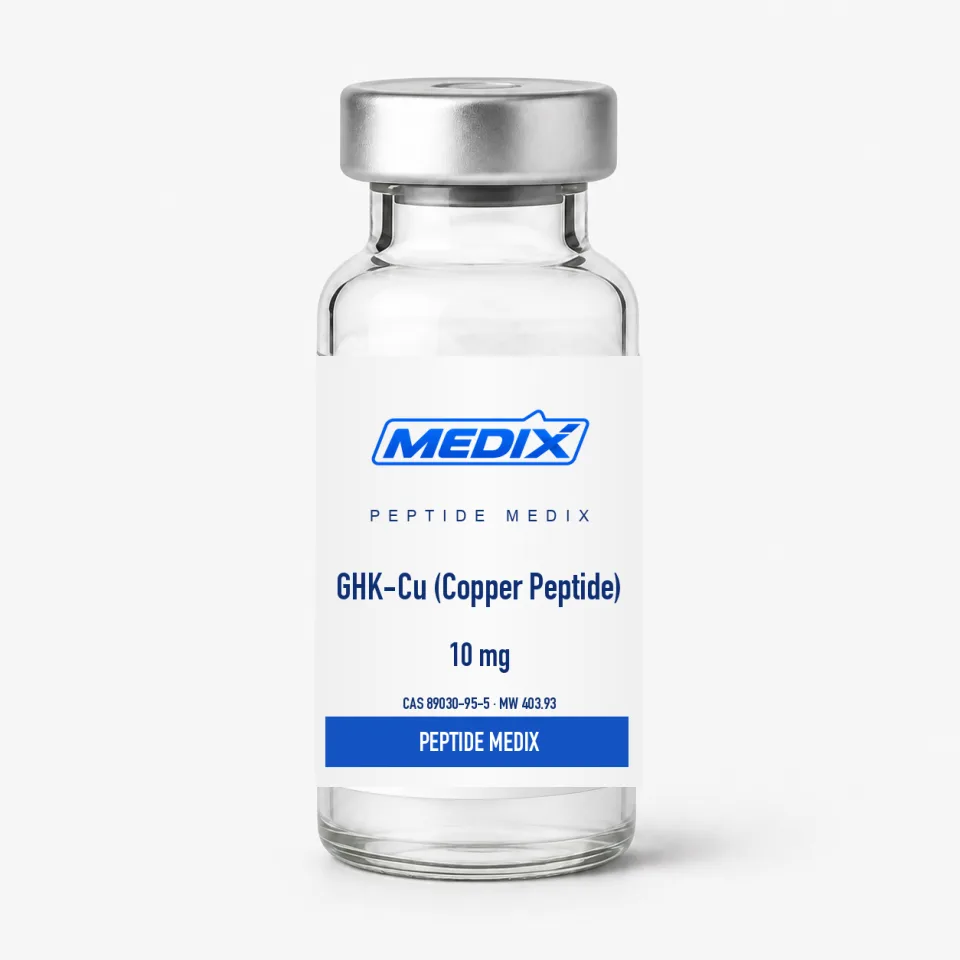
- HPLC purity ≥99%, with a COA for each lot on request
- Certificate of analysis tied to your lot number
- Tracked EU delivery, dispatched the next working day
GHK-Cu (Copper Peptide)
Copper(II)–Gly-His-Lys complex supplied as a blue lyophilised research powder
In stock5 formats availableCAS 89030-95-5
€25Range €25 – €263
This listing is currently unavailable. Contact us and we will tell you when it is back or suggest an equivalent.
Ask about this listing or request its COA- FormLyophilized blue powder, sealed glass vial with crimped stopper
- Mol. weight403.93 g/mol (copper(II) complex)
- Research areasCollagen and glycosaminoglycan synthesis, matrix remodelling, hair follicle and skin models
For laboratory research use only. Sold exclusively for in-vitro laboratory research by qualified professionals. Not for human or veterinary use, and not a medicine, food, cosmetic or dietary supplement. Terms and Conditions
Overview
Key facts
GHK-Cu consists of the tripeptide glycyl-L-histidyl-L-lysine carrying a bound copper(II) ion.
- CAS number
- 89030-95-5
- Molecular formula
- C14H24N6O4·Cu
- Molecular weight
- 403.93 g/mol (copper(II) complex)
- Amino acid sequence
- Gly-His-Lys, complexed with copper(II)
- Purity
- ≥99% by HPLC; lot-matched COA available
- Form
- Lyophilized blue powder, sealed glass vial with crimped stopper
- Storage
- −20 °C, sealed and protected from light and moisture
- Available sizes
- 10 mg · 50 mg · 100 mg · 200 mg · 500 mg
For research use only. Not for human consumption.
GHK-Cu consists of the tripeptide glycyl-L-histidyl-L-lysine carrying a bound copper(II) ion. Researchers found the peptide in human plasma during 1970s studies on cultured liver tissue, and its hallmark is an exceptional affinity for copper: the histidine ring, the N-terminal amine and one backbone nitrogen form a pocket that grips Cu(II) firmly — yet still allows the metal to be handed over to the cell's own copper carriers.
It is this ability to shuttle copper that explains why most published work uses the complex rather than the free tripeptide. The powder is an unmistakable blue, a colour produced by the bound copper itself; a white powder cannot be the copper complex. We offer 50 mg, 100 mg and 200 mg vials — bigger than usual peptide fills, because formulation studies and topical models get through material quickly.
Research centres on extracellular-matrix remodelling, collagen and glycosaminoglycan production by cultured fibroblasts, hair-follicle biology and wound-healing models, plus a substantial set of gene-expression studies. Plasma levels are reported to fall markedly with age, which drives much of the ageing-focused work. Sold for laboratory research only.
What sets this listing apart
GHK-Cu (Copper Peptide) – vial, 10/50/100/200/500 mg. Lyophilized blue powder, sealed glass vial with crimped stopper. Other GHK-Cu listings differ in format, fill or combination partners; the specification and COA always refer to the listing you order.
Same compound, other listings
Specifications
Identity
- CAS number
- 89030-95-5
- Molecular formula
- C14H24N6O4·Cu
- Molecular weight
- 403.93 g/mol (copper(II) complex)
- Amino acid sequence
- Gly-His-Lys, complexed with copper(II)
- Chain length
- 3 amino acids (tripeptide) plus one coordinated copper ion
- Peptide class
- Copper-binding matrix tripeptide
Supply & purity
- Form
- Lyophilized blue powder, sealed glass vial with crimped stopper
- Purity
- ≥99% by HPLC; lot-matched COA available
- Available sizes
- 10 mg, 50 mg, 100 mg, 200 mg, 500 mg
Handling & storage
- Storage (lyophilized)
- −20 °C, sealed and protected from light and moisture
- Storage (reconstituted)
- 2–8 °C, protected from light, used within the study window
Additional detail
- Colour
- Blue in both powder and solution — an indicator of copper coordination
- Research areas
- Collagen and glycosaminoglycan synthesis, matrix remodelling, hair follicle and skin models
Questions about GHK-Cu (Copper Peptide)
What is GHK-Cu?
The copper(II) complex of glycyl-histidyl-lysine, a tripeptide discovered in human plasma in the 1970s. We supply it as a blue lyophilised powder for research on extracellular matrix, wound repair and hair follicles.
What gives the powder its blue colour?
The bound copper ion. Authentic GHK-Cu looks blue both as a powder and dissolved; a white material is the free peptide, not the complex. If a stored solution loses its colour, the complex has probably broken apart.
How does GHK-Cu differ from plain GHK?
GHK is the tripeptide on its own, while GHK-Cu has a copper(II) ion sitting in its binding pocket. The literature mostly works with the complex, because transporting copper lies at the heart of the mechanisms under investigation.
Why are the vials so large?
GHK-Cu is used in larger quantities than most research peptides — especially in topical formulation work and matrix or follicle studies, where one experiment may need tens of milligrams. Fills of 50, 100 and 200 mg keep the cost per experiment sensible.
Is purity documented?
Yes. Reversed-phase HPLC confirms ≥99% purity for each lot, and mass analysis verifies the expected molecular mass. The certificate bearing your vial's lot number can be requested before or after purchase.
Do copper peptides need special handling?
They do. The complex is sensitive to light and to pH, and strongly chelating buffers can strip the copper from the peptide. Labs therefore keep solutions cold and in amber or foil-wrapped containers, and use the blue colour as a quick check that the complex is intact.
Related