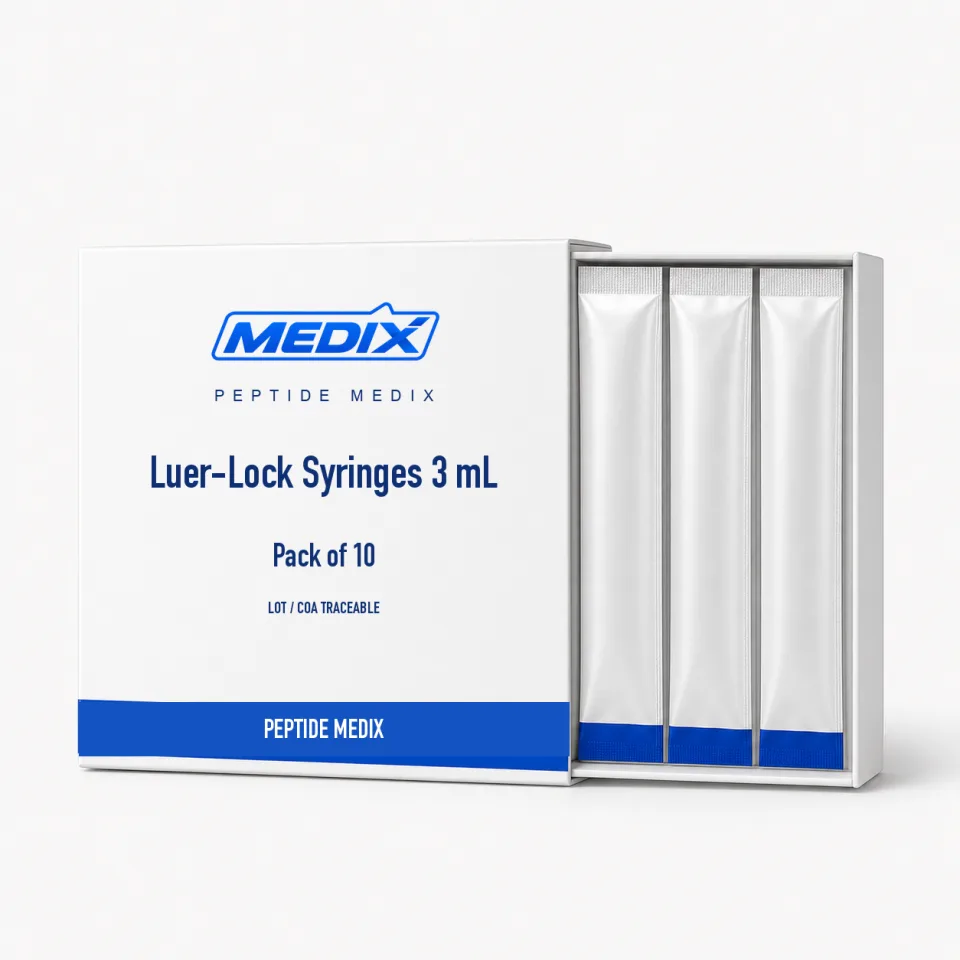
- HPLC-assayed purity of ≥99%
- Certificate of analysis tied to your lot number
- Tracked EU delivery, dispatched the next working day
Luer-Lock Syringes 3 mL
3 mL single-use sterile syringes with screw-on (luer-lock) tip — no needle included
In stock2 formats available
€8Range €8 – €42
This listing is currently unavailable. Contact us and we will tell you when it is back or suggest an equivalent.
Ask about this listing or request its COAFor laboratory research use only. Sold exclusively for in-vitro laboratory research by qualified professionals. Not for human or veterinary use, and not a medicine, food, cosmetic or dietary supplement. Terms and Conditions
Overview
Key facts
Each of these sterile, single-use 3 mL syringes ends in a luer-lock fitting — a screw thread rather than a plain push-on cone.
- Storage
- Room temperature, dry, in the sealed wrapper until the point of use
- Available sizes
- Pack of 10 · Box of 100
For research use only. Not for human consumption.
Each of these sterile, single-use 3 mL syringes ends in a luer-lock fitting — a screw thread rather than a plain push-on cone. That thread is why they belong in reconstitution work: a needle or a filter twisted onto it is held mechanically and can't be forced off. A push-on (slip) tip holds only by friction, and friction is exactly what gives way once you push liquid through a 0.22 µm filter membrane and the pressure behind it climbs.
Three millilitres is the right size for handling diluent: drawing bacteriostatic water out of a 10 mL or 30 mL vial and delivering a measured amount into a vial of lyophilised peptide in one controlled stroke. Markings every 0.1 mL suit that job. They aren't intended for measuring the tiny volumes withdrawn from a reconstituted vial afterwards — a 1 mL insulin-type syringe graduated in 0.01 mL does that, and most labs keep both to hand.
Questions about Luer-Lock Syringes 3 mL
Are needles included?
No. You receive the syringe barrels only, each with a screw-type luer-lock tip, and fit needles yourself. That's deliberate: the same barrel can take a wide needle for drawing up, a fine one for dispensing, or a 0.22 µm filter, depending on the step — something a syringe with a built-in needle can't do.
How does luer-lock differ from luer-slip?
Both use the same standard 6% cone, so any needle fits either type. A slip fitting stays on through friction alone; a lock fitting adds a threaded collar that physically holds the needle hub. When pressure builds — during filtration, with very fine needles or thick liquids — a slip joint can pop apart, which is why filtering is done with luer-lock.
Is a 3 mL syringe suitable for drawing from a reconstituted vial?
It's possible but imprecise. The scale is in 0.1 mL steps, and any syringe is least accurate in the lowest fifth of its range. Measure small withdrawals with a 1 mL insulin-type syringe graduated in 0.01 mL; keep the 3 mL barrel for diluent.
Are the syringes sterile — and can I reuse them?
They arrive sterile and are for one use only. The rubber plunger seal isn't designed to survive an autoclave, and a syringe that has held one liquid can carry traces into the next preparation, corrupting analytical data. If a blister pack is torn or has been opened, throw that syringe away.
Do they fit standard 0.22 µm syringe filters?
Yes, as long as the filter has a luer-lock inlet, as most laboratory filters do. Check first: a luer-slip filter will sit on the taper but won't screw on — exactly the case where filtration pressure can force the connection apart.
Which pack size should I choose?
A pack of 10 is enough for the odd reconstitution or a single short study. For a lab that prepares solutions routinely, the box of 100 is cheaper per syringe — and having a good stock means nobody is tempted to reuse one between vials.
Related