- HPLC-assayed purity of ≥99%
- Certificate of analysis tied to your lot number
- Tracked EU delivery, dispatched the next working day
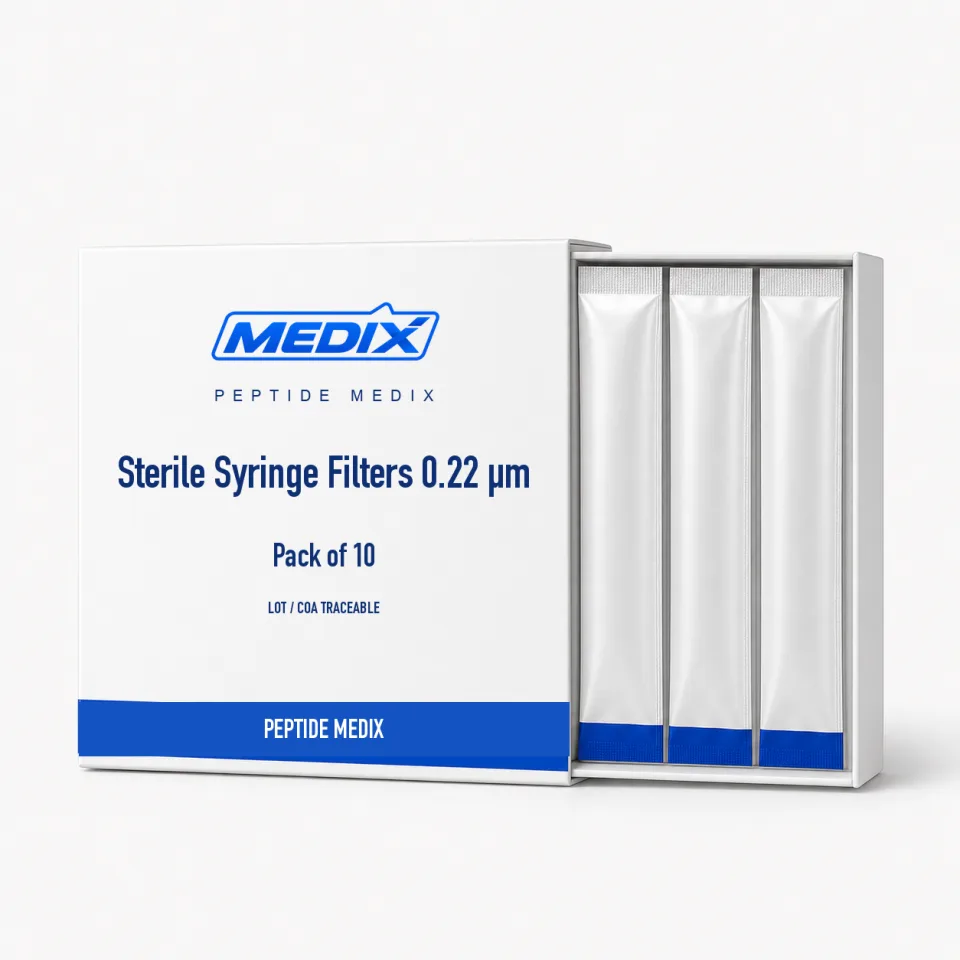
Sterile Syringe Filters 0.22 µm
Sterile 0.22 µm PES syringe filters with luer-lock inlet, individually packed
In stock2 formats available
€12Range €12 – €46
This listing is currently unavailable. Contact us and we will tell you when it is back or suggest an equivalent.
Ask about this listing or request its COAFor laboratory research use only. Sold exclusively for in-vitro laboratory research by qualified professionals. Not for human or veterinary use, and not a medicine, food, cosmetic or dietary supplement. Terms and Conditions
Overview
Key facts
When a small volume can't go into an autoclave, pushing it through a syringe filter is the standard way to make it sterile.
- Storage
- Room temperature, dry, in the sealed wrapper until use
- Available sizes
- Pack of 10 · Pack of 50
For research use only. Not for human consumption.
When a small volume can't go into an autoclave, pushing it through a syringe filter is the standard way to make it sterile. Peptides don't survive heat, so in an ordinary lab a 0.22 µm membrane is realistically the only way to obtain a sterile peptide solution. These filters have a polyethersulfone membrane in a polypropylene body, with a luer-lock inlet (female) and a luer-slip outlet (male), and each one is packed and sterilised individually.
There's a reason for 0.22 µm: this pore size is recognised as sterilising grade because it retains the tiny test bacterium the industry uses to challenge filters, Brevundimonas diminuta. A 0.45 µm filter removes particles and clears a liquid, but does not count as sterilising — and neither size stops viruses, mycoplasma or endotoxin, which call for entirely different methods.
Peptide workflows use these filters at two points: to sterilise a freshly reconstituted solution before it is moved into a sealed vial and stored, and to clarify a solution with a slight haze or fine particles before it is analysed. Polyethersulfone is the usual membrane in both cases because proteins and peptides stick to it only weakly — important when the peptide is dilute and every bit absorbed by the membrane is genuinely lost.
Questions about Sterile Syringe Filters 0.22 µm
Why filter peptide solutions instead of autoclaving them?
An autoclave works with steam at 121 °C, which denatures and breaks down peptides. Passing the solution through a 0.22 µm membrane sterilises it at room temperature and leaves the dissolved peptide chemically unchanged — which is why filtration is the default for solutions that can't tolerate heat.
0.22 µm versus 0.45 µm — what's the difference?
0.22 µm counts as sterilising grade: it holds back the very small bacterium used as the standard test organism. 0.45 µm clears a liquid and removes visible particles but does not sterilise it. If the filtered liquid has to be sterile, use 0.22 µm.
Does filtration remove endotoxin?
No. Endotoxin is a fragment of bacterial lipopolysaccharide far smaller than the pores, so it goes right through — and so do viruses and mycoplasma. Filtering preserves the microbiological quality of a clean preparation; it can't clean up one that is already contaminated.
How much peptide sticks to the membrane?
Polyethersulfone was selected precisely because peptides and proteins bind to it poorly, so the loss is normally small. It isn't zero, though, and it counts for most when solutions are dilute and volumes tiny. Where exact amounts matter, measure the concentration after filtration rather than before.
Can I reuse a filter if only a little liquid went through?
No. They are sterile single-use devices: once the wrapper is open and liquid has passed, the flow path can't be assumed sterile and the membrane may hold retained material. Don't autoclave, rinse or re-sterilise them.
Which syringe size pairs with them?
The inlet accepts any ordinary syringe whose tip is a male luer-lock. Depending on how many particles the liquid contains, one 25 mm filter can handle up to about 100 mL, so syringes of 5–20 mL are the usual partners. Press slowly and evenly instead of forcing the liquid through.
Related