- HPLC-assayed purity of ≥99%
- Certificate of analysis tied to your lot number
- Tracked EU delivery, dispatched the next working day
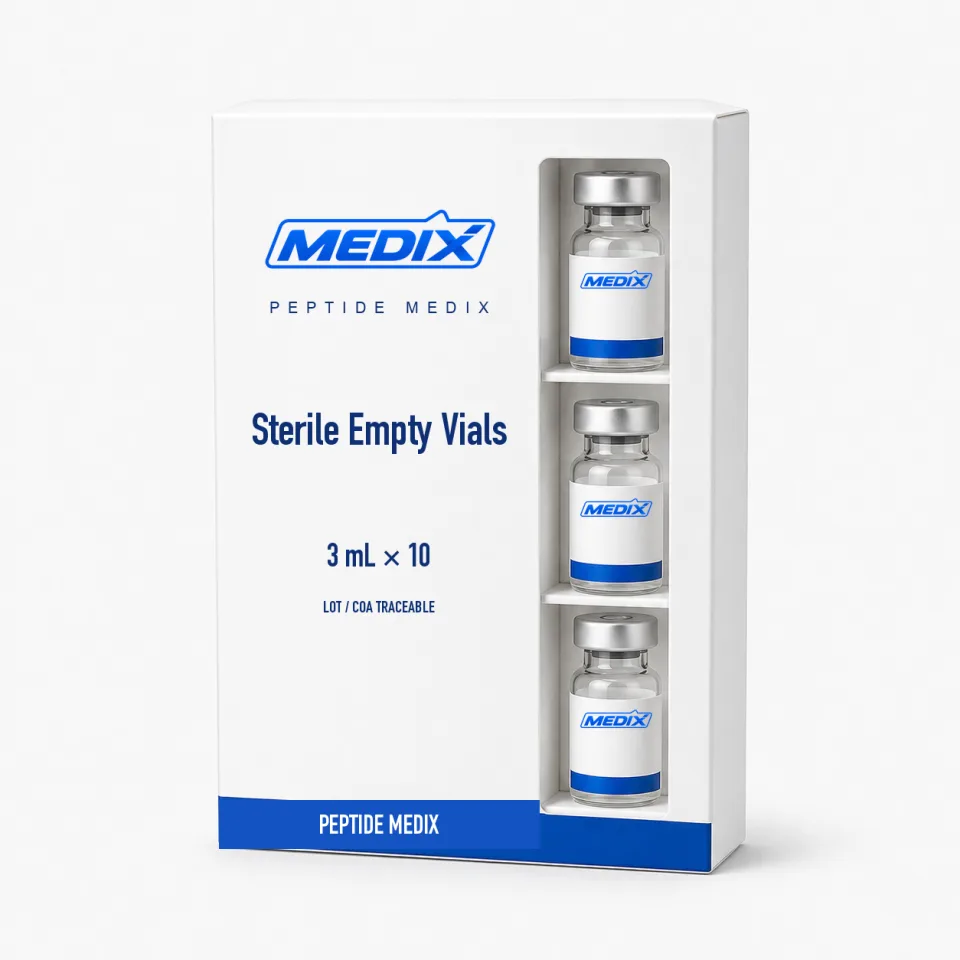
Sterile Empty Vials
Sealed, sterile empty glass vials for dividing and storing reconstituted peptides
In stock2 formats available
€17Range €17 – €25
This listing is currently unavailable. Contact us and we will tell you when it is back or suggest an equivalent.
Ask about this listing or request its COAFor laboratory research use only. Sold exclusively for in-vitro laboratory research by qualified professionals. Not for human or veterinary use, and not a medicine, food, cosmetic or dietary supplement. Terms and Conditions
Overview
Key facts
Most researchers buy these for aliquoting.
- Available sizes
- 3 mL · 10-pack · 10 mL · 10-pack
For research use only. Not for human consumption.
Most researchers buy these for aliquoting. After a lyophilised vial has been reconstituted, splitting the stock over several smaller vials means each one is pierced less often, the whole batch is less likely to be contaminated, and portions can be kept in the fridge or freezer independently. Empty vials also serve to make lower-concentration working dilutions, to combine components for blend experiments, or simply to hold a measured amount of bacteriostatic water for one experiment.
Each vial is clear borosilicate glass closed with a rubber stopper and a crimped aluminium flip-off cap; packs contain ten, in 3 mL or 10 mL sizes. Recommended fills are about 2 mL and 8 mL — the gap is intentional headspace, because water expands on freezing and a brim-full vial at −20 °C may push out its stopper or crack. Glass and closure both withstand refrigeration and freezing. Fill by syringe through the stopper, using a second needle as a vent if displaced air resists the plunger, and let frozen vials reach room temperature before piercing so condensation isn't carried in on the needle.
Specifications
Supply & purity
- Available sizes
- 3 mL × 10 pack; 10 mL × 10 pack
Additional detail
- Product type
- Empty sterile serum-style vial
- Vial material
- Clear borosilicate glass
- Closure
- Rubber stopper with crimped aluminum flip-off cap
- Contents
- Empty — no diluent, no peptide
- Sterility
- Sterilized and sealed prior to shipment
- Fill method
- Syringe transfer through the stopper; vent with a second needle if required
- Nominal fill volume
- Up to about 2 mL (3 mL vial) or 8 mL (10 mL vial) to leave headspace
- Temperature range
- Suitable for refrigerated (2–8 °C) and frozen (−20 °C) storage
- Storage (unused)
- Room temperature, dry, in original tray
- Typical use
- Aliquoting, dilutions, blend preparation, single-experiment volumes
Questions about Sterile Empty Vials
What are these empty vials for?
Mostly for aliquoting: once a peptide has been dissolved, you split it into several small sealed portions, so each is pierced fewer times and can go into the fridge or freezer on its own. They're also useful for preparing working dilutions, mixing ingredients for blend experiments and keeping a measured amount of diluent for one experiment.
3 mL or 10 mL — which do I need?
The 3 mL size takes portions of up to about 2 mL and is the same size as most of the peptide vials we sell. Choose the 10 mL size for bigger working solutions, for dilution series or to hold some bacteriostatic water. Each comes in a pack of ten.
Is freezing the vials OK?
Yes — both the borosilicate glass and the rubber stopper cope with −20 °C. Leave room at the top, because water-based liquids swell when frozen, and before piercing a frozen vial let it come back to room temperature so that condensation isn't drawn in along the needle.
Are they sterile, and is there documentation?
They are sterilised and sealed before dispatch and stay sterile inside until the flip-off cap comes off. Lot details are printed on the packaging and can be requested. Being empty containers without peptide or diluent, they have no HPLC purity figure.
Related