- HPLC purity ≥99%, documented per lot
- Certificate of analysis tied to your lot number
- Tracked EU delivery, dispatched the next working day
Oxytocin
Neurohypophysial nonapeptide with a disulfide-closed ring
In stock3 formats availableCAS 50-56-6
€38Range €38 – €97
This listing is currently unavailable. Contact us and we will tell you when it is back or suggest an equivalent.
Ask about this listing or request its COA- FormLyophilized white powder, sealed glass vial
- Mol. weight1007.19 g/mol
- Research areasSocial behaviour and bonding models, stress and anxiety research, smooth-muscle physiology, OXTR pharmacology
For laboratory research use only. Sold exclusively for in-vitro laboratory research by qualified professionals. Not for human or veterinary use, and not a medicine, food, cosmetic or dietary supplement. Terms and Conditions
Overview
Key facts
Oxytocin is a nine-residue hormone made in the supraoptic and paraventricular nuclei of the hypothalamus and secreted from the posterior pituitary.
- CAS number
- 50-56-6
- Molecular formula
- C43H66N12O12S2
- Molecular weight
- 1007.19 g/mol
- Amino acid sequence
- Cys-Tyr-Ile-Gln-Asn-Cys-Pro-Leu-Gly-NH2 (disulfide bridge Cys1–Cys6)
- Purity
- ≥99% by HPLC; lot-matched COA
- Form
- Lyophilized white powder, sealed glass vial
- Storage
- Lyophilized: −20 °C, desiccated and protected from light. Reconstituted: 2–8 °C, aliquoted to avoid repeated freeze–thaw
- Available sizes
- 2 mg · 5 mg · 10 mg
For research use only. Not for human consumption.
Oxytocin is a nine-residue hormone made in the supraoptic and paraventricular nuclei of the hypothalamus and secreted from the posterior pituitary. Structurally it consists of a six-membered ring, closed by a disulfide bond between the cysteines in positions 1 and 6, plus a three-residue tail ending in a C-terminal amide. Only two positions separate it from vasopressin, so cross-reactivity at vasopressin receptors is a constant consideration when designing oxytocin experiments.
Research on oxytocin splits into two largely separate bodies of work. The peripheral one is classical endocrinology — OXTR-driven contraction of smooth muscle in uterine and mammary tissue, characterised in depth since the 1950s, when Vincent du Vigneaud's synthesis made it the first polypeptide hormone ever produced chemically and earned him a Nobel Prize. The central one is more recent and deals with oxytocin-releasing projections inside the brain, investigated in animal models of social recognition, pair bonding, stress reactivity and anxiety-related behaviour.
What sets this listing apart
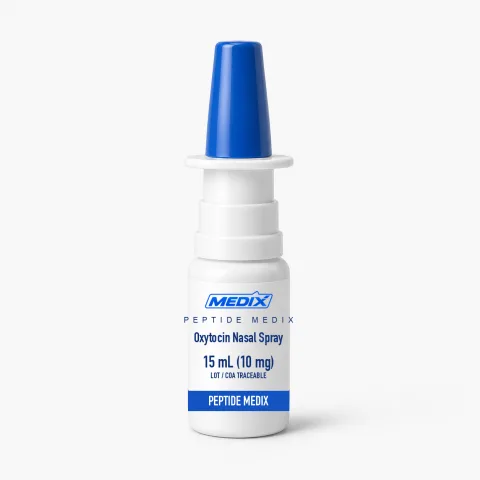
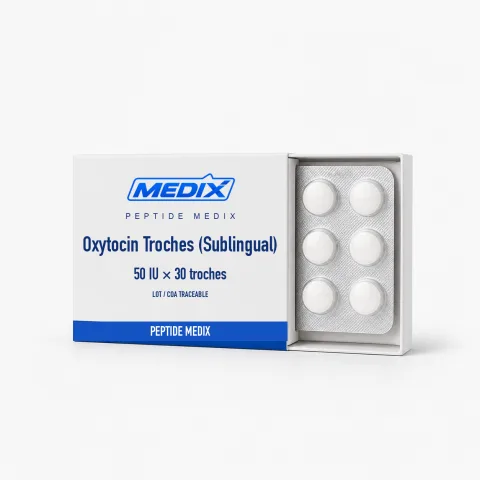
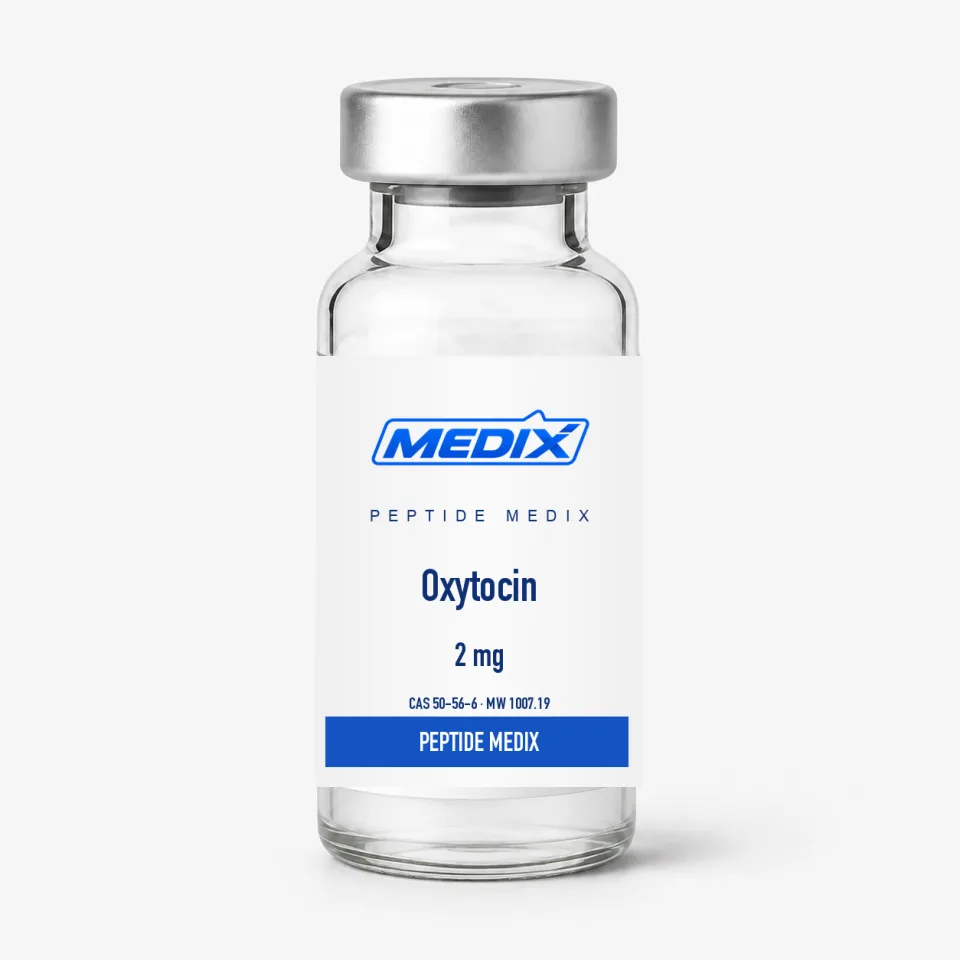
Oxytocin – vial, 2/5/10 mg. Lyophilized white powder, sealed glass vial. Other Oxytocin listings differ in format, fill or combination partners; the specification and COA always refer to the listing you order.
Same compound, other listings
Specifications
Identity
- CAS number
- 50-56-6
- Molecular formula
- C43H66N12O12S2
- Molecular weight
- 1007.19 g/mol
- Amino acid sequence
- Cys-Tyr-Ile-Gln-Asn-Cys-Pro-Leu-Gly-NH2 (disulfide bridge Cys1–Cys6)
- Peptide class
- Cyclic nonapeptide; neurohypophysial hormone
Supply & purity
- Form
- Lyophilized white powder, sealed glass vial
- Purity
- ≥99% by HPLC; lot-matched COA
- Available sizes
- 2 mg, 5 mg, 10 mg
- Solubility
- Freely soluble in water and bacteriostatic water; also soluble in dilute acetic acid
Additional detail
- Receptor target
- Oxytocin receptor (OXTR); partial cross-reactivity at vasopressin receptors
- Approximate activity conversion
- Roughly 1 IU ≈ 2 µg of synthetic oxytocin (see COA for lot-specific values)
- Research areas
- Social behaviour and bonding models, stress and anxiety research, smooth-muscle physiology, OXTR pharmacology
- Storage
- Lyophilized: −20 °C, desiccated and protected from light. Reconstituted: 2–8 °C, aliquoted to avoid repeated freeze–thaw
Questions about Oxytocin
In what form is it delivered?
As lyophilised powder in a sealed, desiccated glass vial containing 2 mg, 5 mg or 10 mg. Dry peptide is much more stable than a solution, so it copes with shipping at room temperature; store it dry at −20 °C until you reconstitute.
Is purity confirmed independently?
Yes. Reverse-phase HPLC (≥99%) and mass spectrometry characterise each lot, and the certificate for your lot can be requested. The batch number on the vial matches the COA, so your data trace back to a specific analysis.
Why is oxytocin more delicate than many peptides?
The Cys1–Cys6 disulfide defines its active ring, and reducing agents, alkaline pH or trace metals can break or reshuffle it. Standard precautions: keep solutions cold, slightly acidic, free of metals and freshly made.
How close is oxytocin to vasopressin?
The two nonapeptides differ only at positions 3 and 8, yet they act through different receptor families. Because of that likeness, cross-reactivity at vasopressin receptors is a genuine risk, and careful oxytocin studies routinely include selectivity controls and receptor-specific antagonists.
What can I reconstitute it with?
Sterile or bacteriostatic water dissolves it easily; dilute acetic acid is an alternative when a lower pH benefits stability in your assay. Add the solvent slowly down the glass, swirl gently, and use low-binding tubes for dilute working solutions to reduce losses on surfaces.
Related