- HPLC-assayed purity of ≥99%
- Certificate of analysis tied to your lot number
- Tracked EU delivery, dispatched the next working day
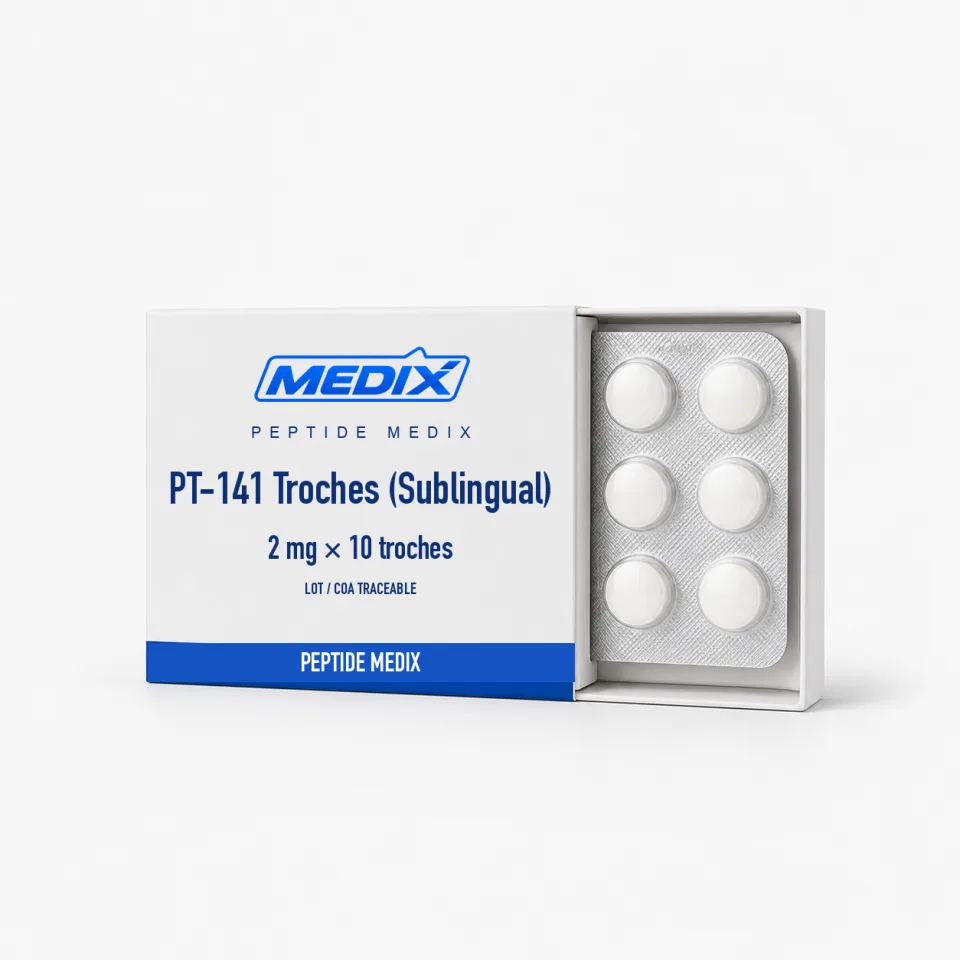
PT-141 Troches (Sublingual)
Sublingual bremelanotide troches — 2 mg each, 10 per pack
In stock1 format available
€72
This listing is currently unavailable. Contact us and we will tell you when it is back or suggest an equivalent.
Ask about this listing or request its COA- FormCompressed sublingual troche (lozenge), slowly dissolving base
For laboratory research use only. Sold exclusively for in-vitro laboratory research by qualified professionals. Not for human or veterinary use, and not a medicine, food, cosmetic or dietary supplement. Terms and Conditions
Overview
Key facts
These compressed sublingual lozenges each contain 2 mg of bremelanotide; a pack holds ten, i.e.
- CAS number
- 189691-06-3
- Molecular formula
- C50H68N14O10
- Molecular weight
- 1025.16 g/mol
- Form
- Compressed sublingual troche (lozenge), slowly dissolving base
- Storage
- Cool, dry and dark; humidity is the principal degradation driver for solid peptide forms
- Available size
- 2 mg · 10 troches
For research use only. Not for human consumption.
These compressed sublingual lozenges each contain 2 mg of bremelanotide; a pack holds ten, i.e. 20 mg of peptide altogether. The active ingredient is the same cyclic heptapeptide we offer as lyophilised powder and as a nasal solution — Ac-Nle-cyclo[Asp-His-D-Phe-Arg-Trp-Lys]-OH, its ring closed by a side-chain lactam between aspartate and lysine; CAS 189691-06-3, molecular weight about 1025.2 g/mol.
Bremelanotide is a melanocortin agonist built on the alpha-MSH framework. It acts mainly at MC3R and MC4R and much less at MC1R than its predecessor Melanotan II. What sets it apart in the literature is that the pathway it targets lies in the central nervous system, not in blood vessels — which is why reviews of sexual-response pharmacology treat it separately from PDE5 inhibitors.
What sets this listing apart
PT-141 Troches (Sublingual) – troches, 2 mg. Compressed sublingual troche (lozenge), slowly dissolving base. Other PT-141 listings differ in format, fill or combination partners; the specification and COA always refer to the listing you order.
Same compound, other listings
Specifications
Identity
- Peptide class
- Cyclic heptapeptide; α-MSH analogue and melanocortin receptor agonist
Supply & purity
- Form
- Compressed sublingual troche (lozenge), slowly dissolving base
Additional detail
- Available size
- 2 mg × 10 troches per pack (20 mg total peptide)
- Peptide per unit
- 2 mg bremelanotide
- Active component
- PT-141 (bremelanotide), ≥99% by HPLC with lot-matched COA
- CAS number (active)
- 189691-06-3
- Molecular formula (active)
- C50H68N14O10
- Molecular weight (active)
- 1025.16 g/mol
- Amino acid sequence (active)
- Ac-Nle-cyclo[Asp-His-D-Phe-Arg-Trp-Lys]-OH (side-chain lactam bridge between Asp and Lys)
- Receptor targets
- MC3R and MC4R principally; weaker MC1R activity than Melanotan II
- Delivery route studied
- Sublingual / buccal mucosal absorption
- Storage
- Cool, dry and dark; humidity is the principal degradation driver for solid peptide forms
- Preparation required
- None — fixed unit content, no reconstitution step
Questions about PT-141 Troches (Sublingual)
What is the bremelanotide content per troche?
2 mg per troche, ten troches per pack — 20 mg of peptide overall. The peptide used in production is HPLC-analysed to ≥99% purity, with the value recorded on the certificate for the lot.
How do troches compare with the vial and nasal spray?
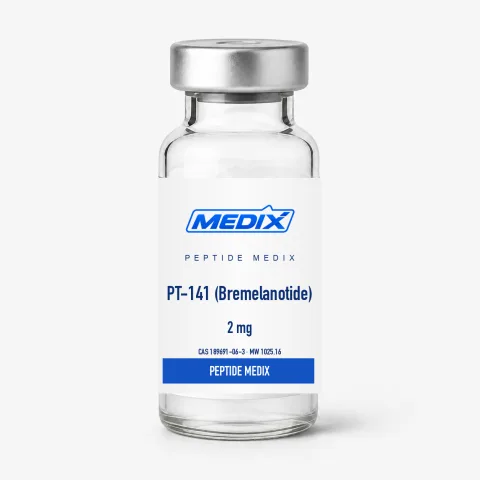
Same molecule, different format: the vial is lyophilised powder you reconstitute, the spray a metered aqueous solution, and the troche a solid with fixed content. Having all three lets a study compare mucosal routes using a single peptide lot.
What is the rationale for sublingual peptide delivery?
Blood from under the tongue enters the systemic circulation without first passing through the liver, which destroys most swallowed peptides. The downside is a permeability barrier that disfavours molecules above roughly one kilodalton — and PT-141 lies right at that interesting boundary for formulation work.
Do you provide a certificate of analysis?
Yes. The PT-141 in each troche lot is checked by reverse-phase HPLC (≥99% purity) and mass spectrometry. The lot COA is available on request — please quote the batch code printed on the pack.
Must the troches be refrigerated?
Not necessarily. A cool, dry, dark place is enough, and controlling humidity matters more than temperature. Refrigeration extends shelf life, but let the pack come to room temperature before opening so moisture doesn't condense on the troches.
Related