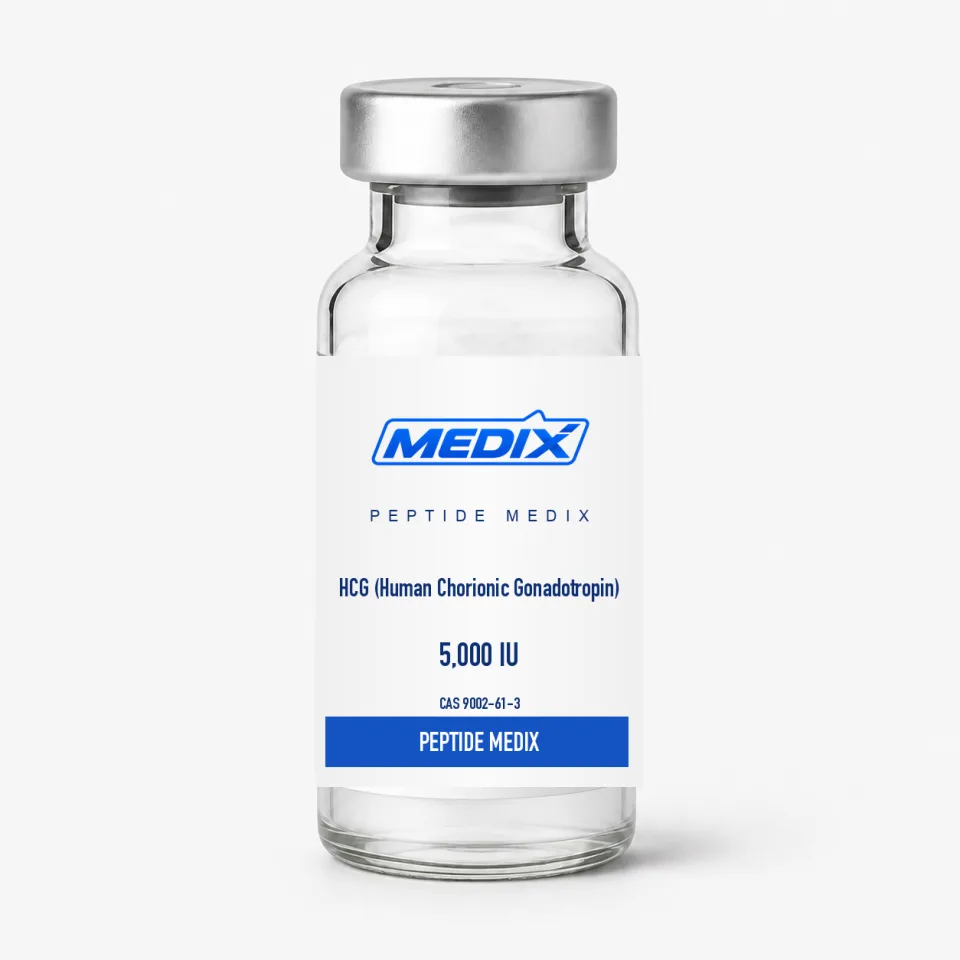
- HPLC-assayed purity of ≥99%
- Certificate of analysis tied to your lot number
- Tracked EU delivery, dispatched the next working day
HCG (Human Chorionic Gonadotropin)
Human chorionic gonadotropin — glycoprotein heterodimer acting at LHCGR
In stock2 formats availableCAS 9002-61-3
€63Range €63 – €102
This listing is currently unavailable. Contact us and we will tell you when it is back or suggest an equivalent.
Ask about this listing or request its COA- FormLyophilized powder, sealed glass vial
- Research areasGlycoprotein hormone structure–function, LHCGR signalling, gonadal steroidogenesis models, HPG-axis research
For laboratory research use only. Sold exclusively for in-vitro laboratory research by qualified professionals. Not for human or veterinary use, and not a medicine, food, cosmetic or dietary supplement. Terms and Conditions
Overview
Key facts
Human chorionic gonadotropin is a glycoprotein hormone, not a simple synthetic peptide.
- CAS number
- 9002-61-3
- Form
- Lyophilized powder, sealed glass vial
- Storage
- 2–8 °C recommended; −20 °C for extended storage, protected from light and moisture
- Available sizes
- 5,000 IU · 10,000 IU
For research use only. Not for human consumption.
Human chorionic gonadotropin is a glycoprotein hormone, not a simple synthetic peptide. It consists of a 92-residue alpha subunit and a 145-residue beta subunit held together without covalent bonds and heavily modified with N- and O-linked sugars. Those sugars are essential, not decorative: they control folding, the stability of the dimer and, above all, how fast the hormone is cleared from plasma. The alpha subunit is common to LH, FSH and TSH; the beta subunit supplies specificity and ends in a C-terminal extension — found in no other glycoprotein hormone — carrying extra O-linked glycans.
hCG activates the luteinising hormone/choriogonadotropin receptor (LHCGR), the receptor LH also uses. Its beta subunit closely resembles LH-beta over roughly the first hundred residues, which explains the shared receptor, while the glycosylated C-terminal tail makes hCG last much longer in circulation than LH. Physiologically, the placental syncytiotrophoblast produces it to maintain the corpus luteum in early pregnancy; in the lab it is the standard long-acting LHCGR agonist and a classic model for structure–function studies of glycoprotein hormones.
Specifications
Identity
- CAS number
- 9002-61-3
Supply & purity
- Form
- Lyophilized powder, sealed glass vial
- Available sizes
- 5,000 IU and 10,000 IU per vial
- Solubility
- Reconstituted with sterile or bacteriostatic water; do not use organic solvents
Handling & storage
- Storage (lyophilized)
- 2–8 °C recommended; −20 °C for extended storage, protected from light and moisture
- Storage (reconstituted)
- 2–8 °C only; solution stability is limited — do not freeze–thaw repeatedly
Additional detail
- Molecular class
- Glycoprotein hormone heterodimer (non-covalently associated α/β subunits)
- Approximate molecular weight
- ≈36–38 kDa including carbohydrate; exact mass varies with glycoform
- Subunit composition
- α subunit 92 residues (shared with LH, FSH, TSH); β subunit 145 residues with a glycosylated C-terminal extension
- Glycosylation
- N-linked sites on both subunits plus O-linked glycans on the β C-terminal peptide
- Receptor target
- LH/choriogonadotropin receptor (LHCGR), Gs-coupled
- Potency expression
- Quantified in international units by bioassay; approximately 10,000 IU per mg for highly purified material
- Research areas
- Glycoprotein hormone structure–function, LHCGR signalling, gonadal steroidogenesis models, HPG-axis research
Questions about HCG (Human Chorionic Gonadotropin)
Why is HCG quantified in IU and not milligrams?
As a glycoprotein with variable glycosylation, the same mass from different preparations need not have the same biological activity. International units — assigned by bioassay against an international reference standard — express activity directly. Base your calculations on the assayed IU value stated on your lot's certificate.
How is HCG related to luteinising hormone?
They share a receptor, LHCGR. Their alpha subunits are identical and their beta subunits very similar. What differs is duration: the glycosylated tail of hCG's beta subunit slows clearance markedly, so researchers often use it as a long-lasting stand-in for LH.
Is it a peptide like the rest of your range?
Not really. Most of our products are chemically synthesised chains of a few dozen residues at most, whereas hCG is a two-subunit glycoprotein of about 36 to 38 kDa rich in carbohydrate — which changes how it is handled, how stable it is and how it is quantified.
Which documents accompany each lot?
A certificate of analysis for the lot, covering identity and assayed potency in international units. Since glycoproteins are characterised differently from small peptides analysed by HPLC, the COA uses methods appropriate to this molecule class. Quote the vial's batch number when requesting it.
Why shouldn't the vial be shaken when reconstituting?
Only non-covalent forces hold the two subunits together. Rough agitation, foaming, heat or extreme pH can separate them, and the individual subunits do not activate LHCGR. Run the solvent slowly down the glass and swirl gently to keep the heterodimer intact.
How long does reconstituted HCG remain stable?
Much less long than the lyophilised form. Keep solutions at 2–8 °C, don't freeze and thaw them, limit and record the in-use period, and discard any solution that turns cloudy or contains particles. For long studies, reconstitute fresh instead of keeping a working stock.