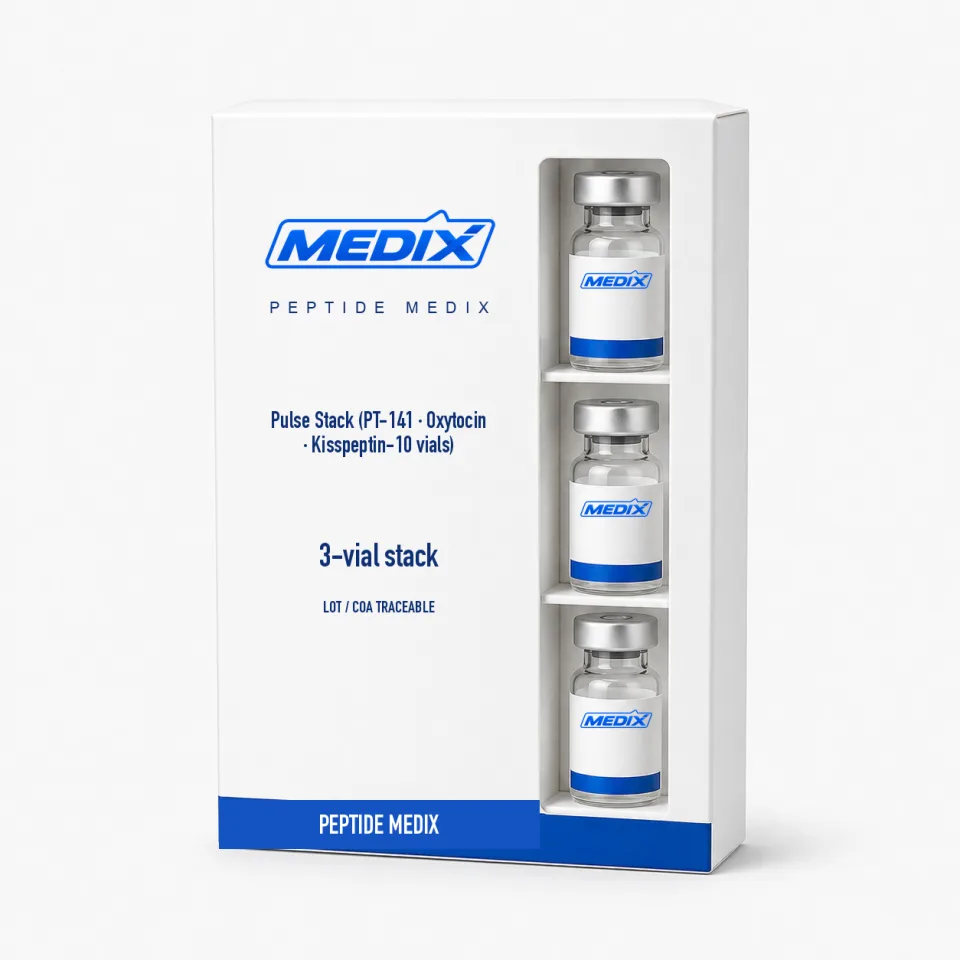
- Every vial assayed to ≥99% (HPLC) with its own lot COA
- Certificate of analysis tied to your lot number
- Tracked EU delivery, dispatched the next working day
Pulse Stack (PT-141 · Oxytocin · Kisspeptin-10 vials)
Neuroendocrine research kit of three vials: PT-141, oxytocin and kisspeptin-10
In stock1 format available
€93
This listing is currently unavailable. Contact us and we will tell you when it is back or suggest an equivalent.
Ask about this listing or request its COA- FormLyophilized powder in each vial, individually capped
- Research areasMelanocortin receptor pharmacology, oxytocin receptor studies, GPR54 and GnRH axis
For laboratory research use only. Sold exclusively for in-vitro laboratory research by qualified professionals. Not for human or veterinary use, and not a medicine, food, cosmetic or dietary supplement. Terms and Conditions
Overview
Key facts
Pulse Stack brings together three neuroendocrine peptides — PT-141, oxytocin and kisspeptin-10 — each sealed in its own lyophilised vial.
- Purity
- ≥99% by HPLC per vial; separate lot-matched COA for each
- Form
- Lyophilized powder in each vial, individually capped
- Storage
- −20 °C, protected from light and moisture
- Available size
- 3-vial stack
For research use only. Not for human consumption.
Pulse Stack brings together three neuroendocrine peptides — PT-141, oxytocin and kisspeptin-10 — each sealed in its own lyophilised vial. They act on different receptor systems within reproductive and social-behaviour neuroendocrinology, so between them a single panel covers melanocortin, oxytocin-receptor and GPR54 signalling.
PT-141, also called bremelanotide, is a ring-shaped seven-residue peptide descended from Melanotan II and investigated for its agonism at the MC3R and MC4R melanocortin receptors. Oxytocin is the body's own nine-residue hormone, produced by hypothalamic neurons and secreted by the posterior pituitary; a disulfide link between its two cysteines is essential to how it works and dictates how carefully it must be handled. Kisspeptin-10 consists of the final ten amino acids of the protein encoded by KISS1; it binds GPR54 and acts at a well-mapped point above GnRH release in the reproductive axis.
These three would make a poor co-formulation: oxytocin's disulfide is sensitive to redox conditions, and each is studied at very different concentrations. Every vial has its own lot number, an HPLC assay at ≥99% purity and a certificate of analysis. Research material for laboratory investigation only.
What sets this listing apart
Pulse Stack combines PT-141 (Bremelanotide), Oxytocin and Kisspeptin-10 in one listing. Components that are also sold on their own are linked below, each with its own specification and COA.
Same compound, other listings
Specifications
Supply & purity
- Form
- Lyophilized powder in each vial, individually capped
- Purity
- ≥99% by HPLC per vial; separate lot-matched COA for each
Handling & storage
- Storage (lyophilized)
- −20 °C, protected from light and moisture
- Storage (reconstituted)
- 2–8 °C, protected from light; oxytocin is least stable
Additional detail
- Product type
- Multi-vial research kit — three separately sealed vials
- Kit contents
- One PT-141 vial, one oxytocin vial, one kisspeptin-10 vial
- PT-141 (bremelanotide)
- CAS 189691-06-3 · C50H68N14O10 · 1025.16 g/mol
- Oxytocin
- CAS 50-56-6 · C43H66N12O12S2 · 1007.19 g/mol
- Kisspeptin-10
- CAS 374675-21-5 · C63H83N17O14 · 1302.47 g/mol
- Oxytocin sequence
- Cys-Tyr-Ile-Gln-Asn-Cys-Pro-Leu-Gly-NH2 (1-6 disulfide bridge)
- Kisspeptin-10 sequence
- Tyr-Asn-Trp-Asn-Ser-Phe-Gly-Leu-Arg-Phe-NH2
- Research areas
- Melanocortin receptor pharmacology, oxytocin receptor studies, GPR54 and GnRH axis
- Reconstitution
- Each vial prepared separately; avoid reducing agents with oxytocin
Questions about Pulse Stack (PT-141 · Oxytocin · Kisspeptin-10 vials)
What links PT-141 to Melanotan II?
PT-141 is an analogue of Melanotan II that comes from its metabolism and no longer has the terminal amide. As a result it favours MC3R and MC4R and has lost most of the MC1R activity responsible for the parent compound's effects on pigmentation.
Why is oxytocin the most delicate of the three?
Its structure hinges on a disulfide bond linking cysteine 1 with cysteine 6. Reducing agents break that ring and inactivate the hormone, and oxytocin also tends to cling to surfaces. Keep anything reducing well away from it and make solutions shortly before you need them.
Does every vial come with its own certificate?
Yes. The three vials come from separate production runs, and each run is released with a certificate stating identity and HPLC purity for its peptide — three documents altogether, which you're welcome to request before ordering.
What research is kisspeptin-10 used for?
It is a standard probe for the hormonal axis that controls reproduction. Being the shortest part of the KISS1 product that remains active, it attaches to GPR54 on neurons that respond to kisspeptin and sit above GnRH release — ideal for dissecting that chain of command in experimental models.
Why aren't they offered as a single blend?
Because each needs different conditions. Oxytocin is damaged by reducing agents, PT-141 is a cyclic peptide and kisspeptin-10 ends in an amide, and they are used at very different concentrations. A single mixed formula would force the same conditions on three chemistries that each need their own handling.
Related