- HPLC-assayed purity of ≥99%
- Certificate of analysis tied to your lot number
- Tracked EU delivery, dispatched the next working day
Botulinum Toxin Type A — Prescription Reference
Clostridial neurotoxin that cleaves SNAP-25 — prescription-only reference entry
In stock2 formats availableCAS 93384-43-1
€161Range €161 – €280
This listing is currently unavailable. Contact us and we will tell you when it is back or suggest an equivalent.
Ask about this listing or request its COA- FormSterile vacuum-dried or lyophilised powder in a single-use glass vial, reconstituted before use
- Mol. weight≈150 kDa neurotoxin; commonly supplied as a ~900 kDa complex with non-toxic accessory proteins, or complex-free
For laboratory research use only. Sold exclusively for in-vitro laboratory research by qualified professionals. Not for human or veterinary use, and not a medicine, food, cosmetic or dietary supplement. Terms and Conditions
Overview
Key facts
The active ingredient is serotype A botulinum neurotoxin, made by the anaerobic bacterium Clostridium botulinum.
- CAS number
- 93384-43-1
- Molecular weight
- ≈150 kDa neurotoxin; commonly supplied as a ~900 kDa complex with non-toxic accessory proteins, or complex-free
- Form
- Sterile vacuum-dried or lyophilised powder in a single-use glass vial, reconstituted before use
- Storage
- Cold chain per approved labelling — unopened vials refrigerated at 2–8 °C (some presentations frozen); reconstituted product refrigerated and used within the…
- Available sizes
- 50 U vial · 100 U vial
For research use only. Not for human consumption.
The active ingredient is serotype A botulinum neurotoxin, made by the anaerobic bacterium Clostridium botulinum. Once purified it is a dichain protein of about 150 kDa: a 100 kDa heavy chain that handles binding to neurons and translocation, joined by a disulfide bond to a 50 kDa light chain that functions as a zinc-dependent endopeptidase. Most commercial products present the neurotoxin within a larger complex of non-toxic accessory proteins, though one purified formulation without those proteins is also on the market.
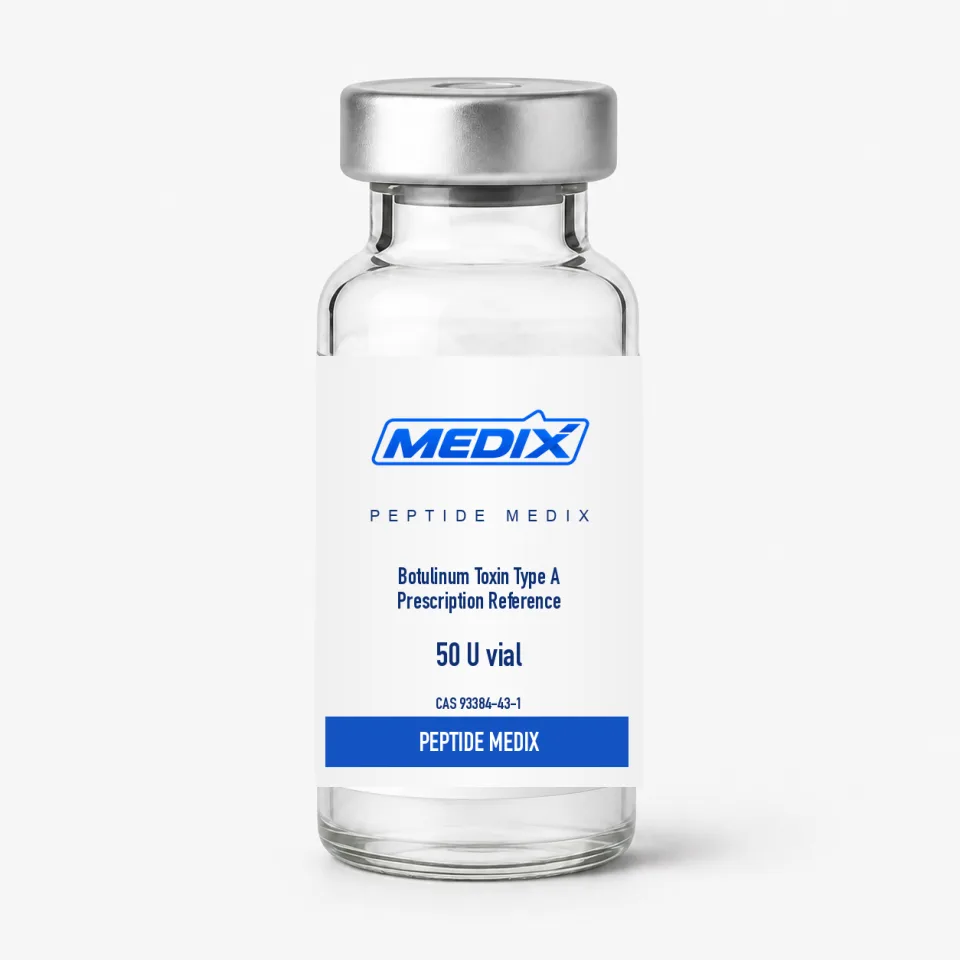
One detail is essential for identification: each manufacturer defines potency Units with its own mouse assay, so Units belong to a specific product and cannot be exchanged between brands. The 50 U and 100 U presentations shown here merely describe vial strength for reference. Listed for reference.
Specifications
Identity
- CAS number
- 93384-43-1
- Molecular weight
- ≈150 kDa neurotoxin; commonly supplied as a ~900 kDa complex with non-toxic accessory proteins, or complex-free
Supply & purity
- Form
- Sterile vacuum-dried or lyophilised powder in a single-use glass vial, reconstituted before use
Additional detail
- Regulatory status
- Prescription-only biologic medicine (Rx); supplied solely against valid prescription or institutional authorisation
- Active substance
- Botulinum neurotoxin type A (BoNT/A)
- Source organism
- Clostridium botulinum, anaerobic culture and purification
- Structure
- Dichain protein — 100 kDa heavy chain and 50 kDa light chain joined by an interchain disulfide bond
- Molecular target
- SNAP-25, cleaved by the zinc-dependent endopeptidase light chain
- Pharmacological effect
- Blocks calcium-dependent acetylcholine release at cholinergic nerve terminals
- Potency units
- Units defined by a manufacturer-specific mouse LD50 assay; not interchangeable between products
- Reference sizes listed
- 50 U vial; 100 U vial
- Storage
- Cold chain per approved labelling — unopened vials refrigerated at 2–8 °C (some presentations frozen); reconstituted product refrigerated and used within the labelled window
- Intended use
- Reference listing only — prescription medicine, administered exclusively by qualified clinicians
Questions about Botulinum Toxin Type A — Prescription Reference
Can botulinum toxin be obtained without a prescription?
No. It is a prescription-only biologic that has to be administered by a qualified clinician; in the United States, quantities above set thresholds are also regulated as a select agent. This page is purely a reference listing, and the product is supplied only on a valid prescription or with documented institutional authorisation.
How does it block muscle contraction?
The heavy chain attaches to SV2 and ganglioside receptors on cholinergic nerve endings, after which the toxin is taken up by endocytosis. As the vesicle acidifies, the light chain moves into the cytosol, where this zinc endopeptidase cuts SNAP-25. With SNAP-25 cleaved, the SNARE complex can no longer fuse vesicles, and acetylcholine release stops.
Is a Unit the same for every brand?
No. Each manufacturer sets its Units using its own mouse assay, so a Unit of one product does not equal a Unit of another. Authorised product information states plainly that Units cannot be converted or compared across botulinum toxin products — which is why a Unit figure is always quoted with the brand.
Related