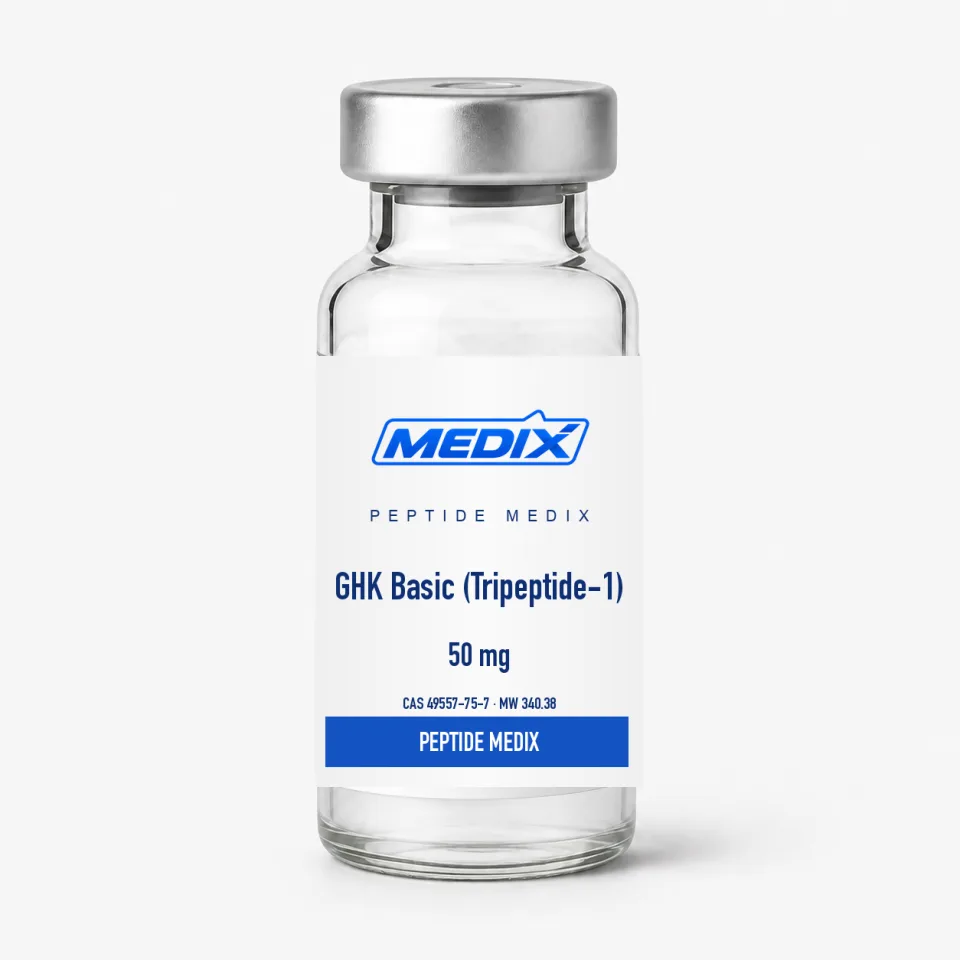
- HPLC purity ≥99%, with a COA for each lot on request
- Certificate of analysis tied to your lot number
- Tracked EU delivery, dispatched the next working day
GHK Basic (Tripeptide-1)
Gly-His-Lys tripeptide without copper, for matrix and fibroblast research
In stock2 formats availableCAS 49557-75-7
€51Range €51 – €157
This listing is currently unavailable. Contact us and we will tell you when it is back or suggest an equivalent.
Ask about this listing or request its COA- FormWhite to off-white lyophilized powder, sealed glass vial
- Mol. weight340.38 g/mol
- Research areasFibroblast signaling, matrix turnover, copper coordination, protease regulation and reactive-carbonyl chemistry
For laboratory research use only. Sold exclusively for in-vitro laboratory research by qualified professionals. Not for human or veterinary use, and not a medicine, food, cosmetic or dietary supplement. Terms and Conditions
Overview
Key facts
GHK Basic is glycyl-L-histidyl-L-lysine with no copper bound — the peptide also known as Tripeptide-1.
- CAS number
- 49557-75-7
- Molecular formula
- C14H24N6O4
- Molecular weight
- 340.38 g/mol
- Amino acid sequence
- Gly-His-Lys (GHK)
- Purity
- ≥99% by HPLC; lot-matched COA available
- Form
- White to off-white lyophilized powder, sealed glass vial
- Storage
- −20 °C lyophilized; protect from moisture and use refrigerated solutions within the study window
- Available sizes
- 50 mg · 200 mg
For research use only. Not for human consumption.
GHK Basic is glycyl-L-histidyl-L-lysine with no copper bound — the peptide also known as Tripeptide-1. It differs from GHK-Cu chemically, not just in marketing: GHK Basic is the bare three-residue ligand, while GHK-Cu is a copper(II) coordination complex with its own mass, colour and redox behaviour. Without copper the peptide is a white to off-white powder instead of the familiar blue. INCI naming follows the same division — Tripeptide-1 for the free peptide, Copper Tripeptide-1 for the complex — so check supplier documents before comparing datasets.
GHK is found naturally in human plasma and as a motif inside extracellular-matrix proteins; it was first reported in the early 1970s as a low-molecular-weight activity isolated from human plasma. Cellular and biochemical studies have explored its copper-binding equilibrium, effects on fibroblast signalling, extracellular-matrix gene expression, protease regulation and reactive-carbonyl chemistry. Because traces of copper in culture media can turn part of a supposedly copper-free preparation into GHK-Cu, rigorous studies measure or control metal content.
Specifications
Identity
- CAS number
- 49557-75-7
- Molecular formula
- C14H24N6O4
- Molecular weight
- 340.38 g/mol
- Amino acid sequence
- Gly-His-Lys (GHK)
- Peptide class
- Endogenous matrix-associated tripeptide and copper-binding ligand
Supply & purity
- Form
- White to off-white lyophilized powder, sealed glass vial
- Purity
- ≥99% by HPLC; lot-matched COA available
- Available sizes
- 50 mg, 200 mg
- Solubility
- Water-soluble; use metal-controlled buffers for copper-comparison studies
Additional detail
- Also known as
- Tripeptide-1, glycyl-L-histidyl-L-lysine, GHK free peptide
- Copper status
- No coordinated copper added; trace-metal conditions remain an assay variable
- Research areas
- Fibroblast signaling, matrix turnover, copper coordination, protease regulation and reactive-carbonyl chemistry
- Storage
- −20 °C lyophilized; protect from moisture and use refrigerated solutions within the study window
Questions about GHK Basic (Tripeptide-1)
Are GHK Basic and GHK-Cu the same?
No. GHK Basic is the Gly-His-Lys ligand without copper; GHK-Cu is its copper(II) complex, with a different molecular mass, a blue colour and distinct redox chemistry. They require separate controls and should be treated as different products.
What does Tripeptide-1 refer to?
It is the cosmetic and catalogue name usually given to glycyl-L-histidyl-L-lysine (GHK). This product is that free peptide — sequence Gly-His-Lys, CAS 49557-75-7.
Why compare GHK Basic with Pal-GHK?
Pal-GHK attaches a sixteen-carbon palmitoyl chain to the same peptide core, altering solubility, membrane partitioning and adsorption to surfaces. Testing both separates the effect of lipidation from that of the GHK sequence itself.
Which purity data and documents are included?
It is released at ≥99% purity by reversed-phase HPLC, with a certificate of analysis matching the vial's lot. If your study depends on copper speciation, run your own metal analysis as well.
Which sizes are listed?
Sealed research vials of 50 mg and 200 mg — the sizes typical of current specialist peptide catalogues, suitable for both cell-culture and formulation-development work.
Related