- HPLC purity ≥99% plus MS identity confirmation, COA for every lot
- Certificate of analysis tied to your lot number
- Tracked EU delivery, dispatched the next working day
Argireline (Acetyl Hexapeptide-8)
Acetyl hexapeptide-8 (EEMQRR), the benchmark cosmetic signal peptide — 10 mg and 50 mg
In stock2 formats availableCAS 616204-22-9
€46Range €46 – €131
This listing is currently unavailable. Contact us and we will tell you when it is back or suggest an equivalent.
Ask about this listing or request its COA- FormWhite lyophilized powder in a sealed glass vial
- Mol. weight888.99 g/mol
- Research areasSNARE assembly, exocytosis interference, expression-line formulation studies
For laboratory research use only. Sold exclusively for in-vitro laboratory research by qualified professionals. Not for human or veterinary use, and not a medicine, food, cosmetic or dietary supplement. Terms and Conditions
Overview
Key facts
Argireline is the brand name of acetyl hexapeptide-8, a six-amino-acid peptide (Glu-Glu-Met-Gln-Arg-Arg) with an acetylated N-terminus and an amidated C-terminus.
- CAS number
- 616204-22-9
- Molecular formula
- C34H60N14O12S
- Molecular weight
- 888.99 g/mol
- Amino acid sequence
- Ac-Glu-Glu-Met-Gln-Arg-Arg-NH2
- Purity
- ≥99% by HPLC with mass-spectrometric identity check; COA per lot
- Form
- White lyophilized powder in a sealed glass vial
- Storage
- −20 °C, sealed, away from light and moisture
- Available sizes
- 10 mg · 50 mg
For research use only. Not for human consumption.
Argireline is the brand name of acetyl hexapeptide-8, a six-amino-acid peptide (Glu-Glu-Met-Gln-Arg-Arg) with an acetylated N-terminus and an amidated C-terminus. First registered as acetyl hexapeptide-3, it has become one of the best-researched cosmetic signal peptides, largely because it is short, dissolves easily in water and is inexpensive to characterise. Its sequence is copied from the N-terminal part of SNAP-25, a member of the SNARE complex that drives vesicle docking and fusion at nerve terminals.
In the lab it is used to study how SNARE complex formation can be disrupted from the extracellular side, and as a reference ingredient in topical formulation work where expression lines are quantified by profilometry or image analysis. Newer analogues such as SNAP-8 are measured against it, so researchers typically test both in one vehicle at equal molar concentrations.
Peptide Medix EU supplies Argireline as lyophilised powder in 10 mg and 50 mg vials, tested by an independent laboratory to ≥99% HPLC purity with a certificate of analysis for every lot, and shipped from our EU warehouse.
What sets this listing apart
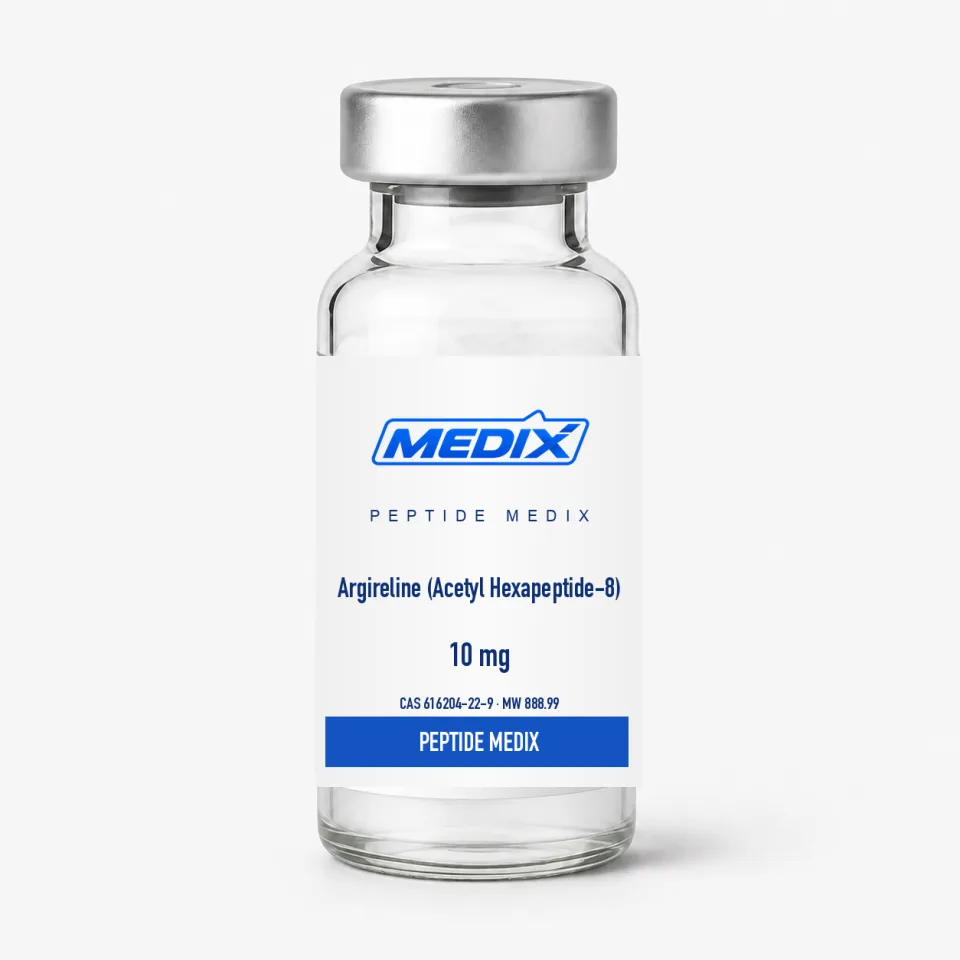
Argireline (Acetyl Hexapeptide-8) – vial, 10/50 mg. White lyophilized powder in a sealed glass vial. Other Argireline listings differ in format, fill or combination partners; the specification and COA always refer to the listing you order.
Same compound, other listings
Specifications
Identity
- CAS number
- 616204-22-9
- Molecular formula
- C34H60N14O12S
- Molecular weight
- 888.99 g/mol
- Amino acid sequence
- Ac-Glu-Glu-Met-Gln-Arg-Arg-NH2
- Peptide class
- Cosmetic signal peptide; SNAP-25 N-terminal fragment analog
Supply & purity
- Form
- White lyophilized powder in a sealed glass vial
- Purity
- ≥99% by HPLC with mass-spectrometric identity check; COA per lot
- Available sizes
- 10 mg, 50 mg
- Solubility
- Freely soluble in water and bacteriostatic water
Handling & storage
- Storage (lyophilized)
- −20 °C, sealed, away from light and moisture
Additional detail
- INCI name
- Acetyl Hexapeptide-8 (formerly acetyl hexapeptide-3)
- Research areas
- SNARE assembly, exocytosis interference, expression-line formulation studies
- Storage (in solution)
- 2–8 °C, short-term; methionine is oxidation-sensitive
Questions about Argireline (Acetyl Hexapeptide-8)
What exactly is Argireline?
It is the trade name of acetyl hexapeptide-8, a hexapeptide with the sequence Ac-Glu-Glu-Met-Gln-Arg-Arg-NH2 taken from the N-terminal region of SNAP-25. It ranks among the most thoroughly studied cosmetic signal peptides and serves widely as a reference material in formulation and SNARE-assembly studies.
Are acetyl hexapeptide-8 and acetyl hexapeptide-3 the same thing?
Yes. The ingredient was first registered as acetyl hexapeptide-3 and later given the INCI name acetyl hexapeptide-8. Older publications and datasheets use the original name for the very same sequence — useful to remember when matching literature data to a current certificate of analysis.
Is the lot independently tested, and can I view the COA?
Yes. An independent laboratory checks identity and purity of every production lot by HPLC with mass-spectrometric confirmation, and you can request the lot's certificate of analysis before buying. It lists lot number, assay result and test date, ready to file with your lab records.
How does it differ from SNAP-8?
SNAP-8 shares the same core but adds two amino acids at the C-terminus, making it an octapeptide. Comparative studies assess binding to the SNARE interface, stability in water and performance in identical vehicles. One cannot stand in for the other in a study; they are normally tested side by side.
What vial sizes and contents are available?
We offer 10 mg and 50 mg lyophilised vials containing pure peptide — no diluent, carrier or preservative. The 10 mg vial fits receptor and assay experiments; the 50 mg vial is intended for repeated formulation trials needing larger stock volumes.
How should I store and dissolve it?
Keep the sealed lyophilisate at −20 °C away from light and humidity. It dissolves readily in water or bacteriostatic water. Since its methionine oxidises easily, make up solutions shortly before use, hold them at 2–8 °C and avoid cycles of freezing and thawing.
Related