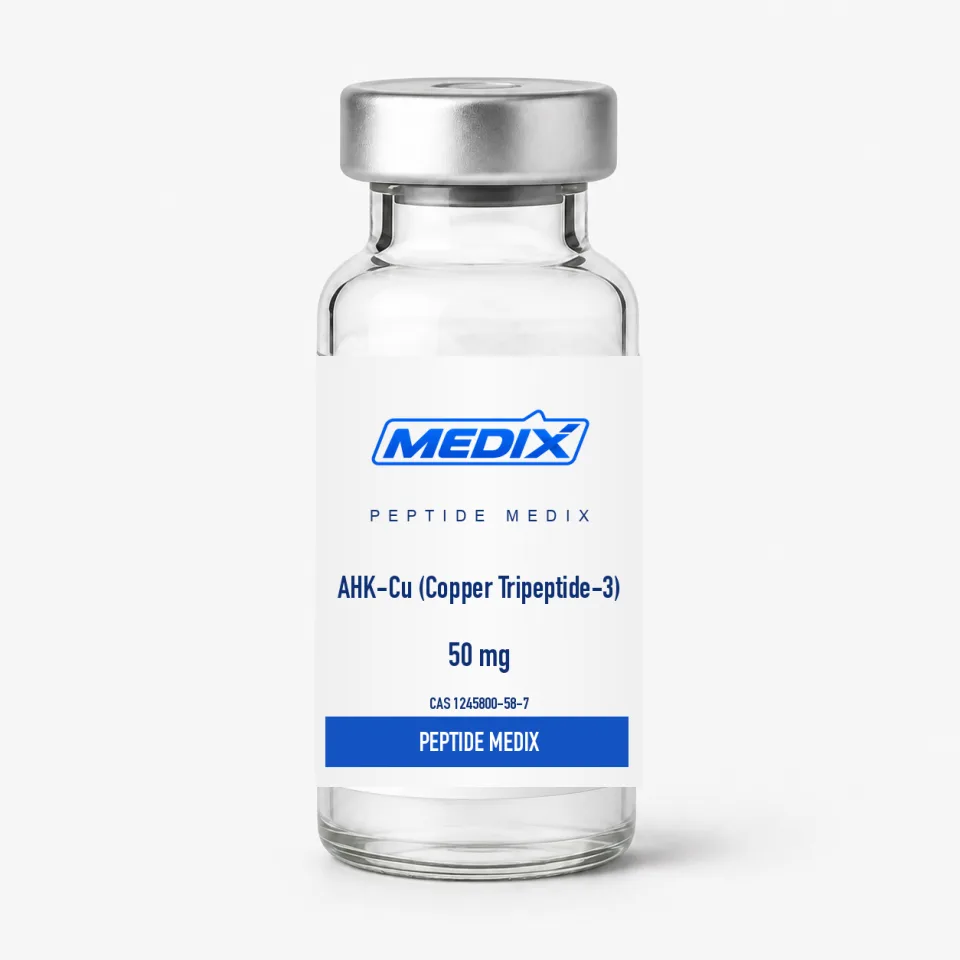
- HPLC purity ≥99%, with a COA for each lot on request
- Certificate of analysis tied to your lot number
- Tracked EU delivery, dispatched the next working day
AHK-Cu (Copper Tripeptide-3)
Copper(II) complex of Ala-His-Lys, researched in hair-follicle models
In stock2 formats availableCAS 1245800-58-7
€55Range €55 – €85
This listing is currently unavailable. Contact us and we will tell you when it is back or suggest an equivalent.
Ask about this listing or request its COA- FormLyophilized blue powder, sealed glass vial with crimped stopper
- Mol. weight≈417.96 g/mol as the copper complex; 354.41 g/mol for the free tripeptide
- Research areasHair follicle biology, dermal papilla cell cultures, angiogenic signalling, topical formulation science
For laboratory research use only. Sold exclusively for in-vitro laboratory research by qualified professionals. Not for human or veterinary use, and not a medicine, food, cosmetic or dietary supplement. Terms and Conditions
Overview
Key facts
AHK-Cu is alanyl-histidyl-lysine bound to copper(II), known under cosmetic INCI naming as copper tripeptide-3.
- CAS number
- 1245800-58-7
- Molecular formula
- C15H26N6O4·Cu (copper(II) complex)
- Molecular weight
- ≈417.96 g/mol as the copper complex; 354.41 g/mol for the free tripeptide
- Amino acid sequence
- Ala-His-Lys (AHK), complexed with copper(II)
- Purity
- ≥99% by HPLC; lot-matched COA available
- Form
- Lyophilized blue powder, sealed glass vial with crimped stopper
- Storage
- −20 °C, sealed and protected from light and moisture
- Available sizes
- 50 mg · 100 mg
For research use only. Not for human consumption.
AHK-Cu is alanyl-histidyl-lysine bound to copper(II), known under cosmetic INCI naming as copper tripeptide-3. It is a close relative of GHK-Cu within the small group of copper-chelating matrix peptides — the only difference is the first residue, alanine instead of glycine. That swap nudges charge and hydrophobicity a little but leaves intact the histidine-lysine motif that holds the divalent copper ion, and the complex shows the intense blue typical of copper peptides.
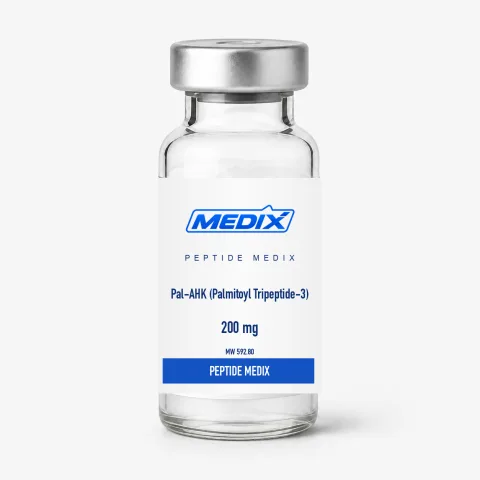
Most research on this tripeptide sits in hair biology: dermal papilla cell cultures, follicle models and the expression of angiogenic markers. That is where it overlaps with the broader copper-peptide field, because copper serves as a cofactor for lysyl oxidase and takes part in several angiogenic processes. Practical handling is governed by coordination chemistry more than by peptide chemistry. Strong acids break the complex apart, and so do competing chelators like EDTA — either way you end up with free peptide and free copper instead of the complex you meant to study, and loss of the blue colour tells you so. Vials hold 50 mg or 100 mg, more than a usual peptide fill, since formulation studies use material fast. Our Pal-AHK listing is the same tripeptide carrying a palmitoyl chain and no bound copper.
What sets this listing apart
AHK-Cu (Copper Tripeptide-3) – vial, 50/100 mg. Lyophilized blue powder, sealed glass vial with crimped stopper. Other AHK-Cu listings differ in format, fill or combination partners; the specification and COA always refer to the listing you order.
Same compound, other listings
Specifications
Identity
- CAS number
- 1245800-58-7
- Molecular formula
- C15H26N6O4·Cu (copper(II) complex)
- Molecular weight
- ≈417.96 g/mol as the copper complex; 354.41 g/mol for the free tripeptide
- Amino acid sequence
- Ala-His-Lys (AHK), complexed with copper(II)
- Peptide class
- Copper-binding matrix tripeptide
Supply & purity
- Form
- Lyophilized blue powder, sealed glass vial with crimped stopper
- Purity
- ≥99% by HPLC; lot-matched COA available
- Available sizes
- 50 mg, 100 mg
- Solubility
- Water and bacteriostatic water; avoid strongly acidic media that dissociate the copper complex
Handling & storage
- Storage (lyophilized)
- −20 °C, sealed and protected from light and moisture
- Storage (reconstituted)
- 2–8 °C, protected from light, used within the study window
Additional detail
- INCI name
- Copper tripeptide-3
- Appearance in solution
- Blue to blue-violet, colour intensity tracking copper coordination
- Research areas
- Hair follicle biology, dermal papilla cell cultures, angiogenic signalling, topical formulation science
Questions about AHK-Cu (Copper Tripeptide-3)
What separates AHK-Cu from GHK-Cu?
Each is a copper-chelating tripeptide, yet AHK-Cu starts with alanine at the N-terminus while GHK-Cu starts with glycine. Their copper binding is much alike; their research literatures are not. GHK-Cu is studied mainly in skin and extracellular-matrix biology, AHK-Cu chiefly in hair-follicle and dermal papilla cell work.
Where does the blue colour come from?
It arises from copper(II) held by the histidine imidazole ring and the free terminal amine. The colour doubles as a handy quality check: if a preparation has turned colourless, the copper complex has usually been lost to acid, a chelating additive or degradation.
What documents support purity?
An independent laboratory tests every lot by HPLC to a minimum of 99%, and the certificate of analysis for your lot can be requested. Filing that COA with your study records links the characterised material to the results it produced.
Which vial sizes are offered?
AHK-Cu comes in sealed 50 mg and 100 mg vials. The smaller vial is usually enough for a single cell-culture study; the 100 mg vial is typically picked for formulation projects that call for larger batches of stock solution.
How do I store it once reconstituted?
Keep it in the fridge at 2–8 °C, shielded from light, and label the vial with concentration and preparation date. Copper-peptide solutions do not keep forever, so most labs write a defined use-by window into the protocol instead of holding stocks indefinitely.