- HPLC-assayed purity of ≥99%
- Certificate of analysis tied to your lot number
- Tracked EU delivery, dispatched the next working day
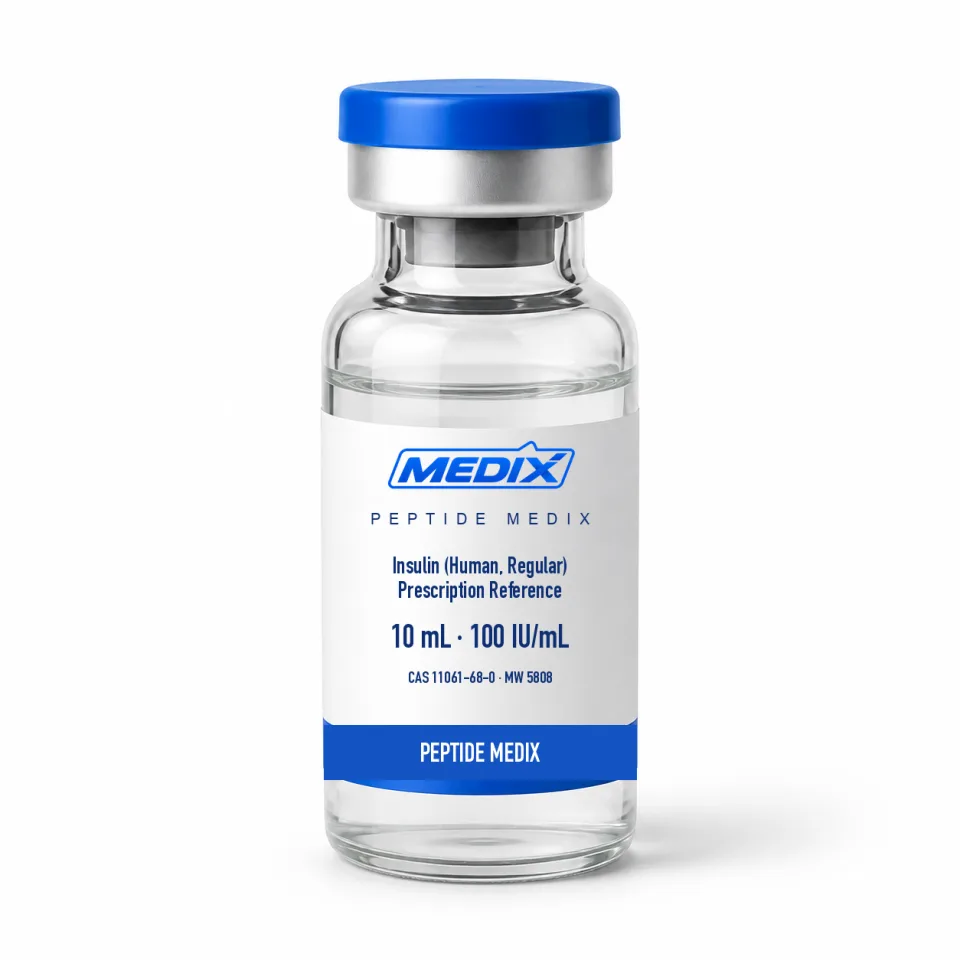
Insulin (Human, Regular) — Prescription Reference
Short-acting recombinant human insulin — reference entry, prescription only
In stock1 format availableCAS 11061-68-0
€46
This listing is currently unavailable. Contact us and we will tell you when it is back or suggest an equivalent.
Ask about this listing or request its COA- Mol. weight≈5,808 Da (monomer)
For laboratory research use only. Sold exclusively for in-vitro laboratory research by qualified professionals. Not for human or veterinary use, and not a medicine, food, cosmetic or dietary supplement. Terms and Conditions
Overview
Key facts
Reference entry for a prescription-only medicine.
- CAS number
- 11061-68-0
- Molecular formula
- C257H383N65O77S6
- Molecular weight
- ≈5,808 Da (monomer)
- Storage
- Unopened vials 2–8 °C, do not freeze, protect from light; in-use storage per the approved labelling
- Available size
- 10 mL · 100 IU/mL
For research use only. Not for human consumption.
Reference entry for a prescription-only medicine. Regular human insulin is a biologic that requires a prescription; it appears in this institutional catalogue only so that clinics, pharmacies and labs can look up the molecule, how it is presented, what it is authorised for and how it must be kept cold. Supply takes place only against a valid prescription or an institution's documented authorisation, and this page contains no guidance on dosing, adjusting doses, administration or sourcing.
Human insulin is a small protein of 51 amino acids arranged as two chains: the A chain has 21 residues and the B chain 30. Two disulfide bridges connect the chains, and a third links two points within the A chain. One molecule weighs roughly 5,808 Da, but in the concentrated, zinc-containing solution inside a vial it exists mostly as hexamers, which fall apart into dimers and single molecules when diluted. Modern insulin is made by recombinant DNA technology in the bacterium Escherichia coli or the yeast Saccharomyces cerevisiae, and its sequence is exactly that of the hormone released by the pancreas's beta cells.
Specifications
Identity
- CAS number
- 11061-68-0
- Molecular formula
- C257H383N65O77S6
- Molecular weight
- ≈5,808 Da (monomer)
Additional detail
- Regulatory status
- Prescription-only biologic medicine (Rx); supplied solely against valid prescription or institutional authorisation
- Generic name
- Insulin human (rDNA origin), regular
- Also known as
- Soluble insulin, neutral insulin, regular human insulin, U-100 insulin
- Structure
- A chain of 21 residues and B chain of 30 residues joined by two interchain disulfide bonds, plus one intrachain A6–A11 bond
- Production
- Recombinant DNA technology in Escherichia coli or Saccharomyces cerevisiae
- Molecular target
- Insulin receptor (α2β2 receptor tyrosine kinase); IRS-1/2, PI3K/Akt signalling
- Principal actions
- GLUT4 translocation in muscle and adipose tissue, suppression of hepatic glucose output, glycogen and lipid storage
- Concentration
- 100 IU/mL (U-100); 1 mg of insulin human corresponds to approximately 28.8 IU
- Storage
- Unopened vials 2–8 °C, do not freeze, protect from light; in-use storage per the approved labelling
- Intended use
- Reference listing only — prescription medicine, not supplied for non-prescribed use
Questions about Insulin (Human, Regular) — Prescription Reference
Can this insulin be obtained without a prescription?
No. This entry refers to a prescription-only medicine and is supplied only against a valid prescription or an institution's documented authorisation. How particular human insulin products are classified has varied over time between countries and between US states, but nothing on this page offers a way to obtain it, and no product leaves us without valid authorisation.
How does insulin work at its receptor?
Insulin binds the outer (α) subunits of its receptor, which is a tyrosine kinase made of two α and two β subunits. The β subunits then phosphorylate each other and draw in IRS proteins. Through the PI3K/Akt branch, GLUT4 moves to the surface of muscle and fat cells, glycogen synthase is activated and the liver releases less glucose; the MAPK branch looks after growth-related gene activity.
What is the difference between “regular” insulin and rapid-acting analogues?
Regular insulin has the natural human sequence and forms zinc hexamers in the vial, which must break apart before absorption. Rapid-acting analogues like lispro and aspart include sequence changes that weaken this self-association, so they separate into monomers more quickly. NPH, a protamine suspension, acts more slowly still.
Why is it listed next to research peptides?
Only as a descriptive reference. Insulin is a standard protein in endocrine and metabolic research and a routine control in receptor and glucose-uptake experiments, so we list it to help identification. Its status doesn't change: it remains a prescription biologic, released only with valid authorisation.
Is dosing information available?
No. Dose, titration, timing and route of insulin are tailored to each patient by the prescriber using the authorised product information. This entry covers identity, chemistry, mechanism, authorised indication, presentation and storage only, with no administration guidance.
Related