- HPLC-assayed purity of ≥99%
- Certificate of analysis tied to your lot number
- Tracked EU delivery, dispatched the next working day
Tissue Repair & Healing Peptides
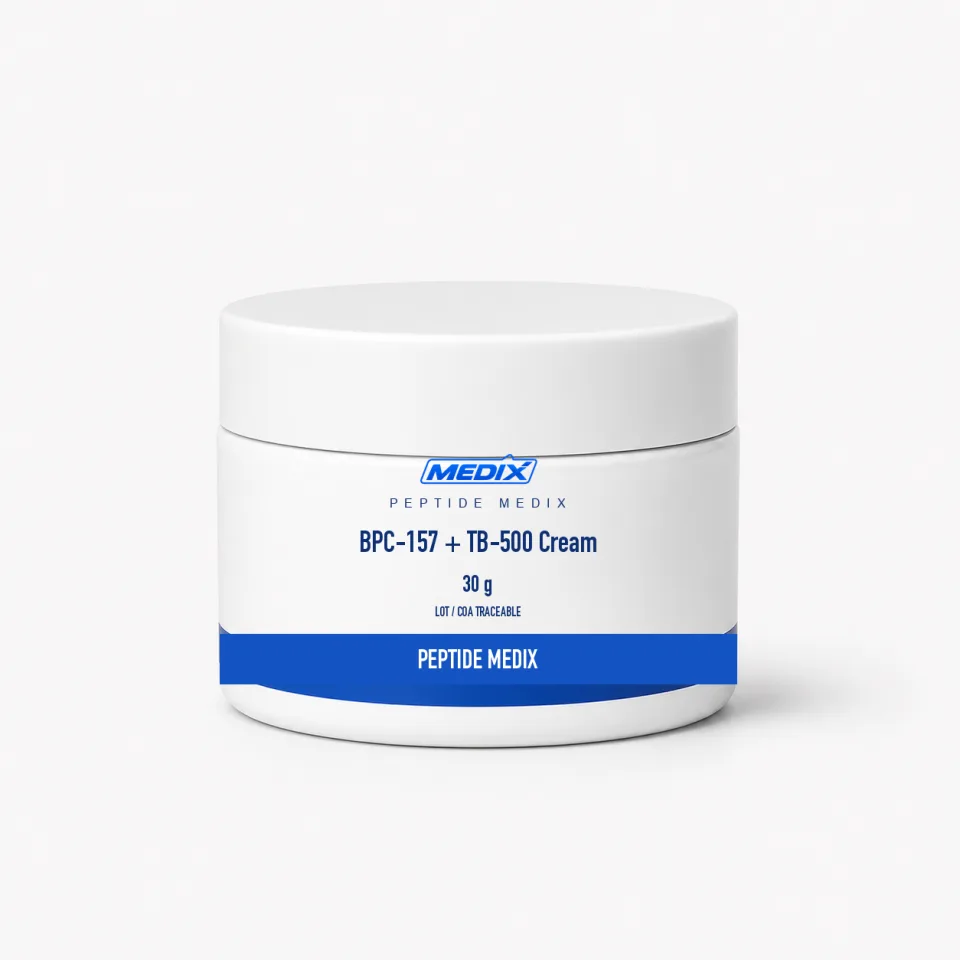
BPC-157 + TB-500 Cream
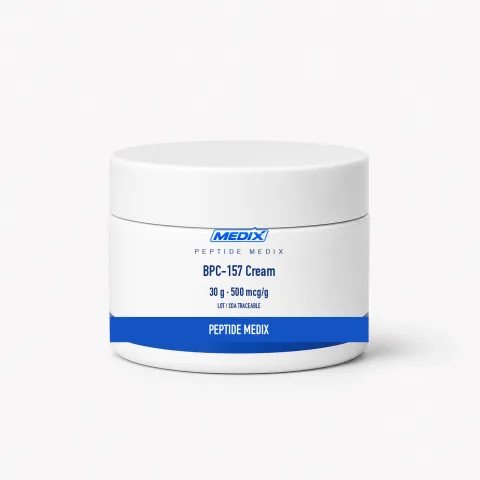
Emollient cream with BPC-157 and TB-500, each at 500 mcg/g
In stock2 formats available
€97Range €97 – €140
This listing is currently unavailable. Contact us and we will tell you when it is back or suggest an equivalent.
Ask about this listing or request its COA- FormEmollient oil-in-water cream in a screw-top jar
- Research areasPercutaneous penetration of large hydrophilic peptides, vehicle and occlusion effects, ex vivo skin models, fibroblast migration and wound-model work
For laboratory research use only. Sold exclusively for in-vitro laboratory research by qualified professionals. Not for human or veterinary use, and not a medicine, food, cosmetic or dietary supplement. Terms and Conditions
Overview
Key facts
Both tissue-repair peptides from our vial range are combined here in one emollient oil-in-water base, each at 500 micrograms per gram — 0.05% w/w per peptide and 1 mg of peptide in total per gram.
- Form
- Emollient oil-in-water cream in a screw-top jar
- Storage
- Cool and dark, ideally 2–8 °C; keep the jar closed between uses
- Available sizes
- 30 g · 50 g
For research use only. Not for human consumption.
Both tissue-repair peptides from our vial range are combined here in one emollient oil-in-water base, each at 500 micrograms per gram — 0.05% w/w per peptide and 1 mg of peptide in total per gram. That gives about 15 mg of BPC-157 and 15 mg of TB-500 in a 30 g jar, and roughly 25 mg of each in a 50 g jar. The two actives are made from ≥99% HPLC-purity material, with a certificate of analysis for each lot.
They are paired because published work places their mechanisms at different stages of the repair process. BPC-157, a synthetic 15-residue fragment of a gastric protein (Gly-Glu-Pro-Pro-Pro-Gly-Lys-Pro-Ala-Asp-Asp-Ala-Gly-Leu-Val), is investigated mainly for angiogenic signalling, fibroblast behaviour and mucosal integrity. TB-500 is the acetylated heptapeptide covering thymosin beta-4 residues 17–23, Ac-Leu-Lys-Lys-Thr-Glu-Thr-Gln; it contains the parent protein's actin-binding motif and appears in research on cell migration and wound closure. Studies that combine them typically ask whether vascular and migration endpoints behave differently when both are present than when each is tested alone.
What sets this listing apart
BPC-157 + TB-500 Cream – cream/serum, 30/50 g. Emollient oil-in-water cream in a screw-top jar. Other BPC-157 listings differ in format, fill or combination partners; the specification and COA always refer to the listing you order.
Same compound, other listings
Specifications
Supply & purity
- Form
- Emollient oil-in-water cream in a screw-top jar
- Available sizes
- 30 g and 50 g jars
Additional detail
- Active concentrations
- 500 mcg/g BPC-157 and 500 mcg/g TB-500 (0.05% w/w each, 1 mg/g total)
- Approximate peptide content
- ≈15 mg of each peptide per 30 g jar; ≈25 mg of each per 50 g jar
- Peptide purity input
- ≥99% by HPLC per component; lot-matched COA available
- BPC-157 identifiers
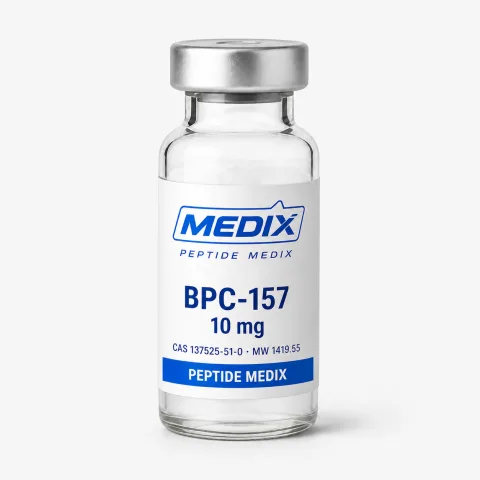
- CAS 137525-51-0 · C62H98N16O22 · 1419.55 g/mol
- BPC-157 sequence
- Gly-Glu-Pro-Pro-Pro-Gly-Lys-Pro-Ala-Asp-Asp-Ala-Gly-Leu-Val
- TB-500 identifiers
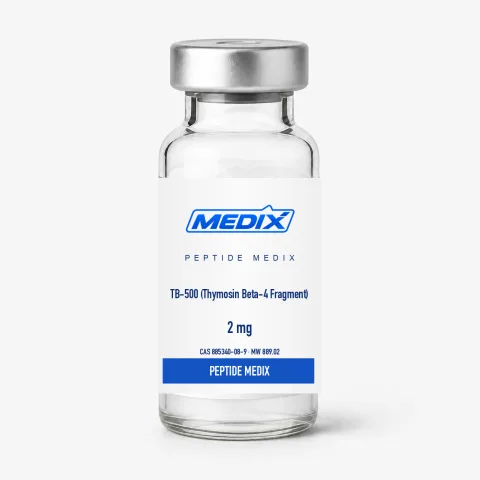
- CAS 885340-08-9 · C38H68N10O14 · 889.02 g/mol
- TB-500 sequence
- Ac-Leu-Lys-Lys-Thr-Glu-Thr-Gln (thymosin beta-4 residues 17–23)
- Vehicle
- Emollient oil-in-water base, no added fragrance or colourant
- Research areas
- Percutaneous penetration of large hydrophilic peptides, vehicle and occlusion effects, ex vivo skin models, fibroblast migration and wound-model work
- Storage
- Cool and dark, ideally 2–8 °C; keep the jar closed between uses
- Preparation required
- None — fixed loading per gram, no reconstitution step
Questions about BPC-157 + TB-500 Cream
What is the peptide content per jar?
Each active is present at 500 micrograms per gram, so the 30 g jar contains roughly 15 mg of BPC-157 and 15 mg of TB-500, and the 50 g jar roughly 25 mg of each. Altogether the cream carries 1 mg of peptide per gram.
How does it compare with the BPC-157-only cream?
It uses the same base and the same BPC-157 loading, plus TB-500 at an equal 500 mcg/g. Together the two creams form a matched pair for studies that want to isolate the contribution of the second peptide, with vehicle and first active held constant.
Can peptides of this size penetrate intact skin?
This should never be taken for granted. Both are hydrophilic and much bigger than the few-hundred-dalton molecules that diffuse passively. Whether any measurable flux occurs depends on vehicle, occlusion, contact time and barrier condition, and must be shown in the specific model you use.
Can I get certificates of analysis?
Yes. Every peptide lot used in production is analysed by reverse-phase HPLC to ≥99% with identity confirmation, and the matching certificates are available on request. Please quote the batch code printed on the jar.
What are the storage requirements?
Keep it cool and dark — ideally in a fridge at 2–8 °C — with the lid screwed tight. Emulsions tolerate temperature swings less well than lyophilised powder, so don't warm and chill it repeatedly, and discard it if the base separates, changes colour or smells different.
Related