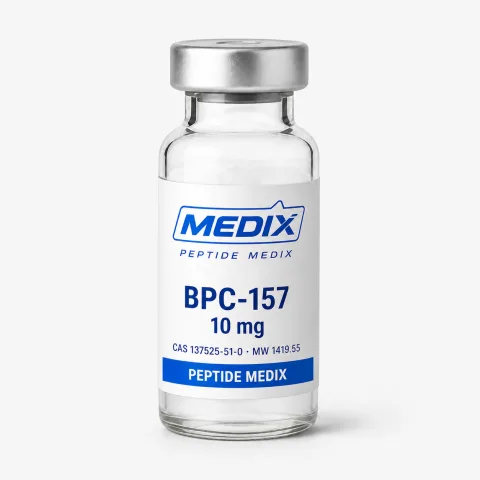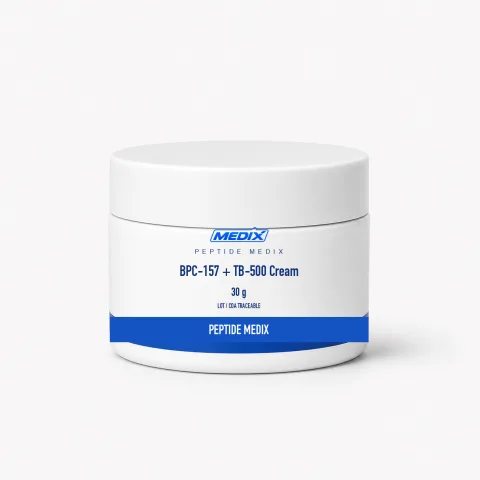
- HPLC-assayed purity of ≥99%
- Certificate of analysis tied to your lot number
- Tracked EU delivery, dispatched the next working day
Tissue Repair & Healing Peptides
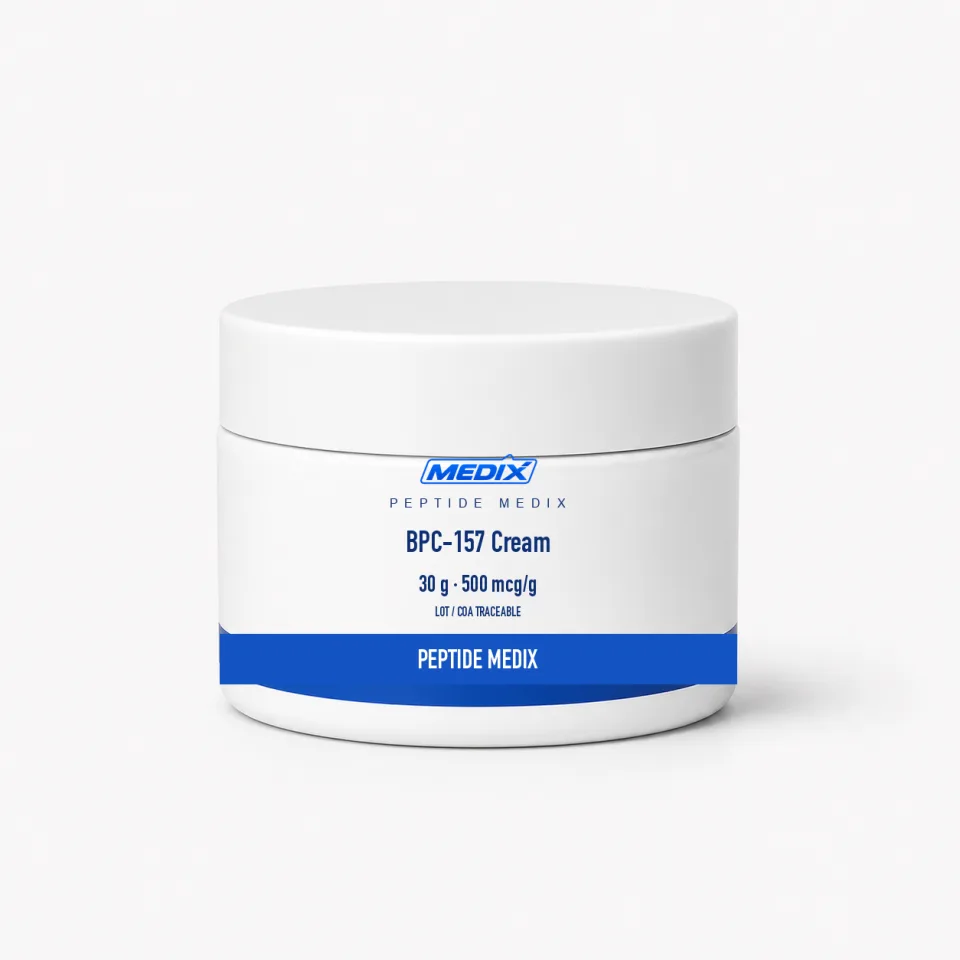
BPC-157 Cream
BPC-157 at 500 mcg/g in an emollient cream — 30 g and 50 g jars
In stock2 formats available
€68Range €68 – €97
This listing is currently unavailable. Contact us and we will tell you when it is back or suggest an equivalent.
Ask about this listing or request its COA- FormEmollient oil-in-water cream in a screw-top jar
- Research areasVehicle and occlusion effects, percutaneous penetration of large hydrophilic peptides, ex vivo skin models, fibroblast and wound-model work
For laboratory research use only. Sold exclusively for in-vitro laboratory research by qualified professionals. Not for human or veterinary use, and not a medicine, food, cosmetic or dietary supplement. Terms and Conditions
Overview
Key facts
This product disperses BPC-157 in an emollient oil-in-water cream at 500 micrograms per gram (0.05% w/w), packed in 30 g and 50 g jars.
- CAS number
- 137525-51-0
- Molecular formula
- C62H98N16O22
- Molecular weight
- 1419.55 g/mol
- Amino acid sequence
- Gly-Glu-Pro-Pro-Pro-Gly-Lys-Pro-Ala-Asp-Asp-Ala-Gly-Leu-Val
- Form
- Emollient oil-in-water cream in a screw-top jar
- Storage
- Cool and dark, ideally 2–8 °C; keep the jar closed between uses
- Available sizes
- 30 g · 500 mcg/g · 50 g · 500 mcg/g
For research use only. Not for human consumption.
This product disperses BPC-157 in an emollient oil-in-water cream at 500 micrograms per gram (0.05% w/w), packed in 30 g and 50 g jars. The peptide is the same synthetic 15-residue gastric pentadecapeptide found in our lyophilised vials — Gly-Glu-Pro-Pro-Pro-Gly-Lys-Pro-Ala-Asp-Asp-Ala-Gly-Leu-Val — made from material of ≥99% HPLC purity with a certificate of analysis for each lot. That works out at about 15 mg of peptide in a 30 g jar and about 25 mg in a 50 g jar.
The question this format is designed to answer is whether a strongly hydrophilic molecule of 1419.55 g/mol can pass through intact stratum corneum at all — it is far larger than the few-hundred-dalton range where passive skin permeation is normally seen. Percutaneous studies with peptides this size therefore vary vehicle composition, occlusion, contact time and barrier integrity, using Franz diffusion cells and ex vivo skin, with fibroblast and wound-model experiments following on. Because both jar sizes share the same 500 micrograms-per-gram loading, those comparisons are not confounded by concentration. The emulsion is what needs protecting: repeated heating and cooling can split an oil-in-water base, so store jars cool, dark and closed, and take each aliquot with a clean spatula.
What sets this listing apart
BPC-157 Cream – cream/serum, 30/50 g. Emollient oil-in-water cream in a screw-top jar. Other BPC-157 listings differ in format, fill or combination partners; the specification and COA always refer to the listing you order.
Same compound, other listings
Specifications
Identity
- Amino acid sequence
- Gly-Glu-Pro-Pro-Pro-Gly-Lys-Pro-Ala-Asp-Asp-Ala-Gly-Leu-Val
Supply & purity
- Form
- Emollient oil-in-water cream in a screw-top jar
- Available sizes
- 30 g · 500 mcg/g; 50 g · 500 mcg/g
Additional detail
- Active concentration
- 500 mcg BPC-157 per gram (0.05% w/w)
- Approximate peptide content
- ≈15 mg per 30 g jar; ≈25 mg per 50 g jar
- Active
- BPC-157, synthetic gastric pentadecapeptide
- Peptide purity input
- ≥99% by HPLC; lot-matched COA available
- CAS number (active)
- 137525-51-0
- Molecular formula (active)
- C62H98N16O22
- Molecular weight (active)
- 1419.55 g/mol
- Vehicle
- Emollient oil-in-water base, no added fragrance or colourant
- Research areas
- Vehicle and occlusion effects, percutaneous penetration of large hydrophilic peptides, ex vivo skin models, fibroblast and wound-model work
- Storage
- Cool and dark, ideally 2–8 °C; keep the jar closed between uses
- Preparation required
- None — fixed loading per gram, no reconstitution step
Questions about BPC-157 Cream
How much BPC-157 does each jar hold?
The loading is 500 micrograms per gram, giving roughly 15 mg of peptide in the 30 g jar and roughly 25 mg in the 50 g jar. Since both share one concentration, data from the two sizes can be compared within the same study.
Can BPC-157 get through the skin?
That is exactly what this format is meant to test. At around 1420 g/mol and highly hydrophilic, BPC-157 is far above the size that passively penetrates intact stratum corneum. Permeation studies therefore examine vehicle, occlusion, contact time and barrier condition rather than presuming systemic uptake.
Is the peptide identical to the vial product?
Yes. The cream is made with the same ≥99% HPLC-pure BPC-157 — same CAS number, molecular formula and 15-residue sequence. Only the format is different: a set amount per gram in an emulsion instead of powder you reconstitute.
Is there a certificate of analysis?
Yes. You can request the COA for the peptide used in your batch, covering HPLC purity and identity by mass spectrometry. Please quote the jar's lot number; note that the COA characterises the peptide input, not the finished cream.
What storage does the cream need?
Keep it cool, dark and closed; refrigerate for longer storage. Avoid repeated warming and cooling, which can split the emulsion. Take each portion with a clean spatula, replace the lid straight away and record the date of first opening so time in use can be tracked.
Related