- HPLC-assayed purity of ≥99%
- Certificate of analysis tied to your lot number
- Tracked EU delivery, dispatched the next working day
Biotin (Vitamin B7)
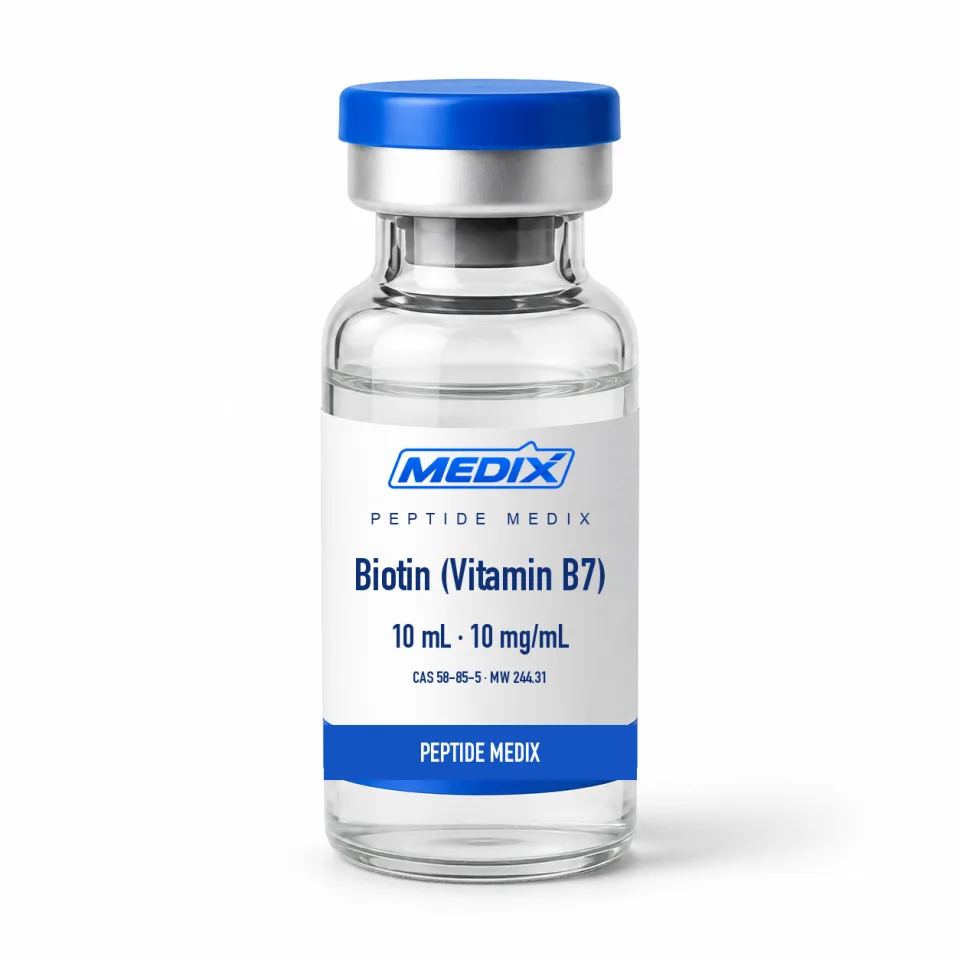
Biotin (vitamin B7) solution, 10 mg/mL, in a 10 mL research vial
In stock1 format availableCAS 58-85-5
€68
This listing is currently unavailable. Contact us and we will tell you when it is back or suggest an equivalent.
Ask about this listing or request its COA- FormClear aqueous solution in a sealed vial
- Mol. weight244.31 g/mol
- Research areasCarboxylase biochemistry, biotinylation and affinity capture, assay interference studies, hair and skin models
For laboratory research use only. Sold exclusively for in-vitro laboratory research by qualified professionals. Not for human or veterinary use, and not a medicine, food, cosmetic or dietary supplement. Terms and Conditions
Overview
Key facts
Biotin — vitamin B7, sometimes called vitamin H — is a bicyclic molecule in which a ureido ring is fused to a tetrahydrothiophene ring bearing a valeric acid side chain.
- CAS number
- 58-85-5
- Molecular formula
- C10H16N2O3S
- Molecular weight
- 244.31 g/mol
- Form
- Clear aqueous solution in a sealed vial
- Storage
- 2–8 °C, protected from light; do not freeze
- Available size
- 10 mL · 10 mg/mL
For research use only. Not for human consumption.
Biotin — vitamin B7, sometimes called vitamin H — is a bicyclic molecule in which a ureido ring is fused to a tetrahydrothiophene ring bearing a valeric acid side chain. The carboxyl group at the end of that chain is where biotin is covalently attached to lysine residues of carboxylase enzymes, creating the biocytin link that lets the vitamin work as a mobile carrier of carboxyl groups.
In mammals biotin is the prosthetic group of five carboxylases: acetyl-CoA carboxylase 1 and 2, which govern fatty acid synthesis and the control of oxidation; pyruvate carboxylase, in gluconeogenesis; propionyl-CoA carboxylase, in the breakdown of odd-chain fatty acids and certain amino acids; and methylcrotonyl-CoA carboxylase, in leucine catabolism. Holocarboxylase synthetase attaches the vitamin and biotinidase recovers it — a cycle investigated in models of inherited metabolic disease.
Outside metabolism, biotin is a cornerstone reagent of molecular biology thanks to its exceptionally strong non-covalent binding to avidin and streptavidin, one of the tightest interactions of its kind. Biotinylation labelling, affinity purification, ELISA detection and a vast range of assay formats rely on it. Supplied as a 10 mg/mL solution in a 10 mL vial, with a COA for each lot.
Specifications
Identity
- CAS number
- 58-85-5
- Molecular formula
- C10H16N2O3S
- Molecular weight
- 244.31 g/mol
Supply & purity
- Form
- Clear aqueous solution in a sealed vial
Additional detail
- Concentration
- 10 mg/mL biotin
- Vial size
- 10 mL
- Also known as
- Vitamin B7, vitamin H, coenzyme R
- Chemical class
- Bicyclic ureido-thiophene water-soluble vitamin
- Enzyme role
- Prosthetic group for acetyl-CoA, pyruvate, propionyl-CoA and methylcrotonyl-CoA carboxylases
- Binding partners
- Avidin and streptavidin, with femtomolar-range dissociation constants
- Research areas
- Carboxylase biochemistry, biotinylation and affinity capture, assay interference studies, hair and skin models
- Storage
- 2–8 °C, protected from light; do not freeze
- Assay note
- Excess free biotin saturates streptavidin capture and can distort immunoassay results
Questions about Biotin (Vitamin B7)
What is biotin?
Biotin (vitamin B7) is a water-soluble bicyclic vitamin serving as the prosthetic group of five carboxylases in mammalian metabolism. It is also the ligand in the biotin–streptavidin system used across molecular biology.
At what concentration is it supplied?
At 10 mg/mL in a 10 mL vial, ready to use without weighing or reconstitution. Because biotin is only moderately soluble in neutral water, a pre-made solution spares you the trouble of dissolving the free-acid powder.
How should the vial be stored?
Refrigerate at 2–8 °C, protect from light and do not freeze. Should crystals form in the cold, letting the vial reach room temperature and mixing gently generally gives a clear solution again before use.
Is each lot tested?
Yes. Every lot comes with its own Certificate of Analysis covering identity, concentration and purity, which you can review before buying to check the material against your acceptance criteria.
Related