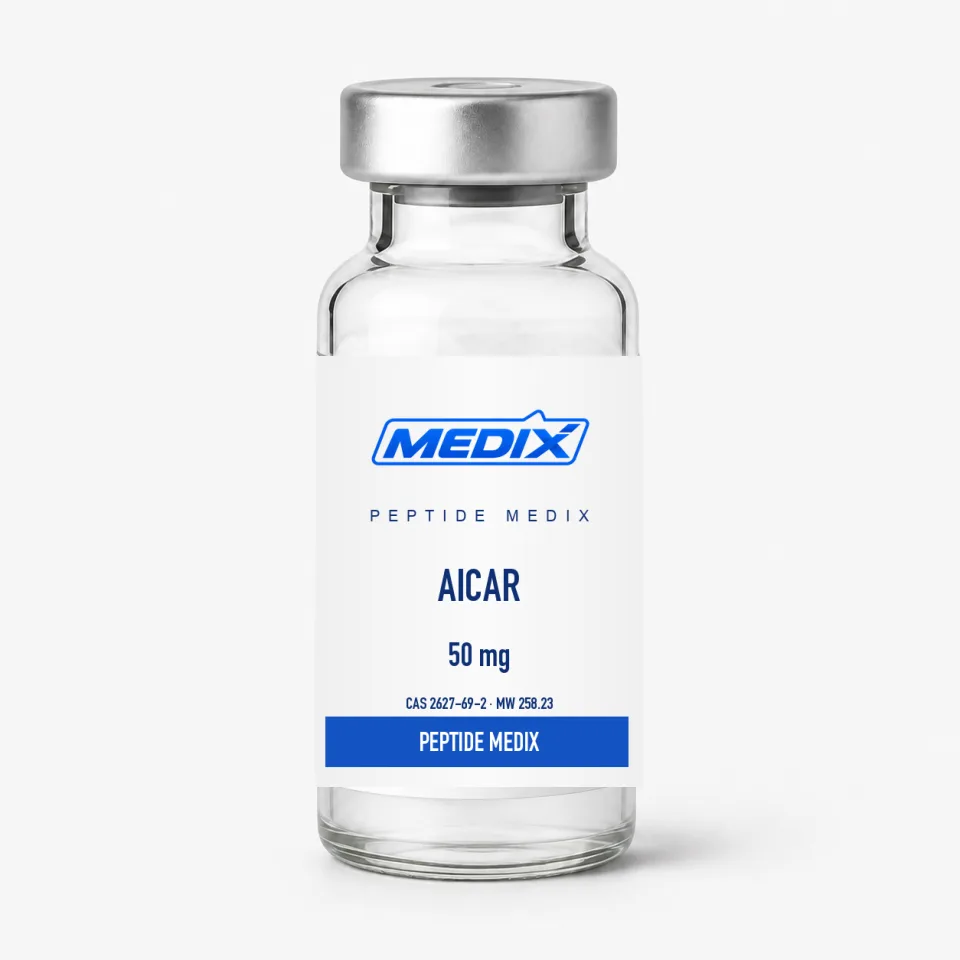
- HPLC purity ≥98%, with a COA for each lot on request
- Certificate of analysis tied to your lot number
- Tracked EU delivery, dispatched the next working day
AICAR
AMP-mimicking AMPK activator (AICA riboside) used as an exercise-mimetic research tool
In stock2 formats availableCAS 2627-69-2
€68Range €68 – €110
This listing is currently unavailable. Contact us and we will tell you when it is back or suggest an equivalent.
Ask about this listing or request its COA- FormLyophilized powder, sealed glass vial
- Mol. weight258.23 g/mol
- Research areasAMPK signalling, GLUT4 translocation and glucose uptake, fatty-acid oxidation, mitochondrial biogenesis, autophagy and mTOR crosstalk
For laboratory research use only. Sold exclusively for in-vitro laboratory research by qualified professionals. Not for human or veterinary use, and not a medicine, food, cosmetic or dietary supplement. Terms and Conditions
Overview
Key facts
AICAR — 5-aminoimidazole-4-carboxamide-1-β-D-ribofuranoside, also known as AICA riboside or acadesine — is a nucleoside, not a peptide.
- CAS number
- 2627-69-2
- Molecular formula
- C9H14N4O5
- Molecular weight
- 258.23 g/mol
- Purity
- ≥98% by HPLC; lot-matched COA available
- Form
- Lyophilized powder, sealed glass vial
- Storage
- −20 °C, sealed and protected from light and moisture
- Available sizes
- 50 mg · 100 mg
For research use only. Not for human consumption.
AICAR — 5-aminoimidazole-4-carboxamide-1-β-D-ribofuranoside, also known as AICA riboside or acadesine — is a nucleoside, not a peptide. It is a small analogue of an intermediate in purine biosynthesis, formula C9H14N4O5, molecular weight 258.23 g/mol. Nucleoside transporters carry it into cells, where adenosine kinase adds a phosphate to give ZMP, a monophosphate that looks structurally like AMP.
This resemblance to AMP is exactly why AICAR is a fixture in the lab. ZMP docks onto the γ-subunit of AMP-activated protein kinase and turns the kinase on even though the cell has plenty of energy, giving researchers a controlled way to trigger AMPK signalling. It has been used to examine glucose uptake, fatty-acid oxidation, mitochondrial biogenesis and mTOR signalling in muscle, liver and fat models, and it is best known from rodent endurance studies that earned it the label “exercise mimetic”.
We supply AICAR as lyophilised powder in a sealed vial; identity and purity are determined by HPLC, and the Certificate of Analysis for each lot can be viewed before you buy. It is sold for laboratory research only and is banned in competitive sport.
Specifications
Identity
- CAS number
- 2627-69-2
- Molecular formula
- C9H14N4O5
- Molecular weight
- 258.23 g/mol
Supply & purity
- Form
- Lyophilized powder, sealed glass vial
- Purity
- ≥98% by HPLC; lot-matched COA available
- Available sizes
- 50 mg, 100 mg
- Solubility
- Soluble in water and aqueous buffers; also soluble in DMSO for concentrated stocks
Handling & storage
- Storage (lyophilized)
- −20 °C, sealed and protected from light and moisture
Additional detail
- Chemical name
- 5-Aminoimidazole-4-carboxamide-1-β-D-ribofuranoside
- Also known as
- AICA riboside, acadesine, AICA-riboside, ZMP precursor
- Compound class
- Purine nucleoside analogue (small molecule, not a peptide)
- Active intracellular species
- ZMP (AICAR 5'-monophosphate), an AMP mimetic
- Molecular target
- AMP-activated protein kinase (AMPK), γ-subunit allosteric site
- Research areas
- AMPK signalling, GLUT4 translocation and glucose uptake, fatty-acid oxidation, mitochondrial biogenesis, autophagy and mTOR crosstalk
- Storage (in solution)
- 2–8 °C short term; aliquot and freeze for longer study windows
Questions about AICAR
What kind of compound is AICAR?
It is 5-aminoimidazole-4-carboxamide riboside, a small nucleoside also referred to as AICA riboside or acadesine. Cells convert it into ZMP, an AMP mimic that switches on AMP-activated protein kinase — which is why it is such a common reagent in AMPK research.
Is AICAR a peptide?
It is not. Although we list it next to metabolic research peptides, AICAR is a nucleoside small molecule, C9H14N4O5, with a molecular weight of 258.23 g/mol. There is no amino acid sequence, and its chemistry is that of a nucleoside.
How do you confirm purity?
Every lot is analysed by HPLC to a purity of 98% or higher and its identity is checked against the expected mass. You can see the Certificate of Analysis for the lot on this page before ordering; it records identity, purity and the complete analytical data.
Which sizes can I buy?
We offer lyophilised vials of 50 mg and 100 mg. The 50 mg size fits pilot dose-response work in cell culture; the 100 mg size is the usual choice for bigger assay series or repeated tissue preparations.
How should AICAR be stored and dissolved?
Store the sealed vial at −20 °C, protected from light and humidity. Because AICAR dissolves readily in water, aqueous buffer suits most preparations; DMSO can be used for concentrated stocks. Keep solutions cold, divide them into aliquots, and log the lot number and date prepared.
Is AICAR prohibited in sport?
Yes. The World Anti-Doping Agency lists AICAR among prohibited metabolic modulators, and validated tests can detect it. Nothing on this page encourages use in sport — the material is supplied solely for laboratory research.
Related