- HPLC purity ≥99%, with a COA for each lot on request
- Certificate of analysis tied to your lot number
- Tracked EU delivery, dispatched the next working day
5-Amino-1MQ
NNMT-blocking small molecule for research on fat-cell and NAD+ metabolism
In stock2 formats availableCAS 42464-96-0
€80Range €80 – €140
This listing is currently unavailable. Contact us and we will tell you when it is back or suggest an equivalent.
Ask about this listing or request its COA- FormLyophilized powder, sealed glass vial with flip-off seal
- Mol. weight159.21 g/mol (cation); 286.11 g/mol (iodide salt)
- Research areasAdipocyte metabolism, NAD-plus salvage, sirtuin signaling, methyl-donor flux
For laboratory research use only. Sold exclusively for in-vitro laboratory research by qualified professionals. Not for human or veterinary use, and not a medicine, food, cosmetic or dietary supplement. Terms and Conditions
Overview
Key facts
Despite its place in a peptide catalogue, 5-Amino-1MQ is a small molecule: it blocks nicotinamide N-methyltransferase (NNMT).
- CAS number
- 42464-96-0
- Molecular formula
- C10H11N2+ cation, supplied as the iodide salt C10H11IN2
- Molecular weight
- 159.21 g/mol (cation); 286.11 g/mol (iodide salt)
- Purity
- ≥99% by HPLC; lot-matched COA available
- Form
- Lyophilized powder, sealed glass vial with flip-off seal
- Available sizes
- 50 mg · 100 mg
For research use only. Not for human consumption.
Despite its place in a peptide catalogue, 5-Amino-1MQ is a small molecule: it blocks nicotinamide N-methyltransferase (NNMT). That enzyme moves a methyl group from S-adenosylmethionine onto nicotinamide, yielding 1-methylnicotinamide — a step that spends a methyl donor and, at the same time, removes nicotinamide that could have been recycled into NAD-plus. NNMT is strongly upregulated in the fat tissue of obese animal models, so inhibiting it is the natural experiment for asking whether this methylation flux actively drives sluggish metabolism or simply accompanies it.
Chemically it is a quinolinium compound delivered as the iodide salt, and its permanent positive charge is what governs handling and study design. Most published studies use cultured adipocytes, reading out intracellular NAD-plus, sirtuin activity, lipolysis and mitochondrial respiration once NNMT is inhibited; others use diet-induced obese rodents and track fat-pad weight alongside metabolic markers. Labs also reach for it as a tool compound whenever the contribution of NNMT in a particular tissue has not yet been pinned down.
What sets this listing apart
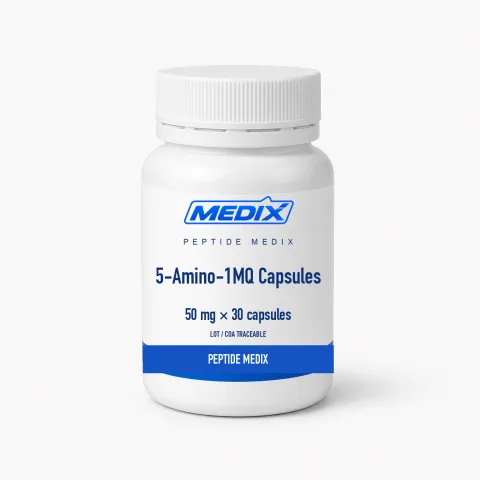
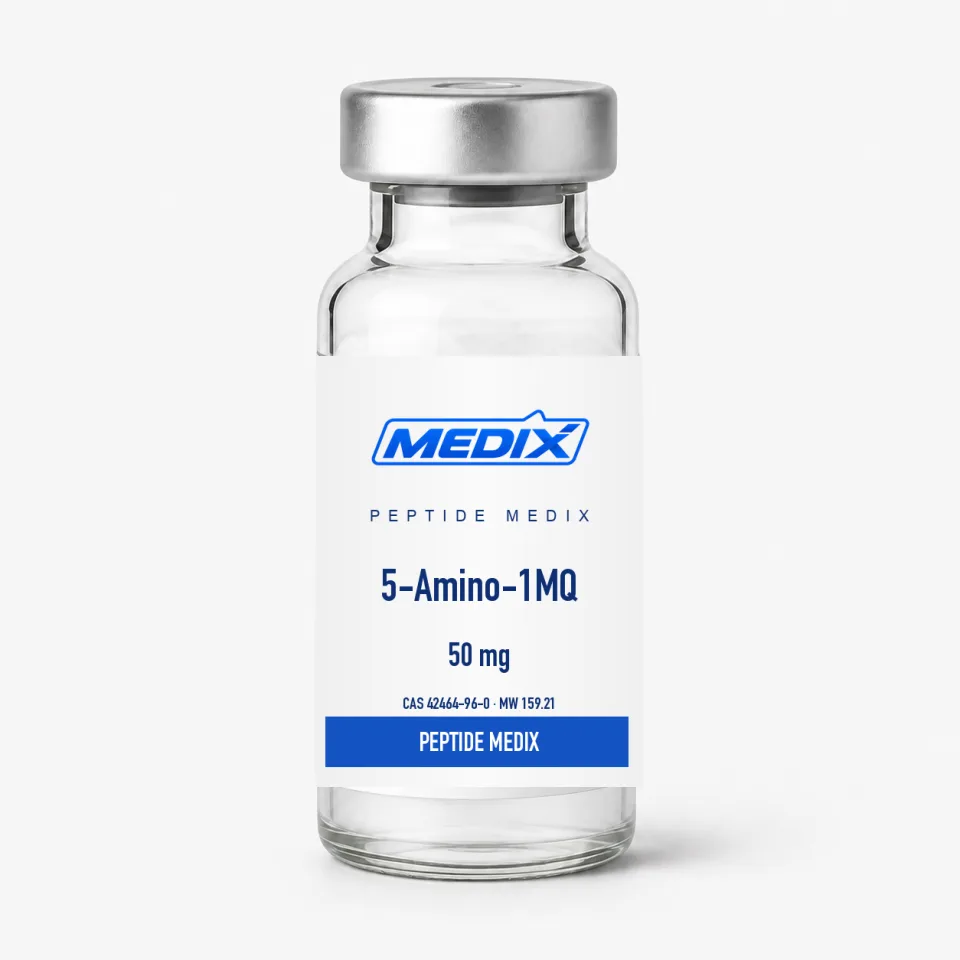
5-Amino-1MQ – vial, 50/100 mg. Lyophilized powder, sealed glass vial with flip-off seal. Other 5-Amino-1MQ listings differ in format, fill or combination partners; the specification and COA always refer to the listing you order.
Same compound, other listings
Specifications
Identity
- CAS number
- 42464-96-0
- Molecular formula
- C10H11N2+ cation, supplied as the iodide salt C10H11IN2
- Molecular weight
- 159.21 g/mol (cation); 286.11 g/mol (iodide salt)
Supply & purity
- Form
- Lyophilized powder, sealed glass vial with flip-off seal
- Purity
- ≥99% by HPLC; lot-matched COA available
- Available sizes
- 50 mg, 100 mg
- Solubility
- Water and bacteriostatic water; DMSO used for concentrated stocks in cell assays
Additional detail
- Compound class
- Small-molecule quinolinium NNMT inhibitor
- Molecular target
- Nicotinamide N-methyltransferase (NNMT)
- Research areas
- Adipocyte metabolism, NAD-plus salvage, sirtuin signaling, methyl-donor flux
- Storage (solid)
- −20 °C, sealed and protected from light and moisture
- Storage (in solution)
- 2–8 °C, protected from light; use within the study window
Questions about 5-Amino-1MQ
Is 5-Amino-1MQ actually a peptide?
No. It is a quinolinium small molecule whose job is to inhibit NNMT. We list it among the metabolic research compounds because of the questions it is used to answer, yet structurally it shares nothing with the peptide sequences elsewhere in the range.
Why does the specification show two molecular weights?
The quinolinium cation — the active part — weighs 159.21 g/mol, whereas the powder you receive is the iodide salt at 286.11 g/mol. Any molar calculation has to include the counter-ion, so both values are printed on the spec sheet.
Which purity data and paperwork come with it?
Each lot is assayed by HPLC to a minimum of 99%, and its certificate of analysis can be requested at any time. That COA carries the same lot number as the vial you receive, keeping the analytical record traceable to the exact material on your bench.
How do researchers show that NNMT is really inhibited?
The usual approach is to quantify 1-methylnicotinamide, the enzyme's own product, or to run an NNMT knockdown arm for comparison. Changes further downstream, such as NAD-plus or lipolysis, cannot by themselves prove the enzyme was hit.
What are the storage conditions?
Store the unopened solid at −20 °C, shielded from light and humidity. Once dissolved, keep it at 2–8 °C in the dark and use it inside the window your protocol documents. Split stocks into aliquots to avoid warming the same tube again and again.
Related