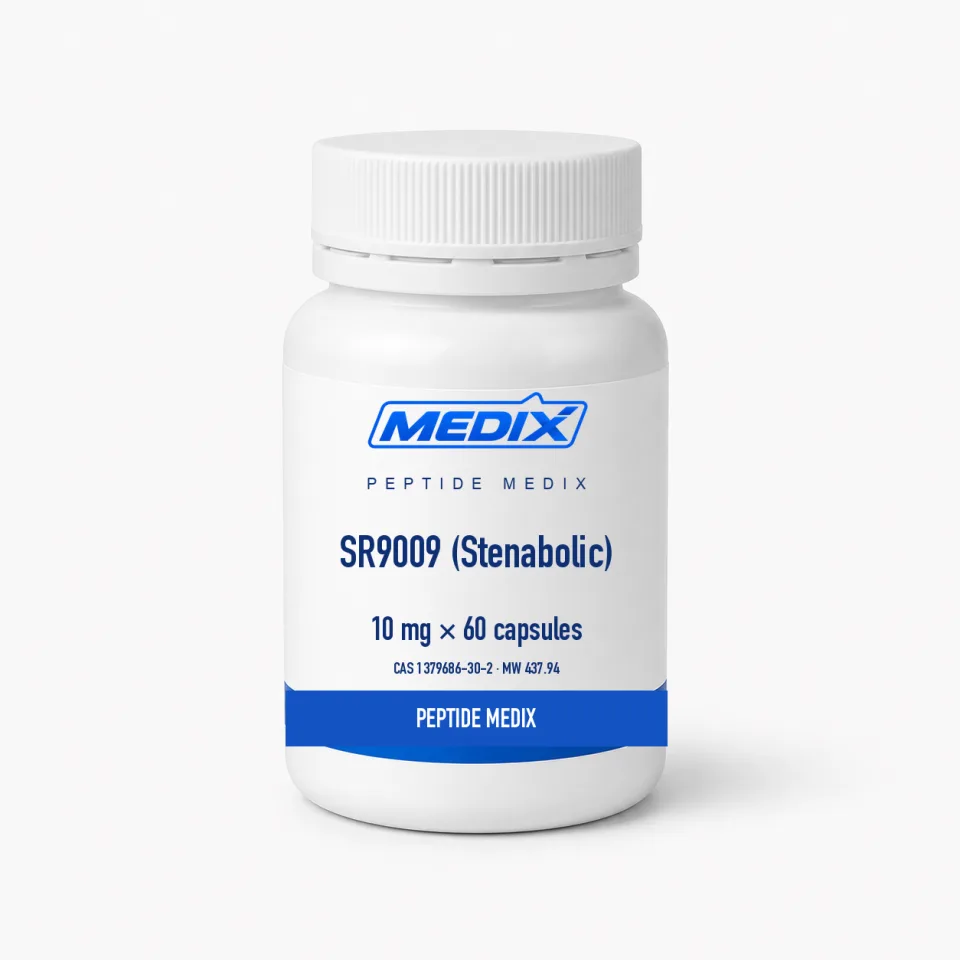
- Purity and identity checked by HPLC; per-lot COA on request
- Certificate of analysis tied to your lot number
- Tracked EU delivery, dispatched the next working day
Metabolic & Circadian Compounds
SR9009 (Stenabolic)
Synthetic Rev-Erb agonist researched in circadian and metabolic models
In stock2 formats availableCAS 1379686-30-2
€55Range €55 – €68
This listing is currently unavailable. Contact us and we will tell you when it is back or suggest an equivalent.
Ask about this listing or request its COA- Mol. weight437.94 g/mol
- Research areasCircadian gene expression, mitochondrial biogenesis, lipid and glucose handling, macrophage inflammatory signalling
For laboratory research use only. Sold exclusively for in-vitro laboratory research by qualified professionals. Not for human or veterinary use, and not a medicine, food, cosmetic or dietary supplement. Terms and Conditions
Overview
Key facts
SR9009 — often sold under the name Stenabolic — contains no peptide.
- CAS number
- 1379686-30-2
- Molecular formula
- C20H24ClN3O4S
- Molecular weight
- 437.94 g/mol
- Purity
- HPLC tested for purity and identity; lot-matched COA available
- Storage
- Cool, dry, dark; solution refrigerated and tightly capped
- Available sizes
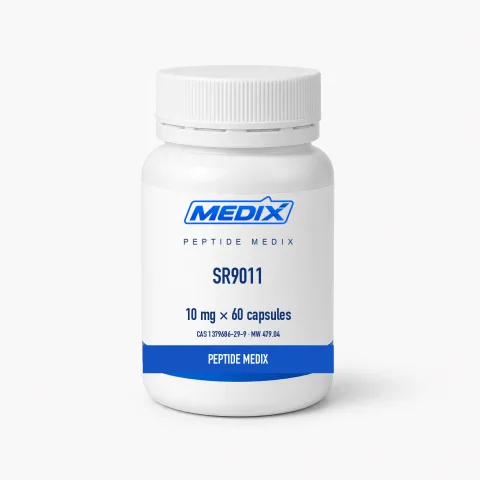
- 10 mg · 60 capsules · 30 mL liquid · 20 mg/mL
For research use only. Not for human consumption.
SR9009 — often sold under the name Stenabolic — contains no peptide. It is a lab-made small molecule designed to switch on two nuclear receptors, REV-ERBα (gene NR1D1) and REV-ERBβ (gene NR1D2). These receptors bind heme and act as brakes on gene activity at the heart of the circadian clock, tying the cell's time-keeping to genes that control how it handles fats and sugar, how many mitochondria it makes and how it signals inflammation.
Its reputation rests on rodent studies in which Rev-Erb activation changed metabolic measures and mitochondrial gene expression — the origin of its popular but loose label “exercise mimetic”. The published pharmacology has significant caveats: mouse pharmacokinetic data show poor oral bioavailability, and later research suggests some of its cellular effects occur without Rev-Erb receptors, so the target cannot be inferred from the phenotype alone.
SR9009 is not an approved medicine anywhere, is not a food supplement, and is banned in sport by the World Anti-Doping Agency as a hormone and metabolic modulator. Peptide Medix EU offers it as 10 mg capsules (60 per bottle) and as 30 mL of liquid at 20 mg/mL, HPLC-tested with a certificate of analysis for each lot.
Specifications
Identity
- CAS number
- 1379686-30-2
- Molecular formula
- C20H24ClN3O4S
- Molecular weight
- 437.94 g/mol
Supply & purity
- Purity
- HPLC tested for purity and identity; lot-matched COA available
Additional detail
- Compound class
- Synthetic small molecule; nuclear receptor (Rev-Erb) agonist — not a peptide
- Molecular targets
- REV-ERBα (NR1D1) and REV-ERBβ (NR1D2)
- Also known as
- Stenabolic, SR-9009
- Available formats
- 10 mg × 60 capsules; 30 mL solution at 20 mg/mL
- Mechanistic role
- Enhances Rev-Erb transcriptional repression within the core circadian feedback loop
- Research areas
- Circadian gene expression, mitochondrial biogenesis, lipid and glucose handling, macrophage inflammatory signalling
- Reported pharmacokinetics
- Low oral bioavailability and short half-life reported in mouse studies
- Regulatory status
- Not approved as a medicine; not a dietary supplement; WADA-prohibited in sport
- Storage
- Cool, dry, dark; solution refrigerated and tightly capped
Questions about SR9009 (Stenabolic)
Is SR9009 a peptide or a SARM?
It's neither. SR9009 is a small synthetic molecule that acts on Rev-Erb receptors, which form part of the body clock. SARMs work on the androgen receptor, and peptides are chains of amino acids; SR9009 is classed with the metabolic modulators.
Why are there concerns about off-target effects?
Published work showed SR9009 still acted in cells missing both Rev-Erb receptors, so at least part of its activity does not run through its nominal target. Studies should therefore include genetic controls rather than assuming every observed change reflects Rev-Erb engagement.
Liquid or capsules — which should I pick?
For in-vitro work, the liquid (20 mg per mL) is easier to dilute accurately, since you simply measure a volume; the capsules (10 mg each) suit designs that need a fixed unit dose. The compound inside is exactly the same.
Related