- Analytical testing on each lot; COA on request
- Certificate of analysis tied to your lot number
- Tracked EU delivery, dispatched the next working day
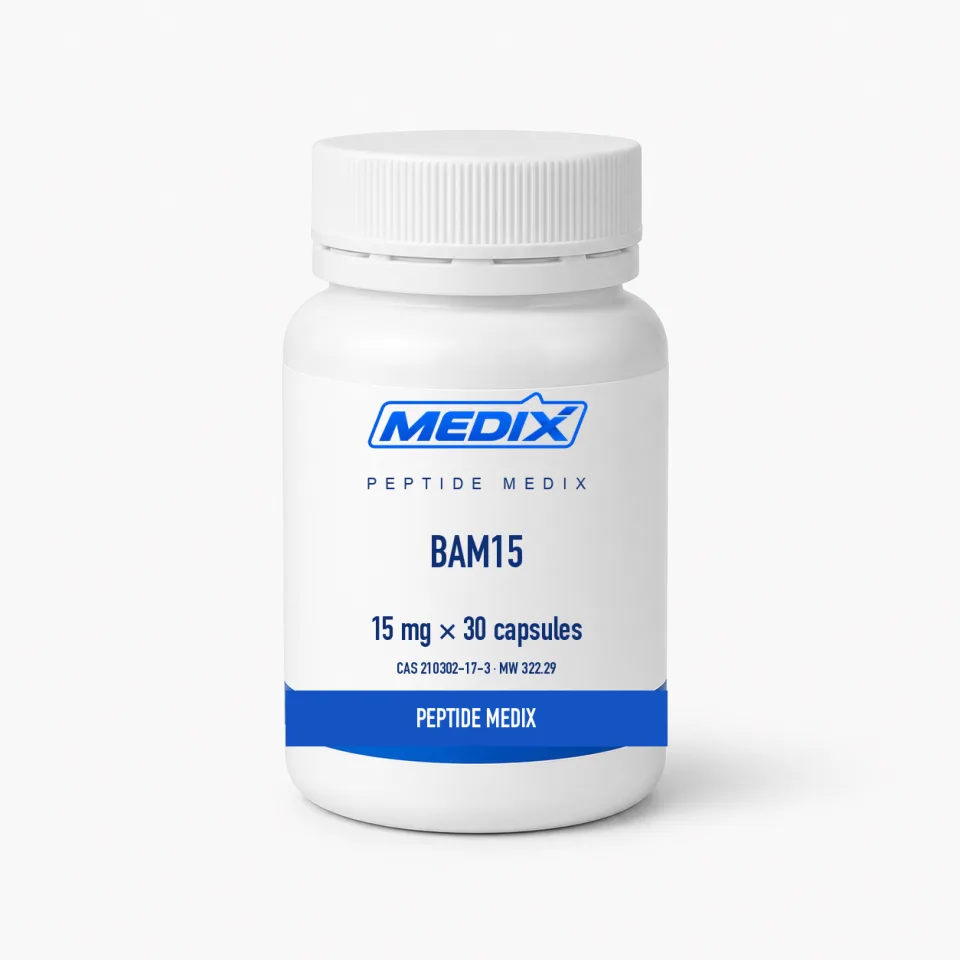
BAM15
Research capsules of a mitochondria-selective protonophore — 15 mg, 30 per bottle
In stock1 format availableCAS 210302-17-3
€85
This listing is currently unavailable. Contact us and we will tell you when it is back or suggest an equivalent.
Ask about this listing or request its COA- FormOral capsule in a sealed bottle with tamper-evident closure
- Mol. weight322.29 g/mol
- Research areasMitochondrial bioenergetics, energy expenditure, diet-induced obesity models, hepatic steatosis models, ischaemia–reperfusion injury
For laboratory research use only. Sold exclusively for in-vitro laboratory research by qualified professionals. Not for human or veterinary use, and not a medicine, food, cosmetic or dietary supplement. Terms and Conditions
Overview
Key facts
BAM15 is an oxadiazolopyrazine small molecule that acts as a mitochondrial protonophore; here it comes as 15 mg capsules, thirty to a sealed bottle.
- CAS number
- 210302-17-3
- Molecular weight
- 322.29 g/mol
- Purity
- Analytically tested; certificate of analysis available
- Form
- Oral capsule in a sealed bottle with tamper-evident closure
- Storage
- Room temperature, sealed, dry and protected from light
- Available size
- 15 mg · 30 capsules
For research use only. Not for human consumption.
BAM15 is an oxadiazolopyrazine small molecule that acts as a mitochondrial protonophore; here it comes as 15 mg capsules, thirty to a sealed bottle. There is no peptide in it. Researchers are interested in it for one mechanistic reason: it ferries protons back through the inner mitochondrial membrane, so part of the proton-motive force is released as heat instead of powering ATP synthase. Fuel is still oxidised, but less ATP is made per unit of substrate — which is precisely what chemical uncoupling means.
Every experiment with uncouplers is shaped by how strongly their effect depends on concentration. Gentle uncoupling increases respiration and reduces mitochondrial membrane potential without collapsing it, whereas too much uncoupling stops ATP synthesis entirely — so titrating concentration against a measured oxygen consumption rate belongs to basic characterisation, not to optional fine-tuning. What sets this compound apart from older protonophores is its reported selectivity: it depolarises the inner mitochondrial membrane at concentrations that largely spare the plasma-membrane potential. Published models cover diet-induced obesity, fatty liver and ischaemia–reperfusion injury. The capsules lock the content at 15 mg across the thirty-count bottle and do not need cold-chain transport; for in-vitro work, start from a DMSO stock, because the compound dissolves poorly in water.
What sets this listing apart
BAM15 – capsules, 15 mg. Oral capsule in a sealed bottle with tamper-evident closure. Other BAM15 listings differ in format, fill or combination partners; the specification and COA always refer to the listing you order.
Same compound, other listings
Specifications
Identity
- CAS number
- 210302-17-3
- Molecular weight
- 322.29 g/mol
Supply & purity
- Form
- Oral capsule in a sealed bottle with tamper-evident closure
- Purity
- Analytically tested; certificate of analysis available
- Solubility
- Poorly water soluble; DMSO is the usual solvent for in vitro stock preparation
Additional detail
- Content per capsule
- 15 mg BAM15
- Available size
- 30 capsules
- Chemical class
- Oxadiazolopyrazine (furazano-pyrazine) diamine — small molecule, non-peptide
- Mechanism studied
- Protonophore; transports protons across the inner mitochondrial membrane, uncoupling respiration from ATP synthesis
- Selectivity note
- Reported to depolarise mitochondrial but not plasma membrane at comparable concentrations
- Research areas
- Mitochondrial bioenergetics, energy expenditure, diet-induced obesity models, hepatic steatosis models, ischaemia–reperfusion injury
- Storage
- Room temperature, sealed, dry and protected from light
- Preparation required
- None — fixed unit content, no reconstitution step
Questions about BAM15
What does BAM15 do at the molecular level?
It carries protons across the inner mitochondrial membrane by a route that bypasses ATP synthase. Part of the gradient built by the electron transport chain is lost as heat, so oxygen use goes up while ATP yield per unit of fuel goes down. This is chemical uncoupling, which studies quantify as a rise in oxygen consumption rate.
In what way does it differ from DNP?
Both are protonophores, but published characterisation reports that BAM15 is selective for mitochondria — it depolarises the inner mitochondrial membrane at concentrations that largely leave plasma-membrane potential untouched — while DNP affects both. DNP is known to have caused fatal hyperthermia and is unsuitable as a reference compound in whole-animal studies.
Is a certificate of analysis available?
Yes. The material undergoes analytical testing, and a certificate for your lot covering identity and purity of the compound in the capsules can be requested. Please quote the lot number shown on the bottle label.
How do I store the capsules?
Keep them sealed at room temperature in a dry place, away from direct light and heat. Unlike lyophilised peptides, this compound needs neither a freezer nor cold-chain shipping. Close the bottle between uses and note the date it was first opened.