- HPLC-assayed purity of ≥99%
- Certificate of analysis tied to your lot number
- Tracked EU delivery, dispatched the next working day
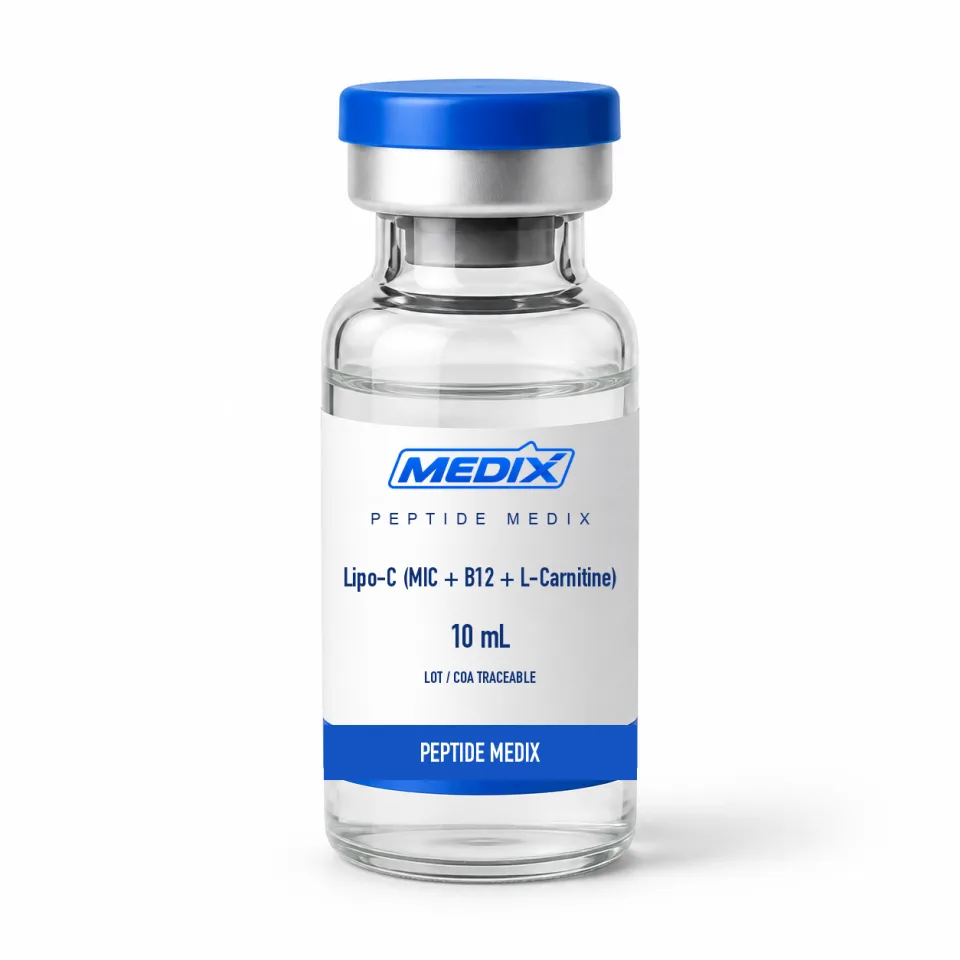
Lipo-C (MIC + B12 + L-Carnitine)
Lipotropic solution of MIC, vitamin B12 and L-carnitine in 10 mL and 30 mL vials
In stock2 formats available
€38Range €38 – €80
This listing is currently unavailable. Contact us and we will tell you when it is back or suggest an equivalent.
Ask about this listing or request its COA- Research areasFatty-acid oxidation, mitochondrial substrate transport, one-carbon metabolism
For laboratory research use only. Sold exclusively for in-vitro laboratory research by qualified professionals. Not for human or veterinary use, and not a medicine, food, cosmetic or dietary supplement. Terms and Conditions
Overview
Key facts
What changes the biochemistry of this mixture is L-carnitine, the essential carrier of the carnitine shuttle.
- Storage
- 2–8 °C, protected from light; cobalamin is photosensitive
- Available sizes
- 10 mL · 30 mL
For research use only. Not for human consumption.
What changes the biochemistry of this mixture is L-carnitine, the essential carrier of the carnitine shuttle. On the outer mitochondrial membrane, carnitine palmitoyltransferase 1 turns long-chain acyl-CoA into acylcarnitine; a translocase carries it through the inner membrane; and inside the matrix CPT2 rebuilds acyl-CoA for beta-oxidation. Without this shuttle, long-chain fatty acids never reach the place where they are burned — so carnitine sits at a step that genuinely influences rate, not a side step.
Surrounding the carnitine is the same methyl-donor base found in Lipo-B: methionine as the source of S-adenosylmethionine, choline for phosphatidylcholine and hence for export of liver triglycerides, inositol as the backbone of phosphatidylinositol signalling lipids, and cyanocobalamin as the precursor of methionine synthase's cofactor. Chemically, carnitine resembles none of these four — it is a small zwitterionic quaternary ammonium compound, neither amino acid nor vitamin — which is why the two formulas are normally run as parallel arms rather than as two strengths of one product. The 10 mL and 30 mL fills contain identical solution. Its deep pink comes from the light-sensitive cobalamin, so noticeable fading is a practical sign that a vial has been exposed to light.
What sets this listing apart
Lipo-C (MIC + B12 + L-Carnitine) – vial, 10/30 mL. Other Lipo-C listings differ in format, fill or combination partners; the specification and COA always refer to the listing you order.
Same compound, other listings
Specifications
Supply & purity
- Available sizes
- 10 mL, 30 mL
Additional detail
- Composition
- Methionine, inositol, choline (MIC), cyanocobalamin (vitamin B12) and L-carnitine
- Product class
- Lipotropic nutrient solution with carnitine (non-peptide)
- Appearance
- Clear deep pink to red solution; colour derives from cobalamin
- L-carnitine
- Quaternary ammonium compound; carrier in the CPT1/CPT2 mitochondrial fatty-acid shuttle
- Methionine
- Essential sulfur amino acid; precursor of S-adenosylmethionine
- Inositol
- Carbocyclic sugar; backbone of phosphatidylinositol signaling lipids
- Choline
- Quaternary ammonium nutrient; required for phosphatidylcholine synthesis
- Cyanocobalamin
- Cobalt corrinoid form of vitamin B12; cofactor precursor for methionine synthase
- Research areas
- Fatty-acid oxidation, mitochondrial substrate transport, one-carbon metabolism
- Storage
- 2–8 °C, protected from light; cobalamin is photosensitive
Questions about Lipo-C (MIC + B12 + L-Carnitine)
What does Lipo-C have that Lipo-B lacks?
L-carnitine. Lipo-B contains methionine, inositol, choline and vitamin B12; Lipo-C adds carnitine, which transports long-chain fatty acids across the inner mitochondrial membrane so they can be oxidised.
Why is carnitine of mechanistic interest?
It controls an unavoidable step: long-chain acyl-CoA can only enter mitochondria after CPT1 converts it to acylcarnitine, and malonyl-CoA inhibits CPT1 — linking fatty-acid oxidation to whether the cell is fed or fasting.
Will extra carnitine always boost fat oxidation?
No. The effect is obvious in carnitine-deficient systems, but where tissue carnitine is sufficient the shuttle rarely limits the rate. Rigorous studies measure baseline carnitine and acylcarnitine profiles before interpreting any change.
What are the storage requirements?
Refrigerate at 2–8 °C, protect from light and never freeze. As the cobalamin is light-sensitive, leave the vial in its carton or another dark container and write down the date it was first punctured.
Related