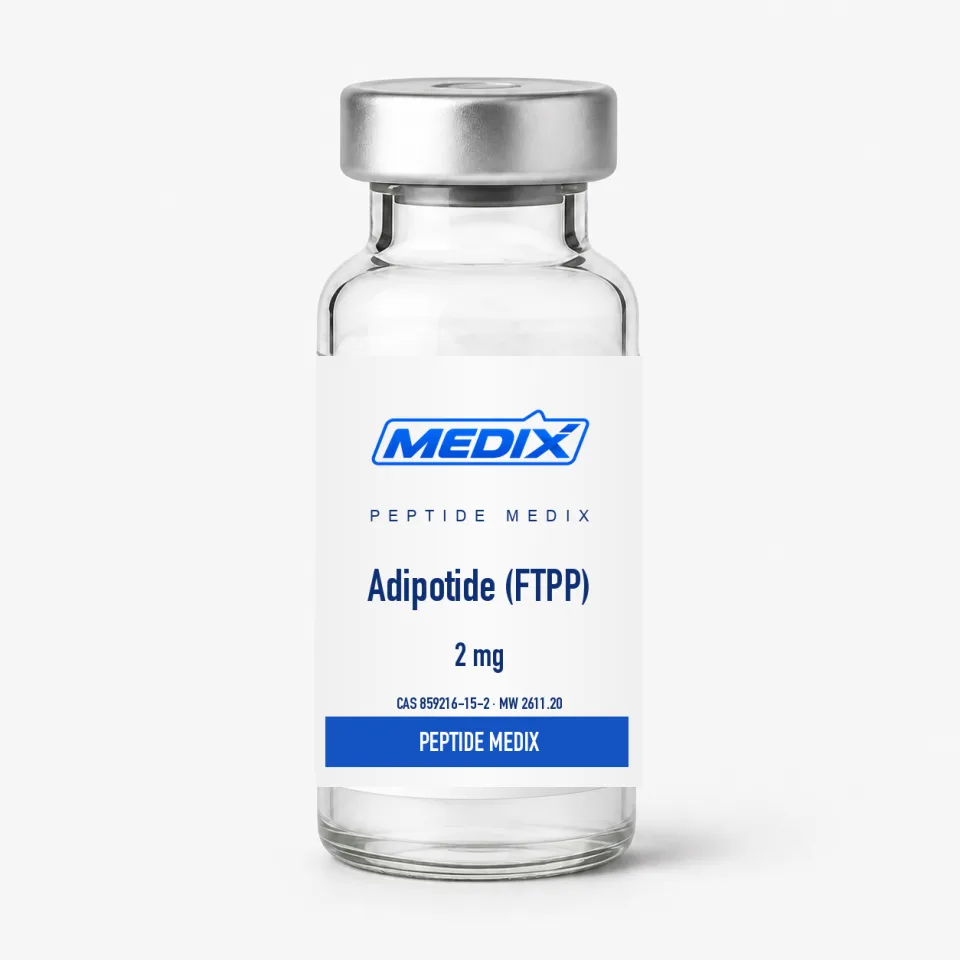
- HPLC purity ≥99%, with a COA for each lot on request
- Certificate of analysis tied to your lot number
- Tracked EU delivery, dispatched the next working day
Adipotide (FTPP)
FTPP peptidomimetic conjugate used in models targeting fat-tissue blood vessels
In stock2 formats availableCAS 859216-15-2
€97Range €97 – €191
This listing is currently unavailable. Contact us and we will tell you when it is back or suggest an equivalent.
Ask about this listing or request its COA- FormLyophilized powder in a sealed glass vial
- Mol. weight≈2611.20 g/mol (trifluoroacetate salt content varies by lot)
- Research areasAdipose vascular targeting, ligand-directed peptide delivery, prohibitin biology, tumour-homing constructs
For laboratory research use only. Sold exclusively for in-vitro laboratory research by qualified professionals. Not for human or veterinary use, and not a medicine, food, cosmetic or dietary supplement. Terms and Conditions
Overview
Key facts
Adipotide — also called FTPP, short for fat-targeted proapoptotic peptide — is a synthetic peptidomimetic in which two functional modules are fused into one molecule.
- CAS number
- 859216-15-2
- Molecular weight
- ≈2611.20 g/mol (trifluoroacetate salt content varies by lot)
- Purity
- ≥99% by HPLC; lot-matched COA available
- Form
- Lyophilized powder in a sealed glass vial
- Storage
- −20 °C, sealed and protected from light and moisture
- Available sizes
- 2 mg · 5 mg
For research use only. Not for human consumption.
Adipotide — also called FTPP, short for fat-targeted proapoptotic peptide — is a synthetic peptidomimetic in which two functional modules are fused into one molecule. The first is a cyclic nine-residue homing sequence, CKGGRAKDC, found by phage-display screening to bind a prohibitin-1 / annexin A2 complex described on endothelial cells of white fat. The second is D(KLAKLAK)2, an amphipathic stretch made of D-amino acids that damages mitochondrial membranes after entering a cell. The literature frames the concept as a targeting address plus a payload: selectivity for the vasculature comes from the homing motif, activity from the effector domain.
The effector module deserves a closer look. Built wholly from D-amino acids, D(KLAKLAK)2 resists proteases yet keeps its activity, since membrane disruption relies on its amphipathic helix and not on stereospecific receptor binding; it does little outside cells and only acts after internalisation, which is why it works as a payload. Studies with the conjugate include phage-display mapping of the homing sequence, prohibitin biology and rodent models of fat-vessel targeting, as well as the broader tumour-homing research from which this design approach originated. Vials contain 2 mg or 5 mg, and the nominal mass of about 2611 g/mol varies with the lot-dependent trifluoroacetate content — something to factor into molar calculations.
Specifications
Identity
- CAS number
- 859216-15-2
- Molecular weight
- ≈2611.20 g/mol (trifluoroacetate salt content varies by lot)
Supply & purity
- Form
- Lyophilized powder in a sealed glass vial
- Purity
- ≥99% by HPLC; lot-matched COA available
- Available sizes
- 2 mg, 5 mg
- Solubility
- Sterile or bacteriostatic water; dilute buffers are commonly used for working solutions
Handling & storage
- Storage (lyophilized)
- −20 °C, sealed and protected from light and moisture
- Storage (reconstituted)
- 2–8 °C for short-term use; aliquot and freeze at −20 °C for longer holds
Additional detail
- Construct
- CKGGRAKDC-GG-D(KLAKLAK)2 — cyclic homing motif joined through a glycine linker to a pro-apoptotic domain
- Compound class
- Chimeric peptidomimetic (vascular-homing peptide plus membrane-disrupting effector)
- Homing motif
- CKGGRAKDC, reported to recognise a prohibitin-1 / annexin A2 complex on white adipose endothelium
- Effector domain
- D(KLAKLAK)2, an amphipathic D-amino acid sequence that perturbs mitochondrial membranes
- Research areas
- Adipose vascular targeting, ligand-directed peptide delivery, prohibitin biology, tumour-homing constructs
Questions about Adipotide (FTPP)
What is Adipotide (FTPP)?
A synthetic peptidomimetic joining the cyclic CKGGRAKDC homing sequence to a D(KLAKLAK)2 domain that disrupts membranes. Published work describes it as an experimental means of steering a cytotoxic effector toward the blood vessels of white adipose tissue.
Does Adipotide belong with GLP-1 or fat-loss peptides?
No. It has no activity at the GLP-1 receptor and does not work through lipolysis pathways. Its rationale is vascular targeting via prohibitin, so mechanistically it is unrelated to incretin analogues or growth-hormone fragments, even though it is shelved in similar research categories.
Which purity level and documents are provided?
Each lot is purified to ≥99% by HPLC and released with its own certificate of analysis covering purity and identity. Send us the lot number from your vial and we will email the matching COA as a PDF.
Which vial sizes can I order?
Adipotide comes as lyophilised vials of 2 mg or 5 mg. Both are sealed glass vials, dispatched from our EU warehouse, with the lot number printed on each label.
How should I store it?
Store the lyophilised powder at −20 °C, tightly sealed and protected from light and humidity. After reconstitution, keep the solution at 2–8 °C for short-term use, or aliquot and freeze at −20 °C to avoid thawing the same material repeatedly.
Can I order Adipotide for personal use?
No. It is sold as a research reagent for laboratory use only and is not a supplement, medicine or cosmetic product.
Related