- HPLC-assayed purity of ≥99%
- Certificate of analysis tied to your lot number
- Tracked EU delivery, dispatched the next working day
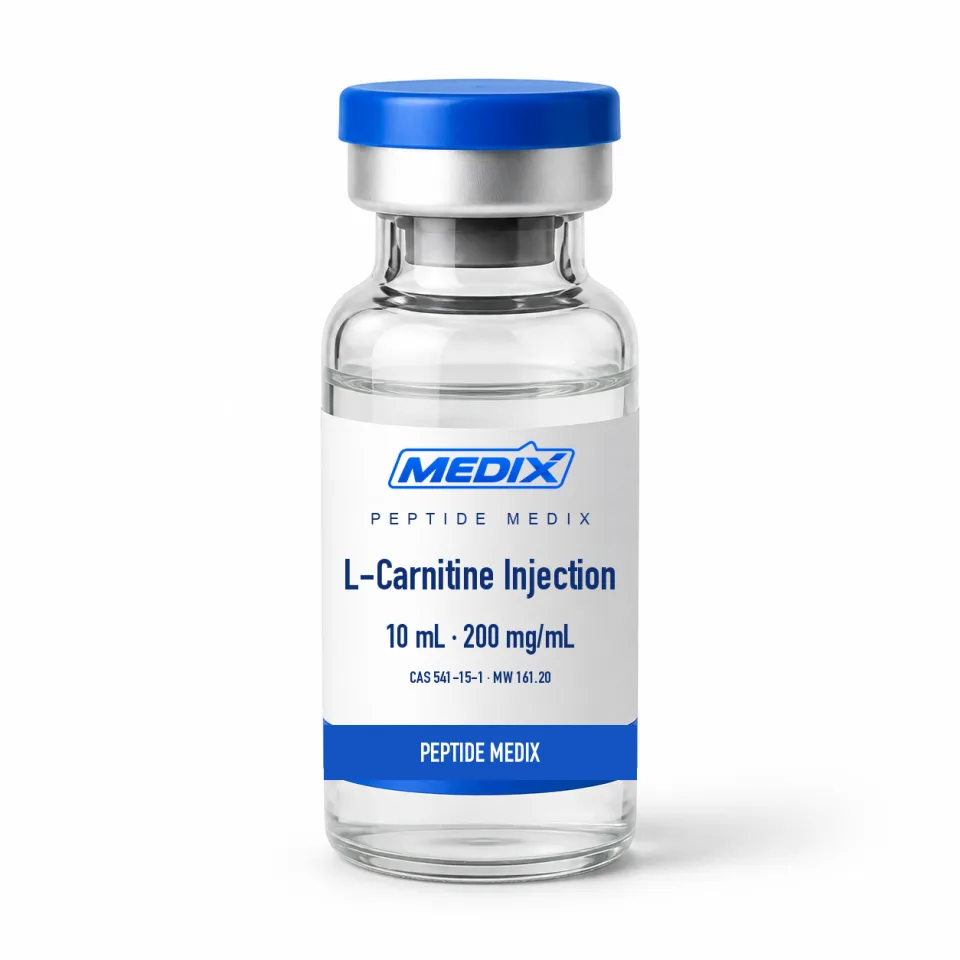
L-Carnitine Injection
200 mg/mL levocarnitine solution for studies of mitochondrial fatty-acid transport
In stock2 formats availableCAS 541-15-1 (L-carnitine)
€38Range €38 – €76
This listing is currently unavailable. Contact us and we will tell you when it is back or suggest an equivalent.
Ask about this listing or request its COA- Mol. weight161.20 g/mol
- Research areasFatty-acid beta-oxidation, acylcarnitine profiling, mitochondrial bioenergetics, exercise-metabolism models
For laboratory research use only. Sold exclusively for in-vitro laboratory research by qualified professionals. Not for human or veterinary use, and not a medicine, food, cosmetic or dietary supplement. Terms and Conditions
Overview
Key facts
The body makes L-carnitine, a small quaternary ammonium molecule, from lysine and methionine.
- CAS number
- 541-15-1 (L-carnitine)
- Molecular formula
- C7H15NO3
- Molecular weight
- 161.20 g/mol
- Storage
- 15–25 °C, protected from light; refrigeration acceptable, do not freeze
- Available sizes
- 10 mL · 200 mg/mL · 30 mL · 200 mg/mL
For research use only. Not for human consumption.
The body makes L-carnitine, a small quaternary ammonium molecule, from lysine and methionine. It carries a hydroxyl group and a carboxylate, and these allow it to form reversible esters with fatty acyl chains — the chemistry behind the carnitine shuttle. Long-chain fatty acids cannot pass the inner mitochondrial membrane as CoA thioesters; carnitine palmitoyltransferase 1 therefore moves the acyl group onto carnitine, a translocase ferries the resulting acylcarnitine inside, and CPT2 returns the acyl group to coenzyme A for beta-oxidation. Biological activity belongs to the L-enantiomer only; D-carnitine inhibits the system and is not used in research material.
What you receive is a ready-to-use aqueous levocarnitine solution at 200 mg/mL, in sealed vials of 10 mL or 30 mL. Having it in solution spares labs doing metabolic, mitochondrial or acylcarnitine-profiling work the weighing and dissolving steps, and it follows the same concentration convention as compounded lipotropic formulas that pair carnitine with MIC nutrients and B12.
Specifications
Identity
- CAS number
- 541-15-1 (L-carnitine)
- Molecular formula
- C7H15NO3
- Molecular weight
- 161.20 g/mol
Supply & purity
- Available sizes
- 10 mL (2 g total), 30 mL (6 g total)
- Solubility
- Freely water soluble; the solid is strongly hygroscopic
Additional detail
- Concentration
- 200 mg/mL levocarnitine
- Chemical class
- Quaternary ammonium betaine; zwitterionic at physiological pH
- Stereochemistry
- L-enantiomer only — the D-form is biologically inactive
- Biochemical role
- Acyl-group carrier in the CPT1 / CACT / CPT2 mitochondrial shuttle
- Research areas
- Fatty-acid beta-oxidation, acylcarnitine profiling, mitochondrial bioenergetics, exercise-metabolism models
- Storage
- 15–25 °C, protected from light; refrigeration acceptable, do not freeze
- Documentation
- Lot-matched COA reporting identity and concentration
Questions about L-Carnitine Injection
Which concentration and volumes are available?
Both sizes contain levocarnitine at 200 mg/mL in water: 2 g in total in the 10 mL vial, 6 g in the 30 mL vial. Concentration is checked for each lot and stated on the certificate of analysis accompanying the batch.
Why a solution instead of powder?
Solid L-carnitine is highly hygroscopic and absorbs moisture from the air while you weigh it, building a concentration error into every dilution that follows. A pre-made, lot-verified solution eliminates that variable and saves a preparation step in metabolic assays.
Do you provide a certificate of analysis?
Yes — every lot is accompanied by a COA giving identity and measured concentration. Quote the lot number to request a copy and keep it with your records so you can report the material grade with your results.
What is the connection to Lipo-C?
Lipo-C is a compounded lipotropic formula containing methionine, inositol and choline plus vitamin B12 and L-carnitine. This listing is carnitine on its own — the format labs choose when carnitine itself, not a mixture, is the variable under study.
May it be given to humans or animals?
No. It is supplied exclusively for laboratory research and, as sold, is not a medicine, supplement or veterinary product.
Related