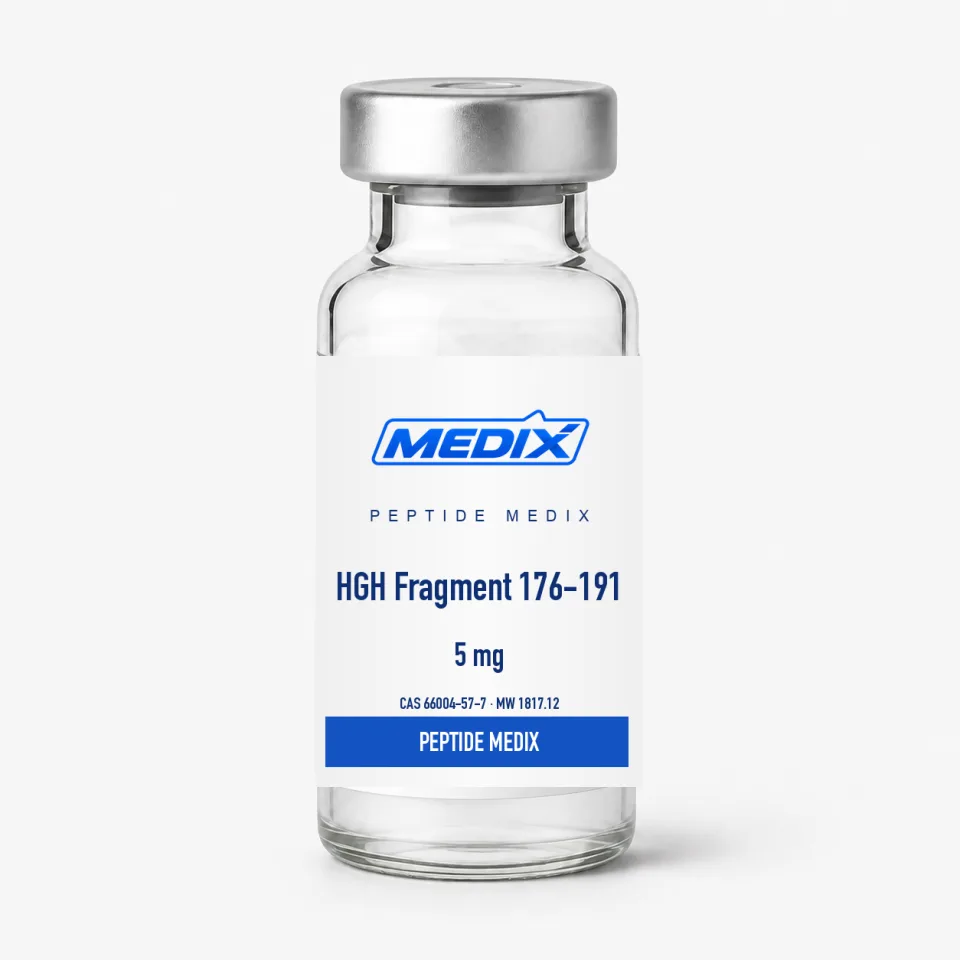
- HPLC purity ≥99%, with a COA for each lot on request
- Certificate of analysis tied to your lot number
- Tracked EU delivery, dispatched the next working day
HGH Fragment 176-191
16-residue C-terminal fragment of human growth hormone
In stock2 formats availableCAS 66004-57-7
€55Range €55 – €97
This listing is currently unavailable. Contact us and we will tell you when it is back or suggest an equivalent.
Ask about this listing or request its COA- FormLyophilized powder, sealed glass vial with flip-off seal
- Mol. weight1817.12 g/mol
- Research areasAdipocyte lipolysis, lipogenesis, growth hormone structure-function studies
For laboratory research use only. Sold exclusively for in-vitro laboratory research by qualified professionals. Not for human or veterinary use, and not a medicine, food, cosmetic or dietary supplement. Terms and Conditions
Overview
Key facts
HGH Fragment 176-191 is a synthetic 16-amino-acid peptide reproducing the C-terminal end of human growth hormone, named after its position within the parent molecule.
- CAS number
- 66004-57-7
- Molecular formula
- C78H125N23O23S2
- Molecular weight
- 1817.12 g/mol
- Amino acid sequence
- Tyr-Leu-Arg-Ile-Val-Gln-Cys-Arg-Ser-Val-Glu-Gly-Ser-Cys-Gly-Phe
- Purity
- ≥99% by HPLC; lot-matched COA available
- Form
- Lyophilized powder, sealed glass vial with flip-off seal
- Storage
- −20 °C, sealed and protected from light and moisture
- Available sizes
- 5 mg · 10 mg
For research use only. Not for human consumption.
HGH Fragment 176-191 is a synthetic 16-amino-acid peptide reproducing the C-terminal end of human growth hormone, named after its position within the parent molecule. Structure–function research on growth hormone in the 1980s and 1990s suggested that the hormone's fat-mobilising activity resides in this region, whereas the domains required for receptor dimerisation and IGF-1 induction lie elsewhere. The isolated fragment allowed researchers to put that separation to a direct test.
It is the unmodified precursor of AOD-9604, which carries an extra N-terminal tyrosine and a stabilising disulfide bridge. As the two differ in whether they are cyclised, labs often test them side by side to see how conformation affects potency and stability. Reported uses focus on adipocyte lipolysis and lipogenesis assays, studies of fat depots in rodents and structure–activity work on growth hormone fragments in general.
Specifications
Identity
- CAS number
- 66004-57-7
- Molecular formula
- C78H125N23O23S2
- Molecular weight
- 1817.12 g/mol
- Amino acid sequence
- Tyr-Leu-Arg-Ile-Val-Gln-Cys-Arg-Ser-Val-Glu-Gly-Ser-Cys-Gly-Phe
- Chain length
- 16 amino acids, hGH numbering 176-191
- Peptide class
- Growth hormone C-terminal fragment
Supply & purity
- Form
- Lyophilized powder, sealed glass vial with flip-off seal
- Purity
- ≥99% by HPLC; lot-matched COA available
- Available sizes
- 5 mg, 10 mg
- Solubility
- Bacteriostatic water; sterile water also reported
Handling & storage
- Storage (lyophilized)
- −20 °C, sealed and protected from light and moisture
- Storage (reconstituted)
- 2–8 °C, protected from light; use within the study window
Additional detail
- Research areas
- Adipocyte lipolysis, lipogenesis, growth hormone structure-function studies
Questions about HGH Fragment 176-191
How does this differ from AOD-9604?
AOD-9604 is the same C-terminal stretch with an extra N-terminal tyrosine plus a Cys7-Cys15 disulfide that holds it in a ring. The plain fragment is linear, which shows up in a different molecular formula and chromatographic behaviour.
Which purity data and documents come with it?
Each lot is HPLC-tested to ≥99% purity with mass spectrometry confirming identity, and its certificate of analysis is available. The COA refers to the vial number you receive, so the data are traceable to that exact material.
Why is it named with residue numbers?
The numbers mark positions 176 to 191 of the 191-amino-acid human growth hormone chain. Naming it by these coordinates shows precisely which part of the hormone the peptide reproduces.
Do the cysteines call for special care?
Yes. Its two cysteines can oxidise or pair incorrectly in solution, so minimise air exposure, avoid buffers containing free thiols and keep reconstituted peptide cold and in the dark. Verifying identity by mass spectrometry before a long study is sensible.
What are the storage conditions?
Unopened lyophilised vials: −20 °C, protected from light and humidity. Once reconstituted: refrigerate at 2–8 °C in the dark and use within your documented study period, splitting it into single-use aliquots so it is never frozen and thawed repeatedly.
Related