- HPLC purity ≥98%, with a COA for each lot on request
- Certificate of analysis tied to your lot number
- Tracked EU delivery, dispatched the next working day
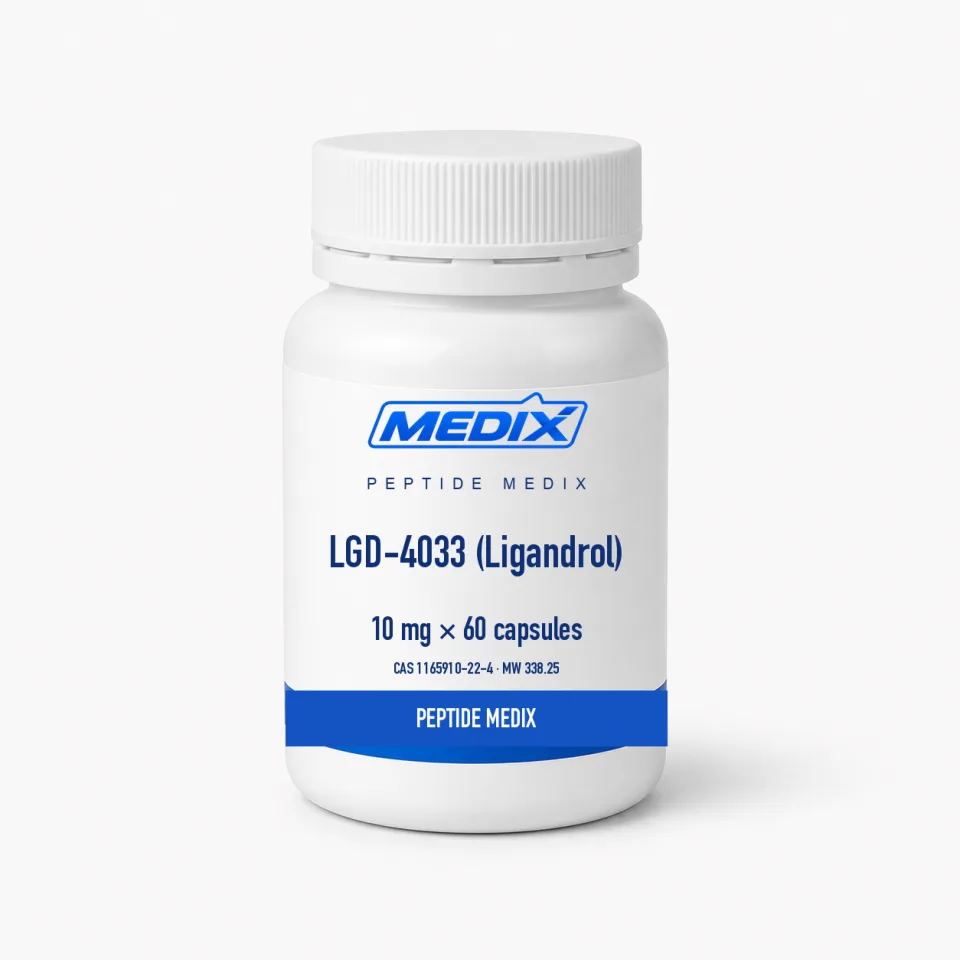
LGD-4033 (Ligandrol)
Non-steroidal SARM available as capsules or a liquid solution
In stock2 formats availableCAS 1165910-22-4
€55Range €55 – €68
This listing is currently unavailable. Contact us and we will tell you when it is back or suggest an equivalent.
Ask about this listing or request its COA- FormOral capsules in a sealed bottle, or 30 mL solution in an amber dropper bottle
- Mol. weight338.25 g/mol
- Research areasAndrogen receptor pharmacology, muscle and bone tissue selectivity, anti-doping analytical methods
For laboratory research use only. Sold exclusively for in-vitro laboratory research by qualified professionals. Not for human or veterinary use, and not a medicine, food, cosmetic or dietary supplement. Terms and Conditions
Overview
Key facts
LGD-4033 — usually called Ligandrol, and also known by the code VK5211 — belongs to the SARMs, the non-steroidal modulators that act selectively on the androgen receptor.
- CAS number
- 1165910-22-4
- Molecular formula
- C14H12F6N2O
- Molecular weight
- 338.25 g/mol
- Purity
- ≥98% by HPLC; lot-matched COA available
- Form
- Oral capsules in a sealed bottle, or 30 mL solution in an amber dropper bottle
- Storage
- Room temperature in the sealed container, dry and protected from light
- Available sizes
- 10 mg · 60 capsules · 30 mL liquid · 20 mg/mL
For research use only. Not for human consumption.
LGD-4033 — usually called Ligandrol, and also known by the code VK5211 — belongs to the SARMs, the non-steroidal modulators that act selectively on the androgen receptor. Its chemical core is a benzonitrile to which a CF3 (trifluoromethyl) group and a pyrrolidine ring are attached, the ring itself bearing a trifluoro-hydroxyethyl substituent. It is not a hormone and not a peptide, but a small synthetic organic molecule that docks into the ligand-binding domain of the androgen receptor.
Both of our formats are drawn from one lot-tested batch: sixty capsules of 10 mg in a sealed bottle, or 30 mL of a 20 mg/mL solution in a brown glass bottle with a dropper. The capsules fix the amount per unit — practical when a design calls for many repeat administrations. The solution is the better option for dilution series and in-vitro experiments with matched vehicle, where the solvent itself becomes something the control wells must reproduce. Among the SARMs we carry, LGD-4033 is generally reported as the stronger androgen-receptor ligand in binding and transactivation tests, whereas ostarine is usually characterised as a partial agonist — so the two are frequently run as separate arms. The purity specification is ≥98% by HPLC, and storage is simple: closed, dry, at room temperature.
Specifications
Identity
- CAS number
- 1165910-22-4
- Molecular formula
- C14H12F6N2O
- Molecular weight
- 338.25 g/mol
Supply & purity
- Form
- Oral capsules in a sealed bottle, or 30 mL solution in an amber dropper bottle
- Purity
- ≥98% by HPLC; lot-matched COA available
- Available sizes
- 10 mg × 60 capsules; 30 mL liquid at 20 mg/mL
Additional detail
- Compound class
- Non-steroidal selective androgen receptor modulator (SARM)
- Also known as
- Ligandrol, VK5211, anabolicum
- Molecular target
- Androgen receptor ligand-binding domain
- Chemical description
- Trifluoromethyl-substituted benzonitrile with a pyrrolidinyl trifluoro-hydroxyethyl group
- Research areas
- Androgen receptor pharmacology, muscle and bone tissue selectivity, anti-doping analytical methods
- Regulatory status
- Not an approved drug; not a dietary supplement or dietary ingredient; WADA prohibited
- Storage
- Room temperature in the sealed container, dry and protected from light
Questions about LGD-4033 (Ligandrol)
Does LGD-4033 have a peptide structure?
No. LGD-4033 is a synthetic organic compound of roughly 338 g/mol, built around a benzonitrile, and contains no chain of amino acids. It is therefore listed with our research compounds rather than the peptides, and it needs neither reconstitution nor cold storage.
What does the published research address?
So far: cell-free and cell-based work on how it binds the androgen receptor and recruits coregulators; rodent experiments comparing its effects on muscle, bone and prostate; one Phase 1 study in healthy men looking at pharmacokinetics and hormone markers; and a large number of anti-doping papers on how to detect it.
Which purity data and documents are provided?
HPLC testing to at least 98% with an identity check is carried out on every lot, and the certificate for your lot is available. Independent testing of SARM products sold to consumers has repeatedly found wrong labels, which is why paperwork at the level of each lot matters so much for this class.
Can anti-doping tests detect it?
Yes. WADA classes LGD-4033 as a banned anabolic agent, and validated LC-MS/MS methods pick up both the original molecule and its breakdown products over long periods after use. Much of the analytical research on it was carried out for exactly that reason.
Related