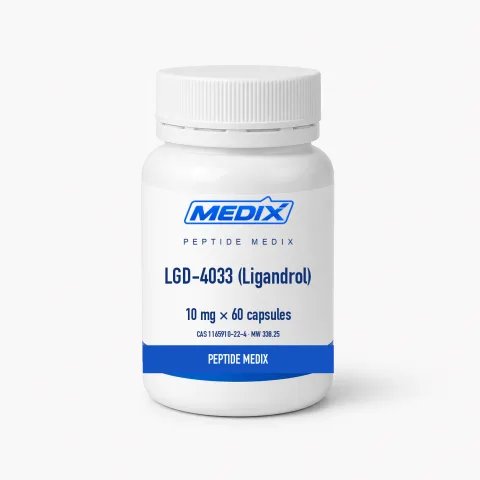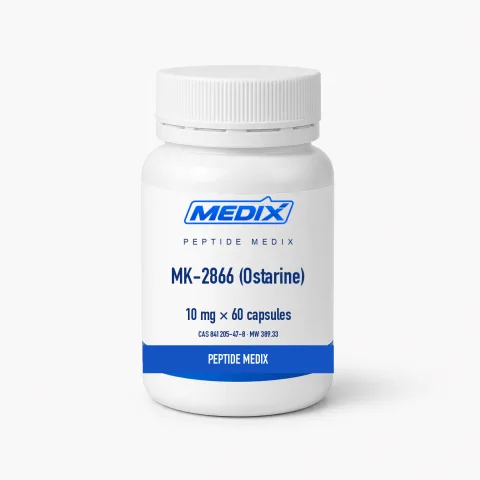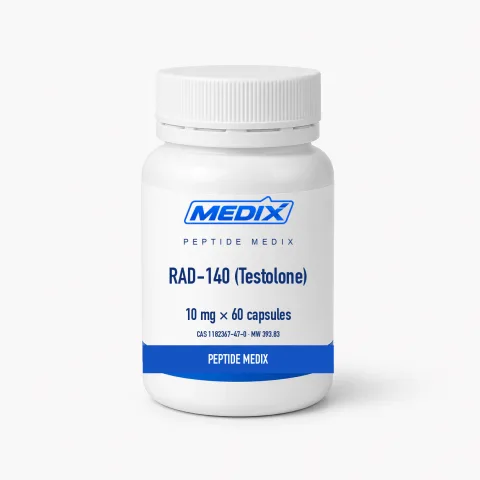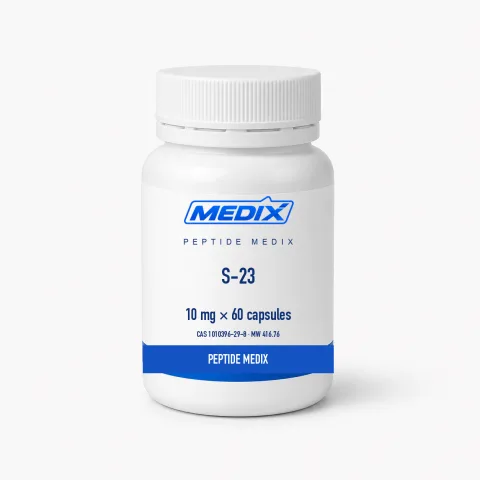
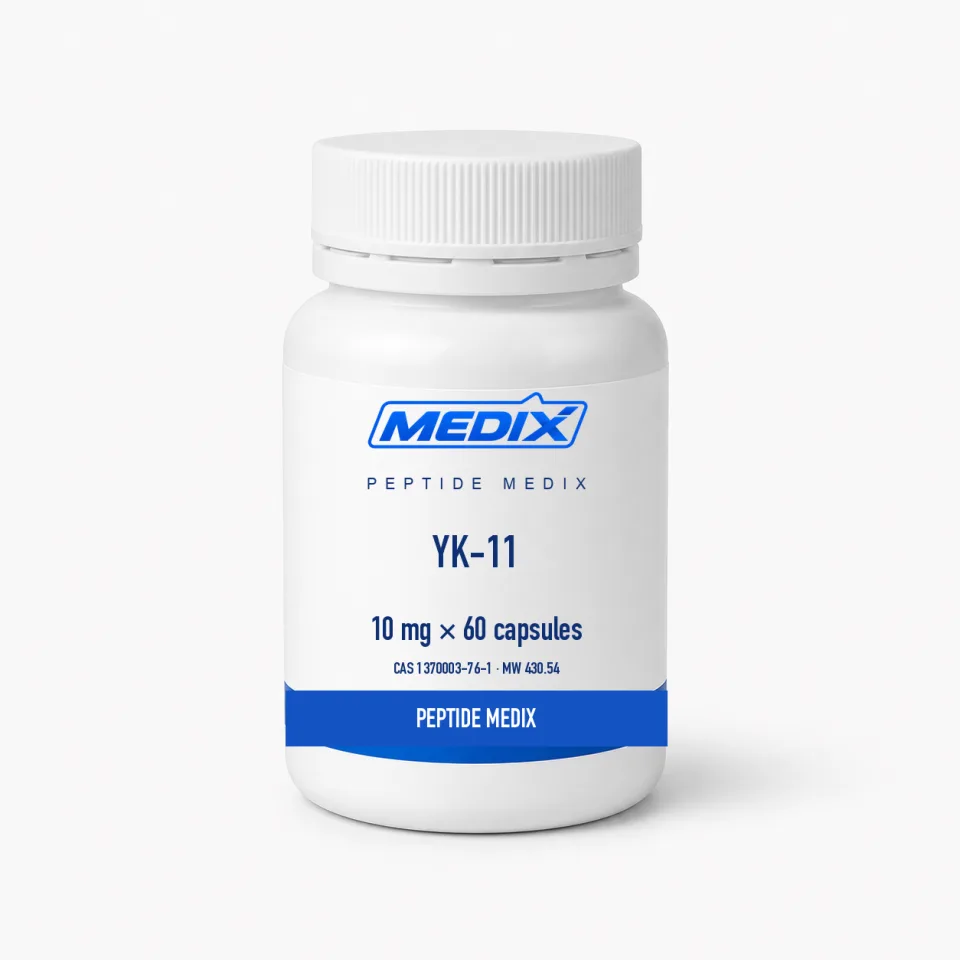
- HPLC purity ≥98%, with a COA for each lot on request
- Certificate of analysis tied to your lot number
- Tracked EU delivery, dispatched the next working day
YK-11
Steroidal partial androgen-receptor agonist studied in myostatin-related research
In stock2 formats availableCAS 1370003-76-1
€55Range €55 – €68
This listing is currently unavailable. Contact us and we will tell you when it is back or suggest an equivalent.
Ask about this listing or request its COA- FormOral capsules in a sealed bottle, or research liquid in a dropper bottle
- Mol. weight430.54 g/mol
- Research areasAndrogen receptor partial agonism, follistatin and myostatin signalling, myotube differentiation
For laboratory research use only. Sold exclusively for in-vitro laboratory research by qualified professionals. Not for human or veterinary use, and not a medicine, food, cosmetic or dietary supplement. Terms and Conditions
Overview
Key facts
YK-11 is a synthetic research compound usually filed with the SARMs, yet it differs from the rest of that group in one key respect: it has a steroid structure.
- CAS number
- 1370003-76-1
- Molecular formula
- C25H34O6
- Molecular weight
- 430.54 g/mol
- Purity
- ≥98% by HPLC; lot-matched COA available
- Form
- Oral capsules in a sealed bottle, or research liquid in a dropper bottle
- Available sizes
- 10 mg · 60 capsules · 30 mL liquid · 20 mg/mL
For research use only. Not for human consumption.
YK-11 is a synthetic research compound usually filed with the SARMs, yet it differs from the rest of that group in one key respect: it has a steroid structure. Its framework is a 5α-androstane skeleton derived from dihydrotestosterone, carrying a gem-dimethyl malonate ester at C-17 (C25H34O6, 430.54 g/mol, CAS 1370003-76-1). Compounds like RAD-140 or LGD-4033, by contrast, contain no steroid nucleus whatsoever.
Yuichiro Kanno and co-workers in Japan first described it around 2011, characterising it as a partial agonist of the androgen receptor. The findings that attracted most interest followed soon after: cultured C2C12 myotubes treated with the compound reportedly produced more follistatin, a natural antagonist of myostatin. This single strand of cell-culture evidence is where the common description of YK-11 as a “myostatin inhibitor” comes from — a label that the published data support only loosely and only in vitro.
We offer YK-11 as 10 mg capsules in bottles of 60 and as a 30 mL research liquid at 20 mg/mL, HPLC-tested to ≥98% with a certificate of analysis for each lot. It is not an approved medicine anywhere, may not be sold as a food supplement in the EU or as a dietary ingredient in the United States, and is supplied strictly for laboratory research.
Specifications
Identity
- CAS number
- 1370003-76-1
- Molecular formula
- C25H34O6
- Molecular weight
- 430.54 g/mol
Supply & purity
- Form
- Oral capsules in a sealed bottle, or research liquid in a dropper bottle
- Purity
- ≥98% by HPLC; lot-matched COA available
- Solubility
- Poorly water soluble; DMSO or ethanol used for concentrated stocks
Additional detail
- Available options
- 10 mg × 60 capsules; 30 mL liquid at 20 mg/mL
- Compound class
- Steroidal selective androgen receptor modulator (partial agonist)
- Core structure
- 5α-androstane nucleus with a gem-dimethyl malonate ester at C-17
- Molecular target
- Androgen receptor; downstream follistatin expression studied in myotubes
- Research areas
- Androgen receptor partial agonism, follistatin and myostatin signalling, myotube differentiation
- Storage (capsules and solid)
- Room temperature, sealed with desiccant, away from light, heat and humidity
- Storage (research liquid)
- Cool and dark, closure tight; refrigerate for extended study windows
- Regulatory status
- Not an approved drug; not a lawful dietary ingredient in the US; prohibited by WADA
Questions about YK-11
Should YK-11 really be called a SARM?
It is marketed and discussed as one, but chemically it is a steroid — a dihydrotestosterone derivative with a gem-dimethyl malonate ester at C-17 — whereas RAD-140 and LGD-4033 lack any steroid nucleus. “Steroidal partial androgen-receptor agonist” describes it more accurately.
Is YK-11 a myostatin inhibitor?
Not directly, based on published evidence. Studies in C2C12 myotubes reported higher expression of follistatin, a natural myostatin antagonist — an indirect, in-vitro observation that is the only basis for the myostatin-inhibitor label usually attached to it.
What does “partial agonist” mean for YK-11?
It binds the androgen receptor but triggers a smaller maximum transcriptional response than a full agonist such as DHT. Where a full agonist is already present, a partial agonist can compete for the binding pocket and lower the overall signal — so the direction of the observed effect depends on context.
How is purity confirmed, and is there a COA?
HPLC analysis to ≥98% with identity checked against the expected 430.54 g/mol, for every lot. The certificate matching the lot number on your bottle can be requested at any time before or after purchase.
Capsules or liquid — which suits my study?
Capsules give a fixed 10 mg unit with no preparation, ideal for repeated-unit protocols. The 30 mL liquid at 20 mg/mL is easier when amounts vary or dilution into a vehicle is needed, since you measure volume directly instead of opening several capsules.
Related