- HPLC purity ≥98%, with a COA for each lot on request
- Certificate of analysis tied to your lot number
- Tracked EU delivery, dispatched the next working day
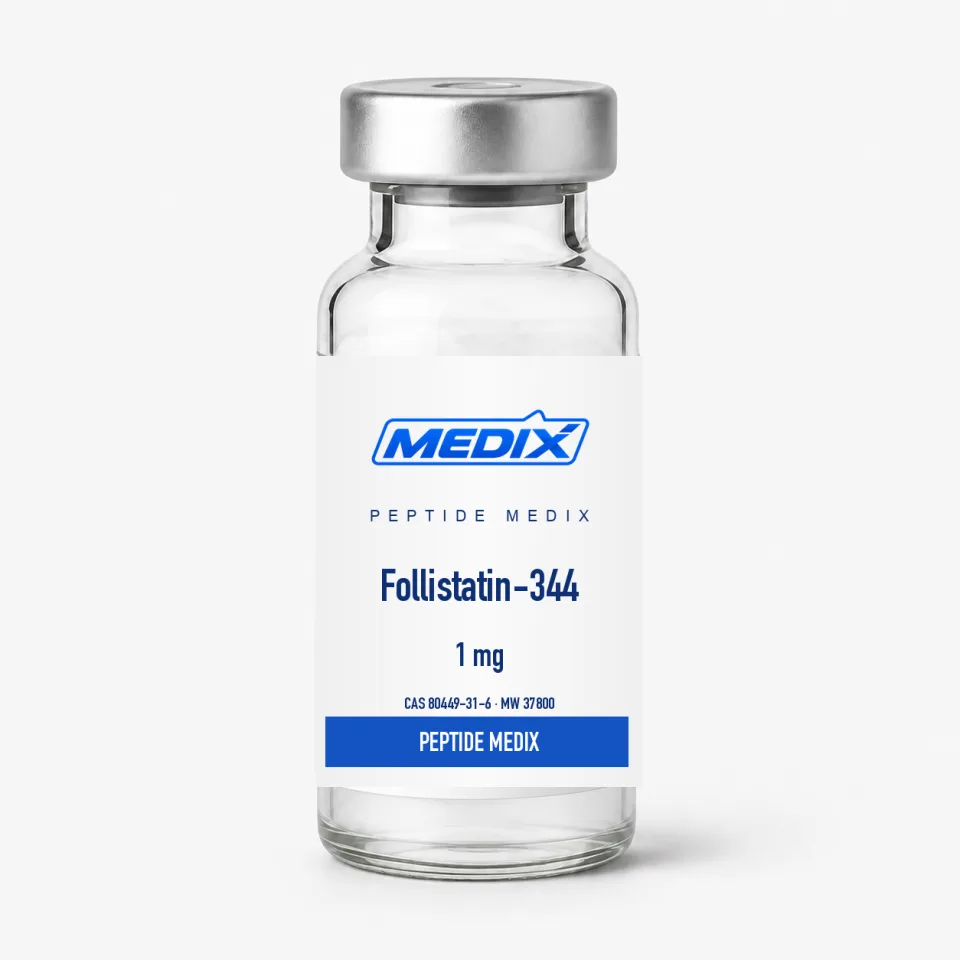
Follistatin-344
Recombinant follistatin isoform of 344 residues that binds activin
In stock1 format availableCAS 80449-31-6
€182
This listing is currently unavailable. Contact us and we will tell you when it is back or suggest an equivalent.
Ask about this listing or request its COA- FormLyophilized recombinant protein, sealed glass vial
- Mol. weight37800 Da (approximately 37.8 kDa)
- Research areasMyostatin inhibition, skeletal-muscle mass regulation, follicular and reproductive biology, fibrosis models
For laboratory research use only. Sold exclusively for in-vitro laboratory research by qualified professionals. Not for human or veterinary use, and not a medicine, food, cosmetic or dietary supplement. Terms and Conditions
Overview
Key facts
Follistatin-344 is the recombinant 344-residue isoform of follistatin, an autocrine glycoprotein originally purified from ovarian follicular fluid.
- CAS number
- 80449-31-6
- Molecular weight
- 37800 Da (approximately 37.8 kDa)
- Purity
- ≥98% by HPLC; lot-matched COA available
- Form
- Lyophilized recombinant protein, sealed glass vial
- Storage
- −20 °C, protected from light and moisture
- Available size
- 1 mg
For research use only. Not for human consumption.
Follistatin-344 is the recombinant 344-residue isoform of follistatin, an autocrine glycoprotein originally purified from ovarian follicular fluid. What defines follistatin is its tight binding to several TGF-β superfamily members — activin A above all, but also myostatin (GDF-8) and a number of bone morphogenetic proteins. By capturing these ligands before they reach their receptors, it works as a natural extracellular brake on that signalling pathway.
Alternative splicing gives two main isoforms: FS-288, whose heparin-binding C-terminus keeps it mostly attached to cells, and FS-315, the circulating form. FS-344 is the precursor that becomes FS-315 once its signal peptide is removed, and it is the isoform recombinant laboratories most often express. As myostatin restrains skeletal muscle growth, follistatin has remained a steady focus of muscle-biology and gene-transfer research since the 1990s.
Specifications
Identity
- CAS number
- 80449-31-6
- Molecular weight
- 37800 Da (approximately 37.8 kDa)
Supply & purity
- Form
- Lyophilized recombinant protein, sealed glass vial
- Purity
- ≥98% by HPLC; lot-matched COA available
- Available sizes
- 1 mg
- Solubility
- Sterile or bacteriostatic water; carrier protein often added for dilute stocks
Handling & storage
- Storage (lyophilized)
- −20 °C, protected from light and moisture
- Storage (reconstituted)
- 2–8 °C for immediate work; aliquot and hold at −20 °C or below for longer studies
Additional detail
- Residue count
- 344 amino acids
- Protein class
- Activin-binding glycoprotein, TGF-β superfamily antagonist
- Principal binding partners
- Activin A, myostatin (GDF-8), selected BMPs
- Isoform relationship
- Precursor isoform to circulating FS-315; distinct from cell-associated FS-288
- Research areas
- Myostatin inhibition, skeletal-muscle mass regulation, follicular and reproductive biology, fibrosis models
Questions about Follistatin-344
What is Follistatin-344, and how does it differ from FS-288 and FS-315?
FS-344 is follistatin's 344-residue precursor isoform. Removing its signal peptide produces FS-315, the form found in circulation, whereas FS-288 is a shorter, heparin-binding variant that remains bound to cells. All share the activin-binding core but differ in where they are found and how they behave.
Why does it cost more than most peptides?
Because it is a recombinant glycoprotein of 344 residues and about 37.8 kDa, not a short synthetic peptide. It has to be expressed in a biological system and then purified and analysed in several steps — far more work than solid-phase peptide synthesis.
Is it independently tested, and can I get a COA?
Yes. An independent lab analyses every lot for purity and identity, and the certificate matches the lot number on your vial. Request it either before you order or once the vial has arrived.
How should it be stored and reconstituted?
Store the sealed lyophilised vial at −20 °C, away from light and humidity. Reconstitute gently in sterile water without shaking, split the solution into single-use aliquots and avoid repeated freezing and thawing — recombinant proteins of this size degrade faster than small peptides.