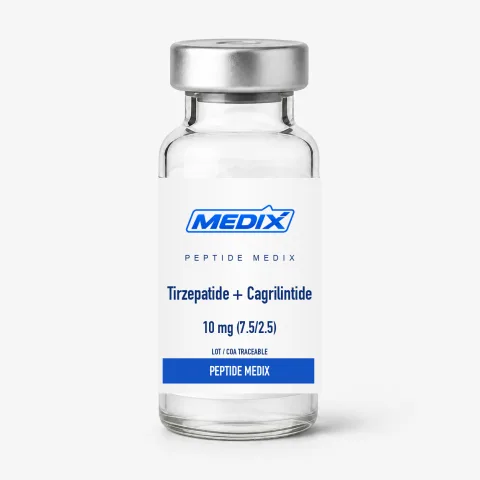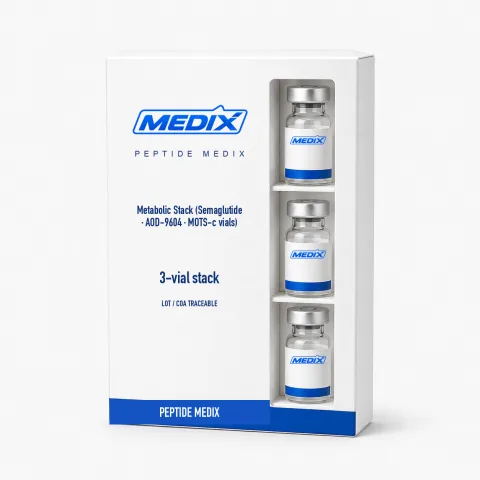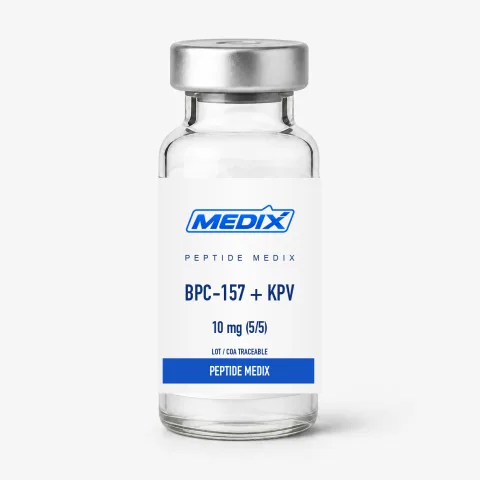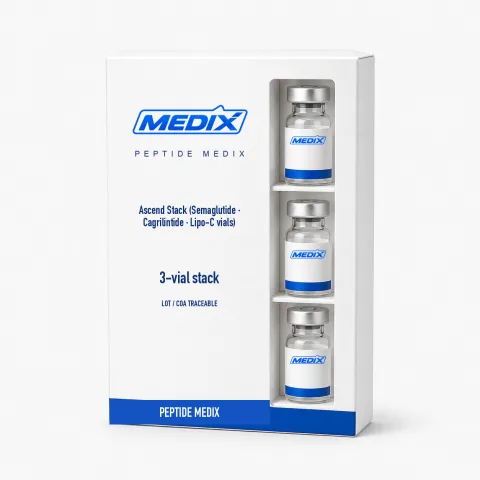
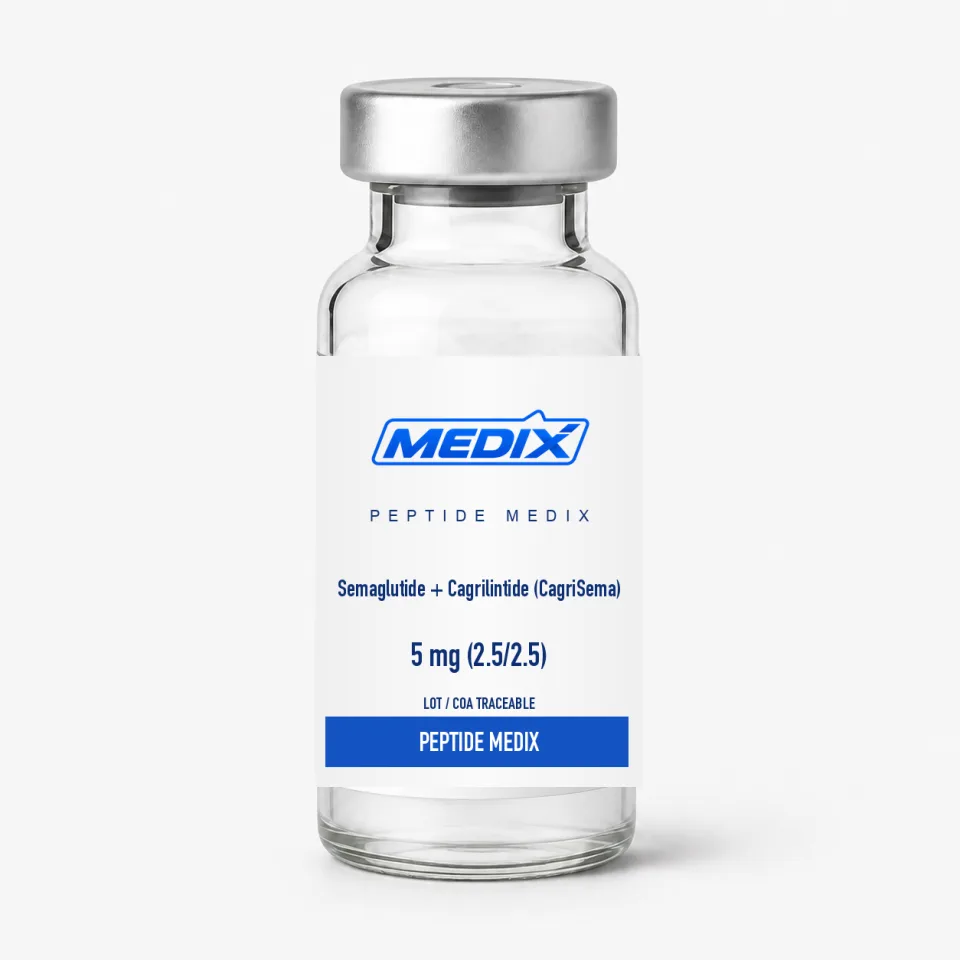
- Each component assayed to ≥99% (HPLC); per-lot COA on request
- Certificate of analysis tied to your lot number
- Tracked EU delivery, dispatched the next working day
Semaglutide + Cagrilintide (CagriSema)
Research blend of a GLP-1 receptor agonist and an amylin analogue in one vial
In stock2 formats available
€97Range €97 – €170
This listing is currently unavailable. Contact us and we will tell you when it is back or suggest an equivalent.
Ask about this listing or request its COA- FormLyophilized powder, sealed glass vial with flip-off seal
- Research areasIncretin and amylin receptor pharmacology, satiation signaling, energy balance models
For laboratory research use only. Sold exclusively for in-vitro laboratory research by qualified professionals. Not for human or veterinary use, and not a medicine, food, cosmetic or dietary supplement. Terms and Conditions
Overview
Key facts
One lyophilised cake, two long-acting metabolic peptides: semaglutide, a 31-residue acylated analogue that activates the GLP-1 receptor, and cagrilintide, an amylin analogue engineered not to form fibrils, which signals via calcitonin and amylin receptor complexes.
- Purity
- ≥99% by HPLC per component; lot-matched COA available
- Form
- Lyophilized powder, sealed glass vial with flip-off seal
- Storage
- −20 °C, sealed and protected from light and moisture
- Available sizes
- 5 mg · (2.5/2.5) · 10 mg · (5/5)
For research use only. Not for human consumption.
One lyophilised cake, two long-acting metabolic peptides: semaglutide, a 31-residue acylated analogue that activates the GLP-1 receptor, and cagrilintide, an amylin analogue engineered not to form fibrils, which signals via calcitonin and amylin receptor complexes. Publications commonly call the pairing “CagriSema”; here the two are present in equal amounts by mass.
They are combined because incretin and amylin signalling overlap only in part. GLP-1 receptor agonism has been investigated for insulin release, gastric emptying and hypothalamic appetite circuits, whereas amylin receptor agonism works through a different receptor family in the area postrema and hindbrain satiety pathways. Researchers pair them to see whether the two inputs add up on energy-balance endpoints, whether one arm alters body composition in a different way, and how receptor cross-talk develops over longer exposure.
What sets this listing apart
Semaglutide + Cagrilintide combines Semaglutide and Cagrilintide in one listing (5/10 mg). Components that are also sold on their own are linked below, each with its own specification and COA.
Same compound, other listings
Specifications
Supply & purity
- Form
- Lyophilized powder, sealed glass vial with flip-off seal
- Purity
- ≥99% by HPLC per component; lot-matched COA available
- Available sizes
- 5 mg total (2.5 mg / 2.5 mg), 10 mg total (5 mg / 5 mg)
- Solubility
- Bacteriostatic water; dilute buffers where assay pH matters
Handling & storage
- Storage (lyophilized)
- −20 °C, sealed and protected from light and moisture
- Storage (reconstituted)
- 2–8 °C, protected from light; use within the study window
Additional detail
- Product type
- Two-peptide metabolic research blend, co-lyophilized in one vial
- Components
- Semaglutide and cagrilintide (AM833), 1:1 by mass
- Semaglutide
- CAS 910463-68-2 · C187H291N45O59 · 4113.58 g/mol
- Cagrilintide
- CAS 1415456-99-3 · C194H309N55O59S2 · 4409.07 g/mol
- Semaglutide class
- Acylated GLP-1 receptor agonist analog, 31 residues, Aib at position 2
- Cagrilintide class
- Long-acting amylin analog acting at calcitonin and AMY1-AMY3 receptor complexes
- Research areas
- Incretin and amylin receptor pharmacology, satiation signaling, energy balance models
Questions about Semaglutide + Cagrilintide (CagriSema)
In what proportions are the two peptides present?
1:1 by mass in both sizes — 2.5 mg of each in the 5 mg vial, 5 mg of each in the 10 mg vial. As their molecular weights are not quite identical, the molar ratio is near, but not exactly, one to one.
Why study the combination instead of each alone?
Incretin and amylin receptors sit mostly in separate brain circuits, so labs ask whether engaging both changes energy-balance and body-composition outcomes compared with either arm by itself. Sound experiments still run single-agent and vehicle controls next to the blend.
Which analytical records accompany it?
Each component is tested by HPLC to ≥99% purity, with mass spectrometry verifying identity. The certificate of analysis is tied to the vial number you receive, keeping the data traceable to the material in your hands.
What storage does the vial need?
Sealed, at −20 °C, away from light and humidity. After reconstitution, keep it at 2–8 °C and finish it within your documented study window; aliquot rather than freezing and thawing one stock again and again.
Is stability affected by co-formulation?
That is a research question in its own right. Amylin-family peptides tend to aggregate, so analytical teams check the blend by HPLC, size-exclusion chromatography and thioflavin-T assays to confirm both peptides stay intact and monomeric together before biological work starts.