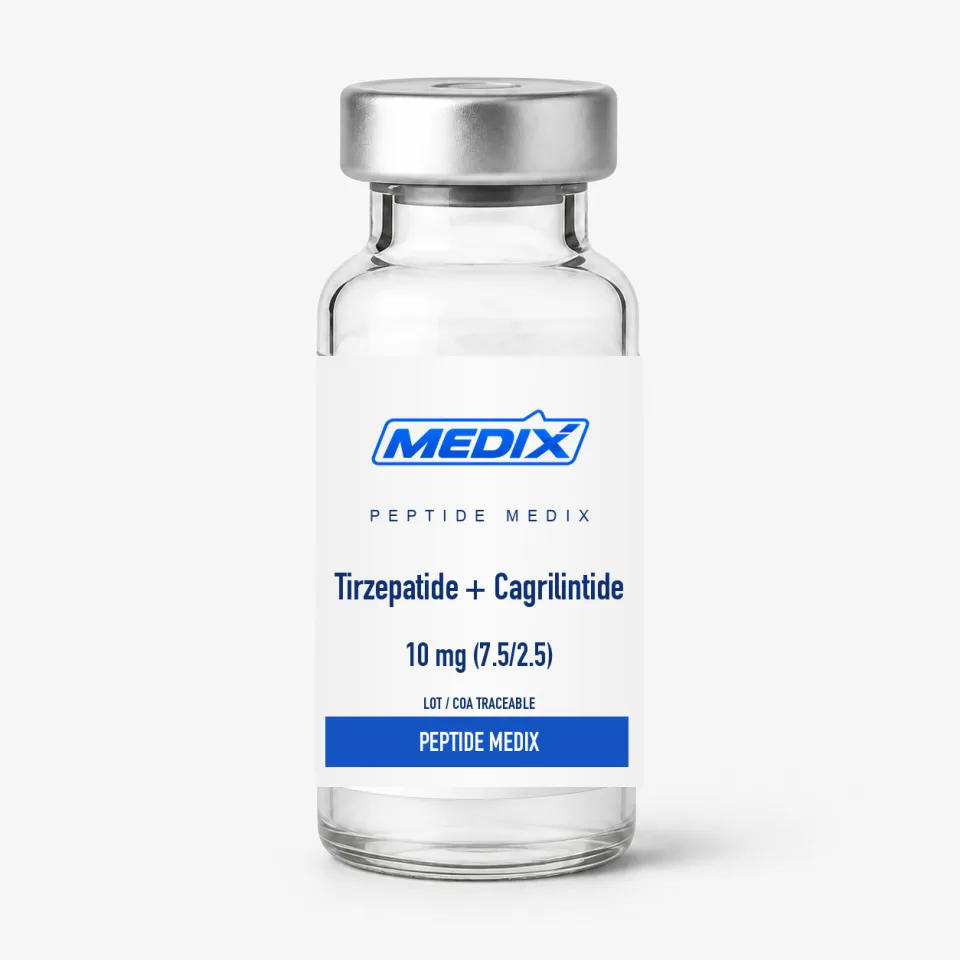
- Each peptide assayed to ≥99% (HPLC); per-lot COA on request
- Certificate of analysis tied to your lot number
- Tracked EU delivery, dispatched the next working day
Tirzepatide + Cagrilintide
Dual GIP/GLP-1 agonist co-lyophilised with a long-acting amylin analogue
In stock2 formats available
€182Range €182 – €323
This listing is currently unavailable. Contact us and we will tell you when it is back or suggest an equivalent.
Ask about this listing or request its COA- FormCo-lyophilized powder, sealed glass vial with flip-off seal
- Research areasIncretin-amylin combination pharmacology, satiation signalling, gastric emptying, adipose and glucose-handling models
For laboratory research use only. Sold exclusively for in-vitro laboratory research by qualified professionals. Not for human or veterinary use, and not a medicine, food, cosmetic or dietary supplement. Terms and Conditions
Overview
Key facts
Two metabolic research peptides are co-lyophilised in this vial: tirzepatide, an acylated 39-residue agonist of GIP and GLP-1 receptors, and cagrilintide, a long-acting acylated analogue of amylin (islet amyloid polypeptide).
- Purity
- ≥99% by HPLC for each peptide; lot-matched COA available
- Form
- Co-lyophilized powder, sealed glass vial with flip-off seal
- Storage
- −20 °C, sealed and protected from light and moisture
- Available sizes
- 10 mg · (7.5/2.5) · 20 mg · (15/5)
For research use only. Not for human consumption.
Two metabolic research peptides are co-lyophilised in this vial: tirzepatide, an acylated 39-residue agonist of GIP and GLP-1 receptors, and cagrilintide, a long-acting acylated analogue of amylin (islet amyloid polypeptide). The rationale is that incretin and amylin signals reach energy-balance circuits via different receptor systems — and how such combinations behave is among the liveliest questions in metabolic research today.
Tirzepatide rests on a GIP-derived backbone, with aminoisobutyric acid substitutions for protease resistance and a C20 diacid chain linked via gamma-Glu-(AEEA)2 at Lys20, promoting albumin binding and a long half-life. Cagrilintide uses an amylin backbone with substitutions that prevent fibril formation, an internal disulfide and its own lipid side chain; it is studied at the calcitonin receptor and at the RAMP-defined AMY1–AMY3 complexes.
What sets this listing apart
Tirzepatide + Cagrilintide combines Tirzepatide and Cagrilintide in one listing (10/20 mg). Components that are also sold on their own are linked below, each with its own specification and COA.
Same compound, other listings
Specifications
Supply & purity
- Form
- Co-lyophilized powder, sealed glass vial with flip-off seal
- Purity
- ≥99% by HPLC for each peptide; lot-matched COA available
- Available sizes
- 10 mg total (7.5 mg tirzepatide / 2.5 mg cagrilintide); 20 mg total (15 mg / 5 mg)
- Solubility
- Bacteriostatic water; dilute alkaline or phosphate buffers where assay pH matters
Handling & storage
- Storage (lyophilized)
- −20 °C, sealed and protected from light and moisture
- Storage (reconstituted)
- 2–8 °C, protected from light; use within the study window
Additional detail
- Blend ratio
- 3:1 tirzepatide to cagrilintide by mass
- Component 1
- Tirzepatide — CAS 2023788-19-2, C225H348N48O68, 4813.45 g/mol
- Component 2
- Cagrilintide — CAS 1415456-99-3, 4409.07 g/mol
- Tirzepatide class
- Acylated dual GIP/GLP-1 receptor agonist (twincretin), 39 residues
- Cagrilintide class
- Long-acting acylated amylin (IAPP) analog
- Key modifications
- Aib substitutions and a C20 diacid on tirzepatide; anti-fibrillation substitutions, disulfide and lipid chain on cagrilintide
- Receptors studied
- GIP receptor, GLP-1 receptor, calcitonin receptor and AMY1–AMY3 complexes
- Research areas
- Incretin-amylin combination pharmacology, satiation signalling, gastric emptying, adipose and glucose-handling models
Questions about Tirzepatide + Cagrilintide
What are the amounts of each peptide per vial?
7.5 mg tirzepatide plus 2.5 mg cagrilintide in the 10 mg vial, 15 mg plus 5 mg in the 20 mg vial — a 3:1 mass ratio in both. The Certificate of Analysis for your lot repeats the exact fill so you can check your calculations.
Are the two peptides combined or packed separately?
Combined — co-lyophilised in one vial, so a single reconstitution gives a working solution at a fixed ratio. If you need to vary the ratio, use the separate tirzepatide and cagrilintide vials we also stock.
Why study an incretin agonist together with an amylin analogue?
They act through different receptor systems — GIP and GLP-1 receptors on one side, calcitonin receptor–RAMP amylin complexes on the other — and reach energy-balance circuits partly by separate routes. Combination arms reveal whether readouts are additive or dominated by one pathway.
Is the blend independently tested?
Yes. Each peptide is HPLC-analysed to confirm ≥99% purity and tested for identity, and a COA for your batch is available. Check that the vial's lot number matches it before recording results.
What should I reconstitute it with?
Bacteriostatic water for multi-use lab preparations; dilute alkaline or phosphate buffers where assay pH is important. Run the diluent slowly down the vial wall and swirl instead of shaking — acylated peptides foam easily.
How does it compare with the semaglutide + cagrilintide blend?
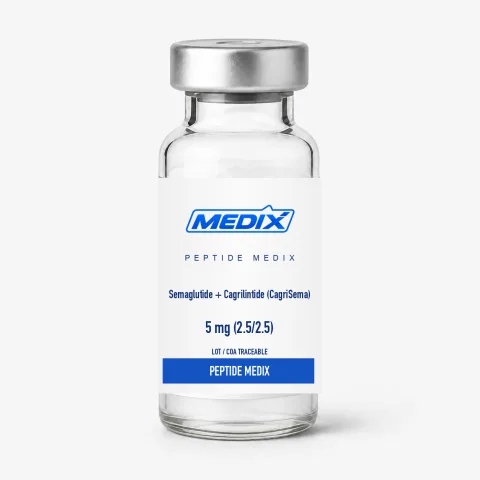
The amylin analogue is of the same class, but the incretin partner differs: semaglutide activates only the GLP-1 receptor, tirzepatide both GIP and GLP-1 receptors. Which blend to choose depends on the receptor question your experiment addresses.