- HPLC purity ≥99%, with a COA for each lot on request
- Certificate of analysis tied to your lot number
- Tracked EU delivery, dispatched the next working day
Cagrilintide
Acylated long-acting amylin analogue for receptor and metabolic research
In stock2 formats availableCAS 1415456-99-3
€97Range €97 – €170
This listing is currently unavailable. Contact us and we will tell you when it is back or suggest an equivalent.
Ask about this listing or request its COA- FormLyophilized powder, sealed glass vial with flip-off seal
- Mol. weight4409.07 g/mol
- Research areasSatiation signaling, gastric emptying, amylin-incretin combination models
For laboratory research use only. Sold exclusively for in-vitro laboratory research by qualified professionals. Not for human or veterinary use, and not a medicine, food, cosmetic or dietary supplement. Terms and Conditions
Overview
Key facts
Cagrilintide is a long-acting synthetic analogue of human amylin, the 37-amino-acid hormone that beta cells release along with insulin.
- CAS number
- 1415456-99-3
- Molecular formula
- C194H309N55O59S2
- Molecular weight
- 4409.07 g/mol
- Purity
- ≥99% by HPLC; lot-matched COA available
- Form
- Lyophilized powder, sealed glass vial with flip-off seal
- Storage
- −20 °C, sealed and protected from light and moisture
- Available sizes
- 5 mg · 10 mg
For research use only. Not for human consumption.
Cagrilintide is a long-acting synthetic analogue of human amylin, the 37-amino-acid hormone that beta cells release along with insulin. Amylin signals through amylin and calcitonin receptor complexes, where it influences satiation and how fast the stomach empties. The native human hormone is notoriously awkward in the lab because it clumps into amyloid fibrils; the analogue therefore contains sequence changes that prevent fibril formation, plus a fatty side chain that prolongs its half-life in circulation by binding reversibly to albumin.
Together these features make cagrilintide usable in experiments where the natural peptide simply fails. Researchers apply it to probe the calcitonin receptor in combination with each of its RAMP partners — which yields the AMY1, AMY2 and AMY3 receptor subtypes — and to map satiation signalling in hindbrain (area postrema) and hypothalamic circuits. It is likewise the usual comparator in combination studies with GLP-1 agonists, since amylin and incretin pathways recruit circuits that only partly overlap.
What sets this listing apart
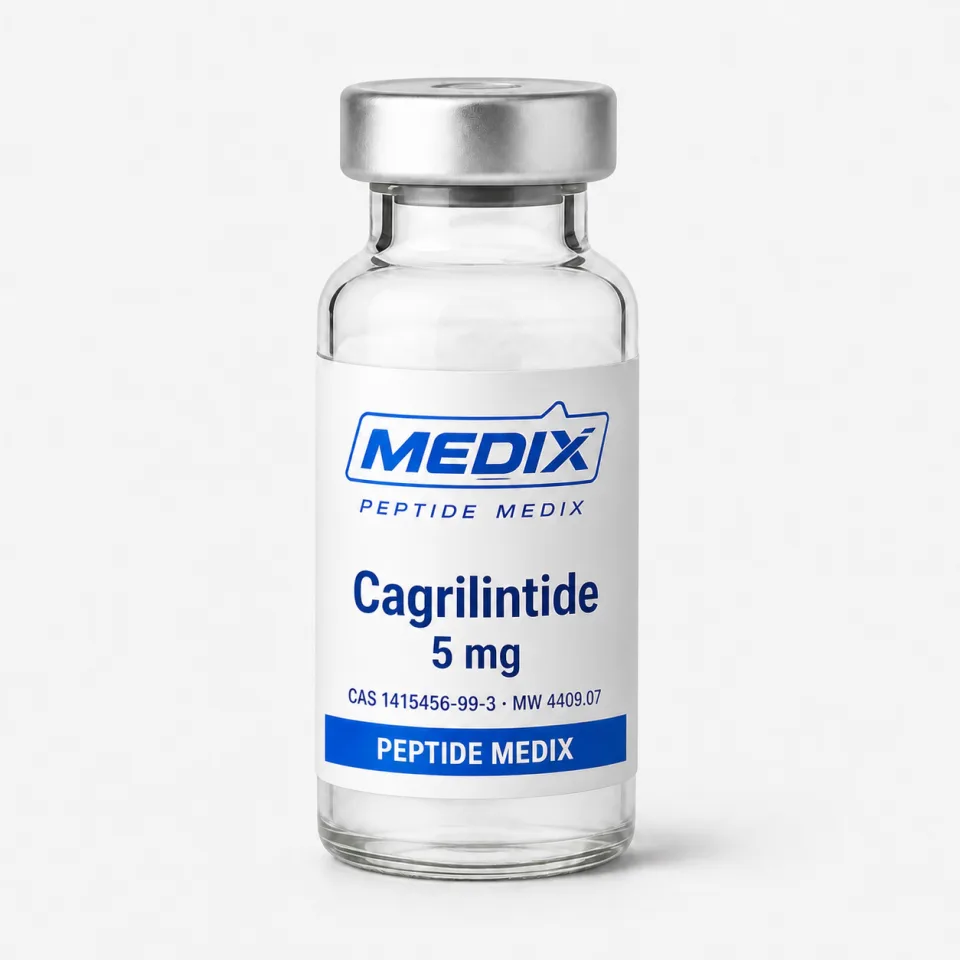
Cagrilintide – vial, 5/10 mg. Lyophilized powder, sealed glass vial with flip-off seal. Other Cagrilintide listings differ in format, fill or combination partners; the specification and COA always refer to the listing you order.
Same compound, other listings
Specifications
Identity
- CAS number
- 1415456-99-3
- Molecular formula
- C194H309N55O59S2
- Molecular weight
- 4409.07 g/mol
- Peptide class
- Acylated long-acting amylin (islet amyloid polypeptide) analog
Supply & purity
- Form
- Lyophilized powder, sealed glass vial with flip-off seal
- Purity
- ≥99% by HPLC; lot-matched COA available
- Available sizes
- 5 mg, 10 mg
- Solubility
- Bacteriostatic water; dilute buffers used where assay pH matters
Handling & storage
- Storage (lyophilized)
- −20 °C, sealed and protected from light and moisture
- Storage (reconstituted)
- 2–8 °C, protected from light; use within the study window
Additional detail
- Receptor targets studied
- Calcitonin receptor and AMY1–AMY3 amylin receptor complexes
- Structural notes
- Amylin-based backbone with anti-fibrillation substitutions, intramolecular disulfide and a lipid side chain
- Research areas
- Satiation signaling, gastric emptying, amylin-incretin combination models
Questions about Cagrilintide
Why choose cagrilintide over native human amylin?
Human amylin readily forms amyloid fibrils, so its solutions are unstable and experiments are hard to reproduce. Engineered substitutions that block fibrillation, together with a fatty acylation, keep cagrilintide dissolved for longer and make it a far more practical tool for work on receptors and satiety.
Which purity data and documents do you provide?
Every lot is HPLC-tested to ≥99% purity, with mass spectrometry used to verify identity, and the certificate for your lot can be requested. Because the COA is linked to the vial number you receive, the purity data remain traceable to your own material.
Which receptors are its targets?
Cell-based work reports that it activates the calcitonin receptor on its own as well as the AMY1–AMY3 subtypes that form when that receptor pairs with a receptor-activity-modifying protein. How selective it is among those complexes remains an open research question.
How should it be stored and handled?
Keep the unopened lyophilised vial frozen at −20 °C, shielded from light and humidity. After reconstitution, refrigerate (2–8 °C) and finish it inside the period your protocol specifies. Swirl instead of shaking and keep air–liquid contact to a minimum to reduce aggregation.
Is it researched in combination with GLP-1 agonists?
Yes. Since amylin and incretin signalling act on partly separate circuits, labs often test cagrilintide together with semaglutide or with a GIP/GLP-1/glucagon triple agonist to see whether the two signals add up in cellular and rodent metabolic models.
Related