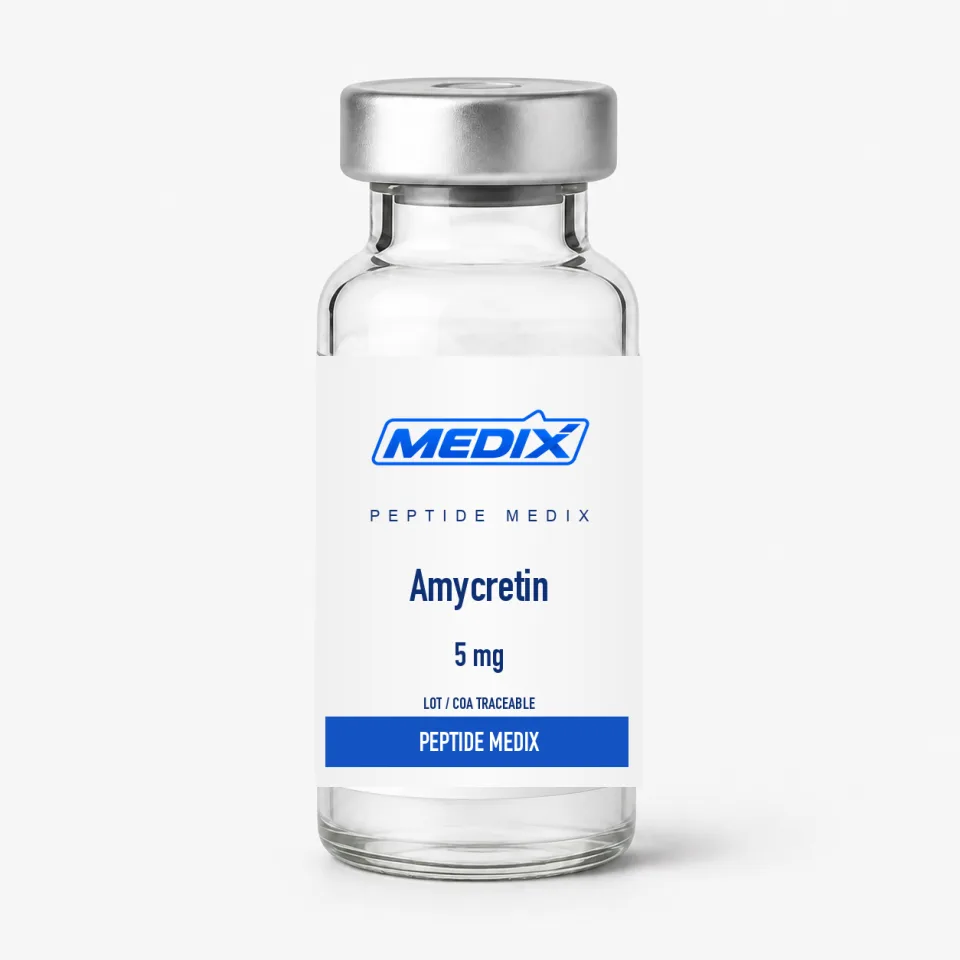
- HPLC purity ≥99%, with a COA for each lot on request
- Certificate of analysis tied to your lot number
- Tracked EU delivery, dispatched the next working day
Amycretin
Investigational single-molecule co-agonist of the GLP-1 and amylin receptors
In stock2 formats available
€123Range €123 – €212
This listing is currently unavailable. Contact us and we will tell you when it is back or suggest an equivalent.
Ask about this listing or request its COA- FormLyophilized powder, sealed glass vial with flip-off seal
For laboratory research use only. Sold exclusively for in-vitro laboratory research by qualified professionals. Not for human or veterinary use, and not a medicine, food, cosmetic or dietary supplement. Terms and Conditions
Overview
Key facts
Amycretin is an investigational peptide built as a unimolecular co-agonist — one molecule that activates both the GLP-1 receptor and the amylin receptor complex.
- Purity
- ≥99% by HPLC; lot-matched COA available
- Form
- Lyophilized powder, sealed glass vial with flip-off seal
- Storage
- −20 °C, sealed and protected from light and moisture
- Available sizes
- 5 mg · 10 mg
For research use only. Not for human consumption.
Amycretin is an investigational peptide built as a unimolecular co-agonist — one molecule that activates both the GLP-1 receptor and the amylin receptor complex. Historically these two targets were addressed with separate drugs, incretin agonists such as semaglutide on one side and amylin analogues such as cagrilintide on the other, and combining them meant giving two peptides together. Amycretin takes the other route, carrying both activities on a single acylated peptide scaffold.
The amylin side is pharmacologically unusual because its receptor is not encoded by one gene. Amylin receptors form when the calcitonin receptor pairs with one of three receptor activity-modifying proteins — RAMP1, RAMP2 or RAMP3 — giving the AMY1, AMY2 and AMY3 subtypes. Which subtypes a co-agonist activates, and how strongly relative to each other, must be measured in cell lines expressing defined RAMP combinations; a single binding value cannot tell you, and this is a major reason the molecule interests bench scientists. We intentionally leave structural data out of the specification, as the public literature does not yet establish it to a standard we can verify. Vials contain 5 mg or 10 mg; swirl gently when reconstituting rather than vortexing.
Specifications
Identity
- Peptide class
- Acylated unimolecular GLP-1 receptor and amylin receptor co-agonist
Supply & purity
- Form
- Lyophilized powder, sealed glass vial with flip-off seal
- Purity
- ≥99% by HPLC; lot-matched COA available
- Available sizes
- 5 mg, 10 mg
- Solubility
- Bacteriostatic water; gentle swirling, no vortexing
Handling & storage
- Storage (lyophilized)
- −20 °C, sealed and protected from light and moisture
- Storage (reconstituted)
- 2–8 °C, protected from light, used within the study window
Additional detail
- Molecular targets
- GLP-1 receptor; calcitonin receptor with RAMP subunits (amylin receptor complex)
- Design rationale
- Two appetite-regulating pathways engaged by one peptide rather than two co-administered agents
- Regulatory status
- Investigational; not approved for any indication in any jurisdiction
- Documentation
- Third-party HPLC purity and identity report per lot
Questions about Amycretin
How does amycretin differ from semaglutide and tirzepatide?
Semaglutide activates only the GLP-1 receptor, and tirzepatide combines GIP and GLP-1 agonism. Amycretin pairs the GLP-1 receptor with amylin instead of a second incretin, acting on the calcitonin receptor–RAMP complexes that transmit amylin signals — all within one molecule.
Has amycretin been approved as a medicine?
No. It is still an investigational compound in early clinical development, with no approval from the EMA, the FDA or any other authority for any use. We offer it purely as a research chemical for laboratory work.
Why is no molecular formula given in the specification?
We only publish figures we can stand behind. The complete structure of amycretin has not been set out in public sources to the standard we apply, so we state its class, targets and status instead of printing a formula or sequence that cannot be checked.
Which documents accompany each lot?
An independent laboratory tests every lot by HPLC for purity and identity, and the certificate of analysis for your lot is available on request. Keep it with your study files so the characterised material can be linked to your results.
How is it prepared in the lab?
Reconstitute the lyophilised powder by running bacteriostatic water slowly down the inside of the vial, then swirl gently — do not shake. Keep solutions at 2–8 °C and away from light. We give no dosing, administration or protocol advice whatsoever.
Related