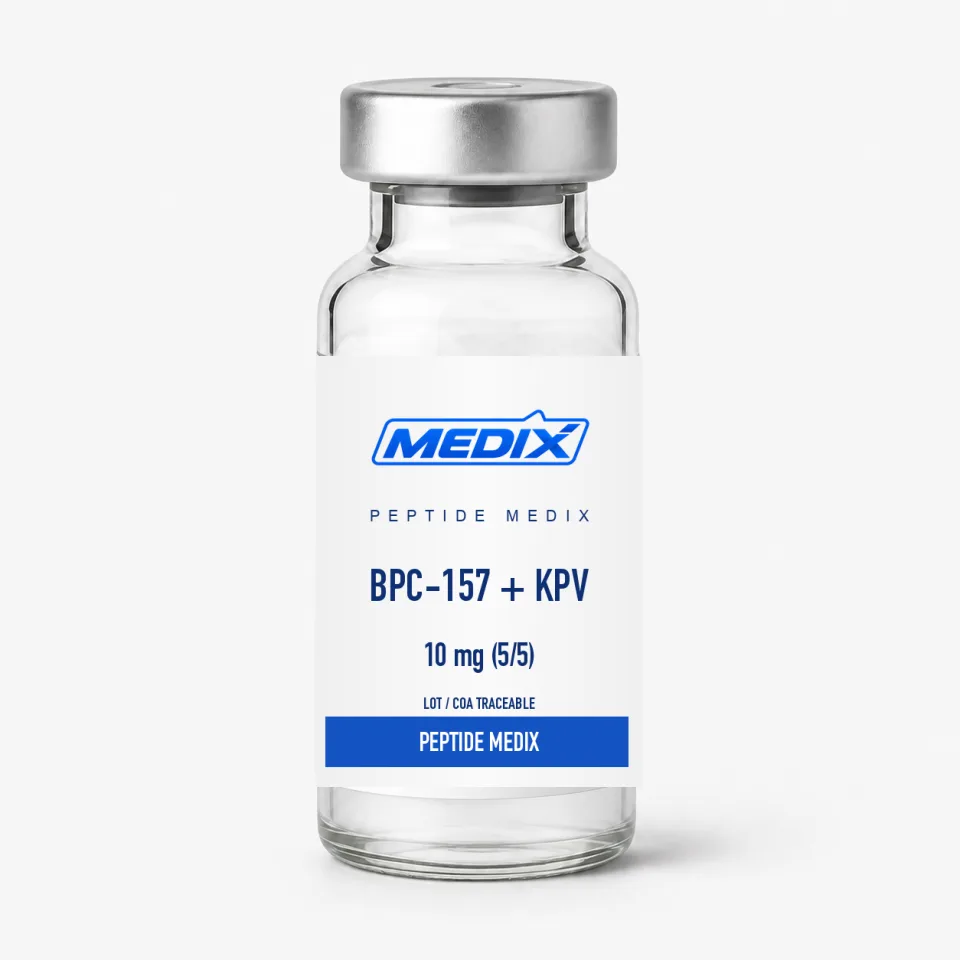
- Each component assayed to ≥99% (HPLC); per-lot COA on request
- Certificate of analysis tied to your lot number
- Tracked EU delivery, dispatched the next working day
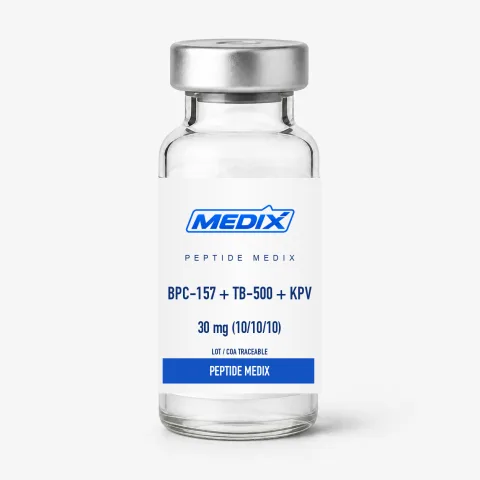
BPC-157 + KPV
BPC-157 and KPV together in one lyophilised vial for repair and inflammation-signalling studies
In stock2 formats available
€97Range €97 – €165
This listing is currently unavailable. Contact us and we will tell you when it is back or suggest an equivalent.
Ask about this listing or request its COA- FormLyophilized powder, sealed glass vial with crimped stopper
- Research areasGastrointestinal mucosal models, inflammatory signalling, tissue repair, NF-kappa B pathway activity
For laboratory research use only. Sold exclusively for in-vitro laboratory research by qualified professionals. Not for human or veterinary use, and not a medicine, food, cosmetic or dietary supplement. Terms and Conditions
Overview
Key facts
Two short peptides share this lyophilised vial in equal amounts by mass.
- Purity
- ≥99% by HPLC per component; lot-matched COA available
- Form
- Lyophilized powder, sealed glass vial with crimped stopper
- Storage
- −20 °C, sealed and protected from light and moisture
- Available sizes
- 10 mg · (5/5) · 20 mg · (10/10)
For research use only. Not for human consumption.
Two short peptides share this lyophilised vial in equal amounts by mass. One is BPC-157, the 15-residue pentadecapeptide taken from body protection compound in gastric juice; the other is KPV, the tripeptide found at the C-terminus of alpha-melanocyte-stimulating hormone. You get 5 mg of each in the 10 mg vial and 10 mg of each in the 20 mg vial.
Equal mass does not mean equal numbers of molecules, and here the difference is large. BPC-157 weighs 1419.55 g/mol while KPV weighs 342.43 g/mol, so a same-mass fill contains around four KPV molecules for every BPC-157 molecule — any protocol that reports molar concentrations must convert explicitly. The peptides have nothing in common in terms of origin either: BPC-157 stems from a cytoprotective protein described in gastric juice, whereas KPV is the terminal tripeptide of alpha-MSH, investigated in the literature for its effects on NF-kappa B-dependent inflammatory signalling. Each dissolves easily in bacteriostatic or sterile water, and the vial contains only the two peptides — no diluent, carrier or preservative.
What sets this listing apart
BPC-157 + KPV combines BPC-157 and KPV in one listing (10/20 mg). Components that are also sold on their own are linked below, each with its own specification and COA.
Same compound, other listings
Specifications
Supply & purity
- Form
- Lyophilized powder, sealed glass vial with crimped stopper
- Purity
- ≥99% by HPLC per component; lot-matched COA available
- Available sizes
- 10 mg total (5 mg BPC-157 / 5 mg KPV); 20 mg total (10 mg / 10 mg)
- Solubility
- Both peptides dissolve readily in bacteriostatic or sterile water
Handling & storage
- Storage (lyophilized)
- −20 °C, sealed and protected from light and moisture
- Storage (reconstituted)
- 2–8 °C, protected from light, used within the study window
Additional detail
- Product type
- Co-formulated two-peptide blend, single vial
- Blend ratio
- 1:1 by mass
- BPC-157
- CAS 137525-51-0 · C62H98N16O22 · 1419.55 g/mol
- BPC-157 sequence
- Gly-Glu-Pro-Pro-Pro-Gly-Lys-Pro-Ala-Asp-Asp-Ala-Gly-Leu-Val
- KPV
- CAS 67727-97-3 · C16H30N4O4 · 342.43 g/mol
- KPV sequence
- Lys-Pro-Val (alpha-MSH 11–13 C-terminal fragment)
- Research areas
- Gastrointestinal mucosal models, inflammatory signalling, tissue repair, NF-kappa B pathway activity
Questions about BPC-157 + KPV
What does the vial contain?
A single lyophilised cake of both peptides, 1:1 by mass: 5 mg BPC-157 plus 5 mg KPV in the 10 mg size, and 10 mg of each in the 20 mg size. Nothing else is added — no diluent, carrier or preservative.
Why choose the blend over two separate vials?
With a blend, the ratio is set during manufacture and one reconstitution is enough, so preparation is simpler and there is less handling between vials. Separate vials allow any ratio you like and single-peptide control arms. If you need to attribute an effect to one of the two, you will usually want the individual vials too.
Can I obtain a certificate of analysis?
Yes. Both components are assayed by HPLC against a ≥99% purity specification with identity confirmed by mass spectrometry, and every blend lot has its own certificate covering the two peptides. You can ask for the current COA before placing an order.
Which diluent should I use?
Both peptides dissolve readily in water: bacteriostatic water is the standard pick when the vial will be drawn from repeatedly, sterile water when it will be used once. Run the diluent gently down the glass and swirl — don't shake. Expect a clear, colourless solution without visible particles.
How long is the reconstituted blend usable?
Stored at 2–8 °C away from light and handled aseptically, reconstituted short peptides are generally used up within a few weeks in lab practice. Set the usage window in your protocol, avoid warming the vial repeatedly, and throw away any solution that turns cloudy or contains particles.
Related