- HPLC purity ≥99%, with a COA for each lot on request
- Certificate of analysis tied to your lot number
- Tracked EU delivery, dispatched the next working day
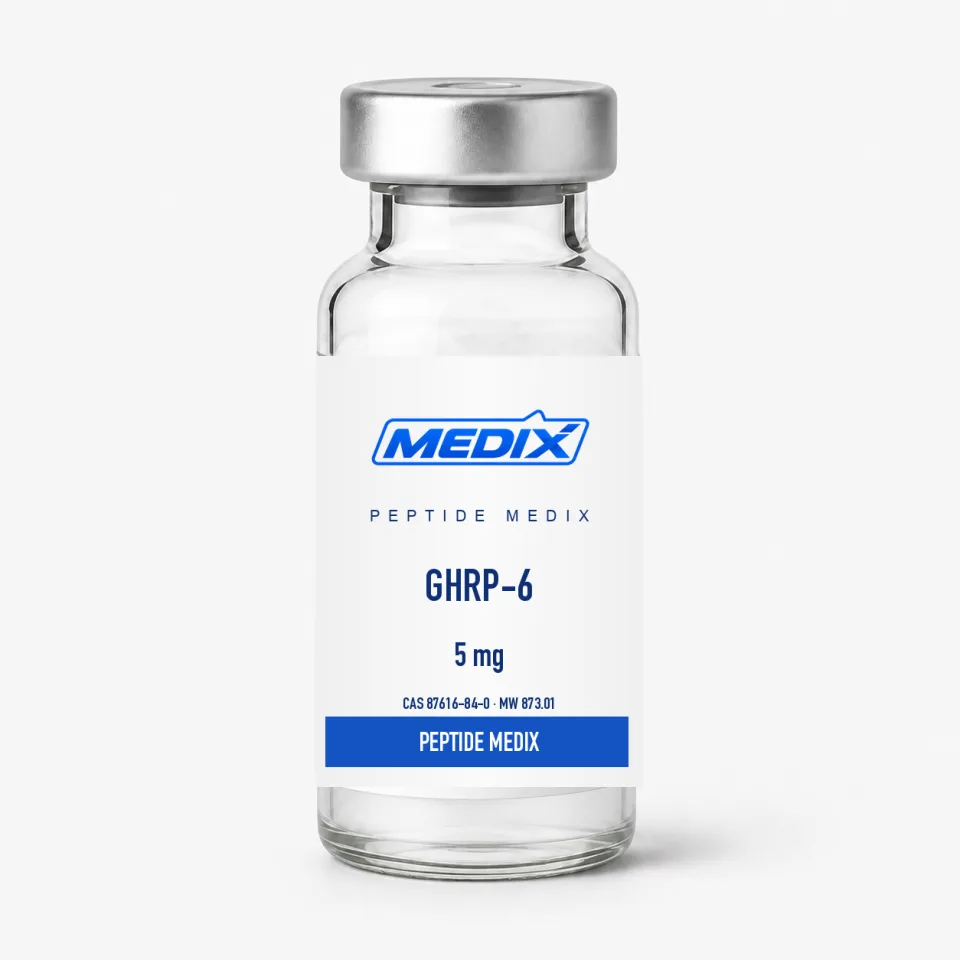
GHRP-6
Original GHS-R1a hexapeptide, His-D-Trp-Ala-Trp-D-Phe-Lys
In stock2 formats availableCAS 87616-84-0
€42Range €42 – €68
This listing is currently unavailable. Contact us and we will tell you when it is back or suggest an equivalent.
Ask about this listing or request its COA- FormLyophilized powder, sealed glass vial
- Mol. weight873.01 g/mol
- Research areasGHS-R1a pharmacology, appetite and feeding models, gastric motility, cytoprotection
For laboratory research use only. Sold exclusively for in-vitro laboratory research by qualified professionals. Not for human or veterinary use, and not a medicine, food, cosmetic or dietary supplement. Terms and Conditions
Overview
Key facts
GHRP-6, sequence His-D-Trp-Ala-Trp-D-Phe-Lys-NH2, was the first growth hormone-releasing hexapeptide.
- CAS number
- 87616-84-0
- Molecular formula
- C46H56N12O6
- Molecular weight
- 873.01 g/mol
- Amino acid sequence
- His-D-Trp-Ala-Trp-D-Phe-Lys-NH2
- Purity
- ≥99% by HPLC; lot-matched COA available
- Form
- Lyophilized powder, sealed glass vial
- Storage
- −20 °C, sealed and protected from light and moisture
- Available sizes
- 5 mg · 10 mg
For research use only. Not for human consumption.
GHRP-6, sequence His-D-Trp-Ala-Trp-D-Phe-Lys-NH2, was the first growth hormone-releasing hexapeptide. It came out of 1980s research on met-enkephalin analogues, when scientists saw that some opioid-derived fragments triggered growth hormone release by a route GHRH antagonists could not block. That hinted at a second, undiscovered receptor — and GHRP-6 became the probe used to track it down.
The search paid off twice: GHS-R1a, the growth hormone secretagogue receptor, was cloned in 1996, and ghrelin was identified as its natural ligand in 1999. GHRP-6 is still a frequently cited reference agonist in that field and is also used to study ghrelin-receptor roles in appetite, gastric motility and cytoprotection models — where its effect on rodent food intake is stronger than that of later, more selective analogues.
What sets this listing apart
GHRP-6 – vial, 5/10 mg. Lyophilized powder, sealed glass vial. Other GHRP-6 listings differ in format, fill or combination partners; the specification and COA always refer to the listing you order.
Same compound, other listings
Specifications
Identity
- CAS number
- 87616-84-0
- Molecular formula
- C46H56N12O6
- Molecular weight
- 873.01 g/mol
- Amino acid sequence
- His-D-Trp-Ala-Trp-D-Phe-Lys-NH2
- Chain length
- 6 residues, C-terminal amide
- Peptide class
- Growth hormone releasing peptide (GHRP), GHS-R1a agonist
Supply & purity
- Form
- Lyophilized powder, sealed glass vial
- Purity
- ≥99% by HPLC; lot-matched COA available
- Available sizes
- 5 mg, 10 mg
Handling & storage
- Storage (lyophilized)
- −20 °C, sealed and protected from light and moisture
- Storage (reconstituted)
- 2–8 °C, protected from light, used within the study window
Additional detail
- Also known as
- Growth hormone releasing hexapeptide, SKF-110679, GHRP
- Research areas
- GHS-R1a pharmacology, appetite and feeding models, gastric motility, cytoprotection
Questions about GHRP-6
What is GHRP-6?
A synthetic six-residue agonist of GHS-R1a, the growth hormone secretagogue receptor. As the first compound of its class to see wide use, it remains a standard reference in receptor pharmacology and ghrelin-pathway studies.
Why does GHRP-6 matter historically?
Its growth hormone release could not be accounted for by the GHRH receptor, suggesting another receptor existed. GHRP-6 served as the ligand in the work that cloned GHS-R1a — and that orphan receptor in turn led straight to ghrelin.
What distinguishes it from GHRP-2?
They share a six-residue framework but not the same sequence. GHRP-2 has D-2-naphthylalanine at position 2 and is usually reported to be more potent, whereas GHRP-6 more strongly increases food intake in rodent feeding studies.
Why protect this peptide from light?
It contains two tryptophans, and tryptophan is one of the most light-sensitive amino acids. Extended light exposure oxidises it and breaks the peptide down, so keep powder and solutions alike in the dark.
Is a COA available for every lot?
Yes. An independent laboratory checks identity and ≥99% purity of each lot by HPLC, and the matching Certificate of Analysis can be requested. Make sure your vial's lot number corresponds before you log the material.