- HPLC-assayed purity of ≥99%
- Certificate of analysis tied to your lot number
- Tracked EU delivery, dispatched the next working day
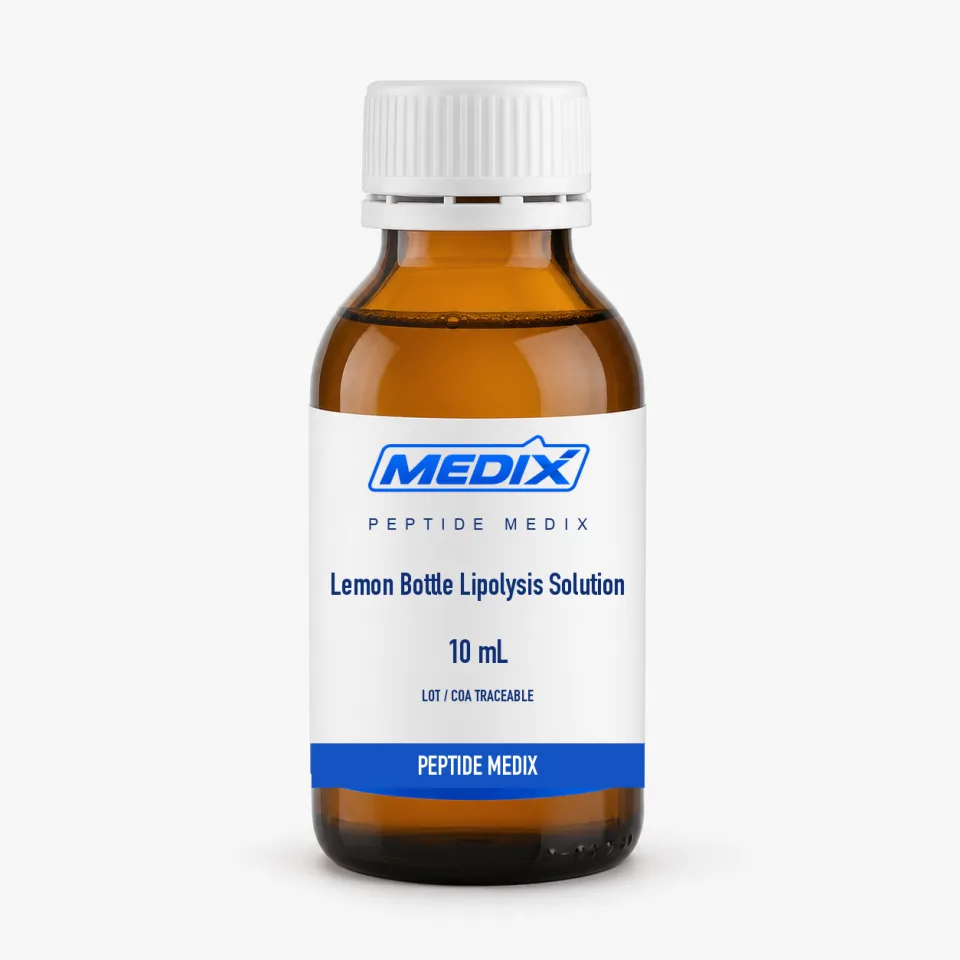
Lemon Bottle Lipolysis Solution
Aqueous lipolysis solution with bromelain, riboflavin and lecithin — 10 mL vials
In stock2 formats available
€68Range €68 – €293
This listing is currently unavailable. Contact us and we will tell you when it is back or suggest an equivalent.
Ask about this listing or request its COA- FormPre-mixed aqueous solution, sealed 10 mL vial
- Research areasAdipocyte viability and lipolysis assays, membrane-disruption models, enzyme-formulation stability
For laboratory research use only. Sold exclusively for in-vitro laboratory research by qualified professionals. Not for human or veterinary use, and not a medicine, food, cosmetic or dietary supplement. Terms and Conditions
Overview
Key facts
Every vial contains 10 mL of a clear to pale-yellow solution, sold singly or in packs of five for larger study series.
- Form
- Pre-mixed aqueous solution, sealed 10 mL vial
- Storage
- 2–8 °C, upright and protected from light; do not freeze
- Available sizes
- 10 mL · 10 mL · 5-pack
For research use only. Not for human consumption.
Every vial contains 10 mL of a clear to pale-yellow solution, sold singly or in packs of five for larger study series. It comes pre-mixed, so there is nothing to reconstitute, weigh or dissolve — you sample directly from the vial.
The shared aqueous base holds three ingredients with nothing chemically in common, which makes the mixture both hard to characterise and interesting to investigate. Bromelain is a group of cysteine proteases from the stem of the pineapple (Ananas comosus), so the product has enzymatic activity that a plain surfactant solution would lack. Riboflavin (C17H20N4O6, 376.36 g/mol) is a strongly coloured, light-sensitive flavin. Lecithin is an emulsifying phospholipid rich in phosphatidylcholine. Lab work on formulations like this focuses on adipocyte viability and lipolysis assays, membrane-disruption endpoints and the stability of enzyme formulations — studies that must tease apart what the protease does from what the surfactant does. The formula originates in South Korea and is supplied at a fixed composition, so lot-to-lot comparisons rely on that stated composition rather than on weighing ingredients separately.
Specifications
Supply & purity
- Form
- Pre-mixed aqueous solution, sealed 10 mL vial
- Available sizes
- 10 mL single vial; 10 mL × 5 pack
Additional detail
- Appearance
- Clear to pale-yellow liquid; colour derives from riboflavin
- Stated composition
- Bromelain, riboflavin (vitamin B2) and lecithin in an aqueous base
- Bromelain
- Cysteine protease complex from pineapple (Ananas comosus) stem
- Riboflavin
- Vitamin B2, C17H20N4O6, 376.36 g/mol; light-sensitive flavin
- Lecithin
- Phosphatidylcholine-rich phospholipid mixture used as an emulsifier
- Origin
- Formulation of South Korean origin
- Reconstitution
- None required — supplied ready to sample
- Research areas
- Adipocyte viability and lipolysis assays, membrane-disruption models, enzyme-formulation stability
- Storage
- 2–8 °C, upright and protected from light; do not freeze
- Stability note
- Riboflavin photodegrades and proteases lose activity when warm — keep cold and dark
- Regulatory status
- Not an approved drug or device in the United States; not a cosmetic for human application
Questions about Lemon Bottle Lipolysis Solution
What exactly does the solution contain?
According to its stated composition: bromelain (a protease complex from pineapple stem), riboflavin (vitamin B2) and lecithin, in a water-based vehicle. It comes ready-mixed at a fixed concentration, with no weighing or reconstitution needed before sampling.
What makes the liquid yellow?
Riboflavin, a deeply yellow flavin. The colour also works as a practical stability check: riboflavin breaks down easily in light, so if the colour visibly fades after light exposure, the preparation has not been stored properly.
What are the storage conditions?
Keep it upright in the fridge at 2–8 °C, in the dark, and never freeze it. Enzyme activity falls when it gets warm and riboflavin degrades in light, so log both temperature and light exposure alongside your results.
Is reconstitution required?
No. Unlike our lyophilised peptide vials, it arrives as a finished aqueous solution. Let the vial reach room temperature, swab the septum and draw from it directly — no diluent, bacteriostatic water or solvent preparation involved.
Related