- HPLC-assayed purity of ≥99%
- Certificate of analysis tied to your lot number
- Tracked EU delivery, dispatched the next working day
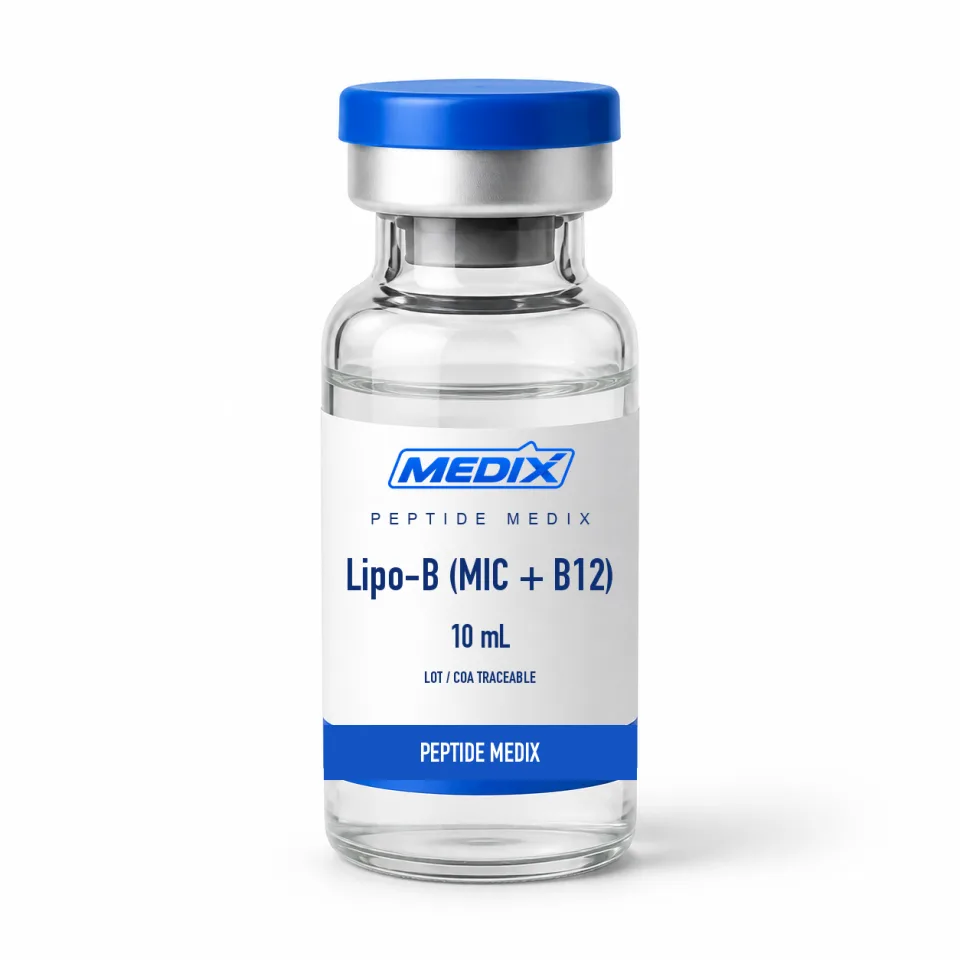
Lipo-B (MIC + B12)
Lipotropic solution of MIC plus vitamin B12 in 10 mL and 30 mL vials
In stock2 formats available
€34Range €34 – €72
This listing is currently unavailable. Contact us and we will tell you when it is back or suggest an equivalent.
Ask about this listing or request its COA- Research areasOne-carbon metabolism, hepatic lipid export, methyl-donor availability
For laboratory research use only. Sold exclusively for in-vitro laboratory research by qualified professionals. Not for human or veterinary use, and not a medicine, food, cosmetic or dietary supplement. Terms and Conditions
Overview
Key facts
Every ingredient plays a specific part in one-carbon and lipid metabolism.
- Storage
- 2–8 °C, protected from light; cobalamin is photosensitive
- Available sizes
- 10 mL · 30 mL
For research use only. Not for human consumption.
Every ingredient plays a specific part in one-carbon and lipid metabolism. Methionine, an essential sulfur-containing amino acid, is the precursor of S-adenosylmethionine, the cell's main methyl donor. Choline, a quaternary ammonium compound, is needed to make phosphatidylcholine, which the liver requires to export triglycerides in very-low-density lipoproteins — choline deficiency is the textbook way to induce fatty liver in rodents. Inositol is a carbocyclic sugar forming the backbone of phosphatidylinositol and its phosphorylated signalling derivatives. Cyanocobalamin is the precursor of the cofactors used by methionine synthase and methylmalonyl-CoA mutase, tying B12 status directly to methylation capacity and propionate metabolism.
The choice of cyanocobalamin as the B12 form is deliberate. It is the most stable and least easily degraded cobalamin, yet it is not a cofactor in its own right: cells must strip off the cyano group and convert it to methylcobalamin or adenosylcobalamin before methionine synthase or methylmalonyl-CoA mutase can use it. If that conversion is the variable you are studying, our methylcobalamin listing makes the better comparator. “Lipotropic” goes back to mid-20th-century nutrition research on substances that changed fat build-up in the liver, which is where the three-part base originates. The same solution comes in two fills, 10 mL and 30 mL, stored cold and dark because the cobalamin that colours it is light-sensitive.
Specifications
Supply & purity
- Available sizes
- 10 mL, 30 mL
Additional detail
- Composition
- Methionine, inositol, choline (MIC) with cyanocobalamin (vitamin B12)
- Product class
- Lipotropic nutrient solution (non-peptide)
- Appearance
- Clear deep pink to red solution; colour derives from cobalamin
- Methionine
- Essential sulfur amino acid; precursor of S-adenosylmethionine
- Inositol
- Carbocyclic sugar; backbone of phosphatidylinositol signaling lipids
- Choline
- Quaternary ammonium nutrient; required for phosphatidylcholine synthesis
- Cyanocobalamin
- Cobalt corrinoid form of vitamin B12; cofactor precursor for methionine synthase
- Research areas
- One-carbon metabolism, hepatic lipid export, methyl-donor availability
- Storage
- 2–8 °C, protected from light; cobalamin is photosensitive
- Documentation
- Certificate of analysis available for the supplied lot
Questions about Lipo-B (MIC + B12)
What is MIC?
Methionine, inositol and choline — the three lipotropic ingredients in this solution. Lipo-B adds cyanocobalamin, the stable form of vitamin B12, which gives the liquid its deep pink colour.
How does it differ from Lipo-C?
Lipo-C uses the same MIC and B12 base but adds L-carnitine, the carrier that brings long-chain fatty acids into mitochondria. That extra ingredient is what separates the two in comparative study designs.
Why protect it from light?
Cobalamin is light-sensitive and breaks down with extended exposure. Because it is responsible for the colour, visible fading is a handy sign that the vial has been stored incorrectly and needs checking before use.
Which documents are supplied?
The certificate of analysis for your lot is available on request. Filing it with your experimental notes links the analytical data to the specific vial you used — important for multi-component solutions.
Related