- HPLC-assayed purity of ≥99%
- Certificate of analysis tied to your lot number
- Tracked EU delivery, dispatched the next working day
Metabolic & Circadian Compounds
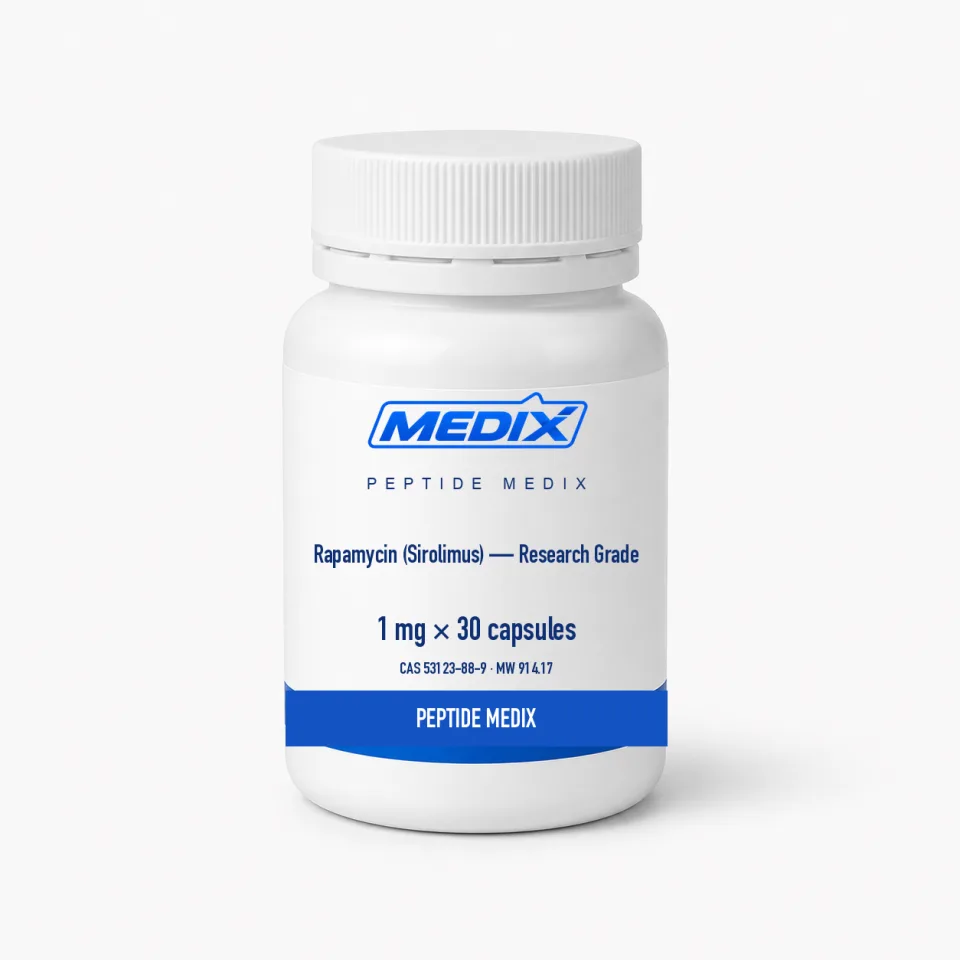
Rapamycin (Sirolimus) — Research Grade
Macrolide mTOR inhibitor — reference entry, prescription only
In stock2 formats availableCAS 53123-88-9
€97Range €97 – €191
This listing is currently unavailable. Contact us and we will tell you when it is back or suggest an equivalent.
Ask about this listing or request its COA- Mol. weight914.17 g/mol
For laboratory research use only. Sold exclusively for in-vitro laboratory research by qualified professionals. Not for human or veterinary use, and not a medicine, food, cosmetic or dietary supplement. Terms and Conditions
Overview
Key facts
Reference entry for a prescription-only medicine.
- CAS number
- 53123-88-9
- Molecular formula
- C51H79NO13
- Molecular weight
- 914.17 g/mol
- Storage
- Per the approved product labelling — original sealed container, protected from light; oral solution requires refrigeration
- Available sizes
- 1 mg · 30 capsules · 5 mg · 30 capsules
For research use only. Not for human consumption.
Reference entry for a prescription-only medicine. Rapamycin — generic name sirolimus — can only be supplied on prescription. We list it in this institutional catalogue purely so that labs and clinics can recognise the substance and look up its chemistry and legal status. Material is released only against a valid prescription or an institution's documented authorisation, and this page gives no information on obtaining, dosing or administering it.
Sirolimus occurs in nature: it is a large ring-shaped lactone with 31 atoms in the ring, first isolated from Streptomyces hygroscopicus bacteria in soil collected on Rapa Nui (Easter Island) — the origin of the name rapamycin, used before sirolimus became the official generic term. Formula C51H79NO13, 914.17 g/mol. It barely dissolves in water but does dissolve in ethanol, methanol and DMSO, which is why cell-culture work includes a control containing the same solvent. It works in an unusual way, not by attaching to its target directly but via a helper protein: first it pairs with FKBP12, an immunophilin in the cytosol, and that pair then latches onto the FRB domain of mTOR. Storage should follow the authorised product information — sealed in the original pack and kept out of the light.
Specifications
Identity
- CAS number
- 53123-88-9
- Molecular formula
- C51H79NO13
- Molecular weight
- 914.17 g/mol
Supply & purity
- Solubility
- Practically insoluble in water; soluble in ethanol, methanol and DMSO
Additional detail
- Regulatory status
- Prescription-only medicine (Rx); supplied solely against valid prescription or institutional authorisation
- Generic name
- Sirolimus
- Also known as
- Rapamycin, RAPA, AY-22989
- Chemical class
- 31-membered macrocyclic lactone (macrolide) natural product
- Natural source
- Streptomyces hygroscopicus
- Molecular target
- FKBP12; the rapamycin–FKBP12 complex inhibits mTOR complex 1
- Drug class
- mTOR inhibitor; immunosuppressant
- Reference options listed
- 1 mg × 30 capsules, 5 mg × 30 capsules
- Storage
- Per the approved product labelling — original sealed container, protected from light; oral solution requires refrigeration
- Intended use
- Reference listing only; dispensed exclusively against valid authorisation
Questions about Rapamycin (Sirolimus) — Research Grade
Can rapamycin be obtained without a prescription?
No. Sirolimus requires a prescription. This page is an entry in an institutional reference catalogue that describes the substance and its legal status; supply happens only against a valid prescription or an institution's documented authorisation, and we point to no other source.
By what route does rapamycin inhibit mTOR?
Via a helper protein. Rapamycin first attaches to FKBP12, an immunophilin in the cell's cytosol; the resulting pair then binds mTOR at its FRB domain and inhibits mTOR complex 1 allosterically. Signalling through 4E-BP1 and S6 kinase 1 declines and autophagy is switched on, whereas mTOR complex 2 is barely affected by brief exposure.
Why is it listed with NMN and metformin?
Only because of research theme — all three feature prominently in nutrient-sensing and ageing research. The grouping reflects shared subject matter, not a suggestion to combine them, and it does not change rapamycin's prescription status.
Is dosing information given?
No. For a prescription medicine the prescriber decides on dose, monitoring and administration using the authorised product information. We restrict this entry to the substance's chemistry, how it works, its legal status and how it is stored.
Related