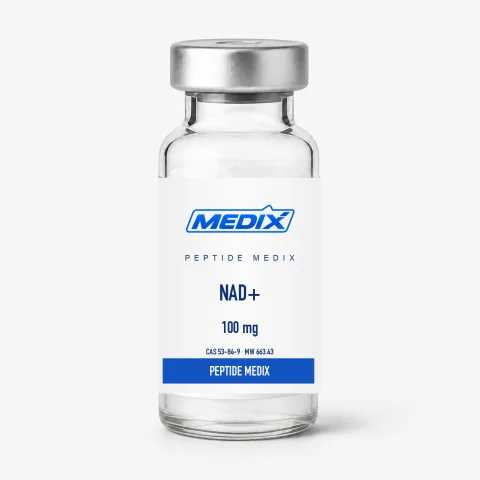
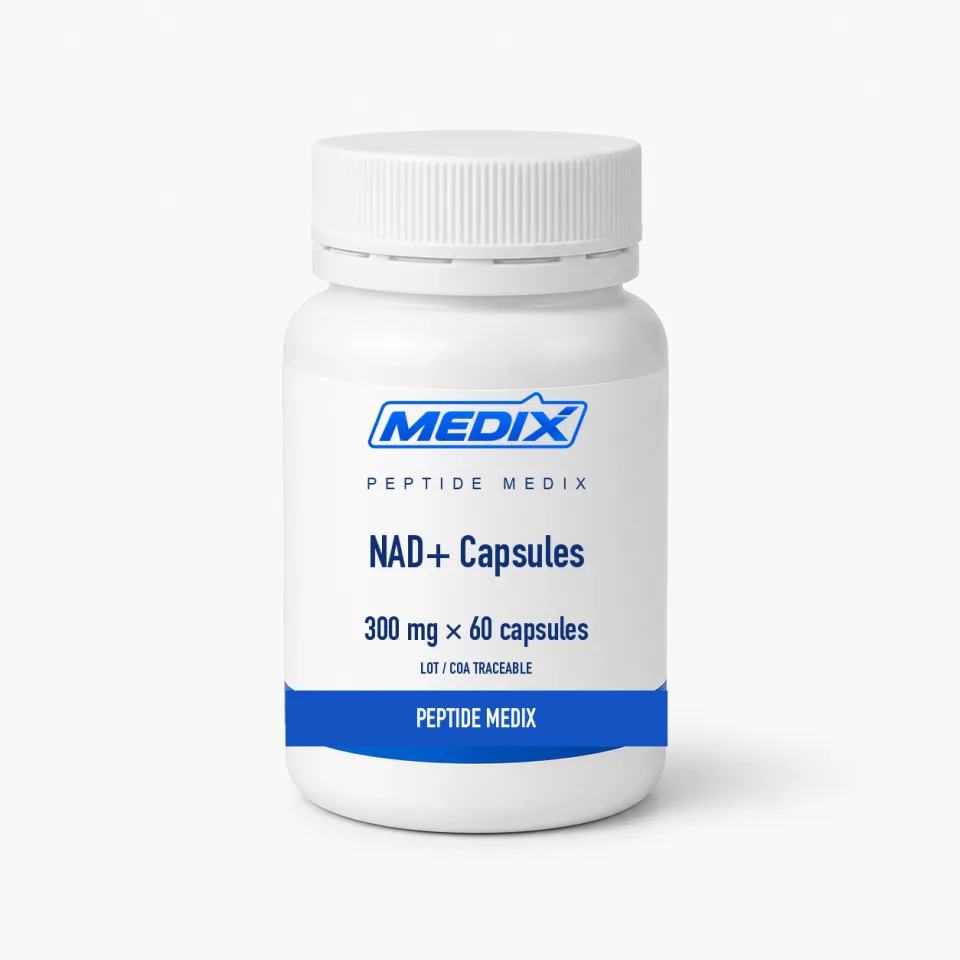
- HPLC-assayed purity of ≥99%
- Certificate of analysis tied to your lot number
- Tracked EU delivery, dispatched the next working day
NAD+ Capsules
NAD+ research capsules for oral-route studies — 300 mg of the coenzyme each
In stock1 format availableCAS 53-84-9
€51
This listing is currently unavailable. Contact us and we will tell you when it is back or suggest an equivalent.
Ask about this listing or request its COA- FormOral capsules in a sealed bottle with desiccant and tamper-evident closure
- Mol. weight663.43 g/mol
- Research areasCellular redox state, mitochondrial metabolism, DNA repair signalling, ageing biology, oral bioavailability of NAD precursors
For laboratory research use only. Sold exclusively for in-vitro laboratory research by qualified professionals. Not for human or veterinary use, and not a medicine, food, cosmetic or dietary supplement. Terms and Conditions
Overview
Key facts
These capsules supply nicotinamide adenine dinucleotide (NAD+) as a fixed oral research unit of 300 mg instead of a lyophilised vial.
- CAS number
- 53-84-9
- Molecular formula
- C21H27N7O14P2
- Molecular weight
- 663.43 g/mol
- Form
- Oral capsules in a sealed bottle with desiccant and tamper-evident closure
- Storage
- Cool, dry and dark in the sealed bottle; refrigeration extends shelf stability
- Available size
- 300 mg · 60 capsules
For research use only. Not for human consumption.
These capsules supply nicotinamide adenine dinucleotide (NAD+) as a fixed oral research unit of 300 mg instead of a lyophilised vial. The molecule is exactly what our NAD+ vials contain — the oxidised free acid of the dinucleotide coenzyme, CAS 53-84-9, C21H27N7O14P2, 663.43 g/mol — assayed against a ≥99% HPLC specification and documented with a certificate of analysis for each lot.
NAD+ lies at the heart of cellular redox chemistry, accepting electrons for hundreds of dehydrogenases, and sirtuins, PARPs and CD38 use it up as a substrate. Oral-route research concentrates on one question: does the intact dinucleotide survive digestion, or is it broken down to precursors such as nicotinamide riboside and nicotinamide before absorption? That remains unresolved and is a frequent study endpoint.
What sets this listing apart
NAD+ Capsules – capsules, 300 mg. Oral capsules in a sealed bottle with desiccant and tamper-evident closure. Other NAD+ listings differ in format, fill or combination partners; the specification and COA always refer to the listing you order.
Same compound, other listings
Specifications
Identity
- CAS number
- 53-84-9
- Molecular formula
- C21H27N7O14P2
- Molecular weight
- 663.43 g/mol
Supply & purity
- Form
- Oral capsules in a sealed bottle with desiccant and tamper-evident closure
Additional detail
- Content per capsule
- 300 mg NAD+ (free acid)
- Available counts
- 60 capsules
- Purity (raw material)
- ≥99% by HPLC; lot-matched COA available
- Active compound
- NAD+ (nicotinamide adenine dinucleotide), oxidised form
- Chemical class
- Dinucleotide coenzyme — not a peptide
- Also known as
- Nicotinamide adenine dinucleotide, oxidised NAD, DPN
- Enzyme substrate for
- Sirtuins (SIRT1–7), PARP family, CD38/CD157
- Research areas
- Cellular redox state, mitochondrial metabolism, DNA repair signalling, ageing biology, oral bioavailability of NAD precursors
- Storage
- Cool, dry and dark in the sealed bottle; refrigeration extends shelf stability
Questions about NAD+ Capsules
What does a single capsule hold?
300 mg of NAD+ (the oxidised free acid of nicotinamide adenine dinucleotide); each sealed bottle has 60 capsules. The raw material matches our NAD+ vials, assayed to ≥99% by HPLC with a certificate for each lot.
Does NAD+ taken by mouth get absorbed intact?
Nobody knows for certain yet. NAD+ is a big, charged, chemically fragile molecule that gut glycohydrolases can cleave, so studies ask whether any rise in measured NAD reflects intact absorption or breakdown into precursors followed by rebuilding via the salvage pathway.
NAD+ or NMN — which suits my research?
NMN is a smaller, more soluble salvage-pathway precursor that NMNAT enzymes convert into NAD+; NAD+ is the end product. To shift the coenzyme pool, many studies prefer a precursor; assays that need NAD+ itself as an enzyme substrate use the dinucleotide directly.
Can I see a certificate of analysis?
Yes. The NAD+ in these capsules is HPLC-analysed against a ≥99% purity specification, and a COA stating identity, method and measured purity for your lot is available on request, before or after you order.
How are the capsules best stored?
Keep the bottle closed, cool, dry and dark with the desiccant inside; refrigeration extends shelf life. Let a cold bottle reach room temperature before opening so moisture doesn't condense on the contents, and don't leave it open in humid air.
Related