- HPLC-assayed purity of ≥99%
- Certificate of analysis tied to your lot number
- Tracked EU delivery, dispatched the next working day
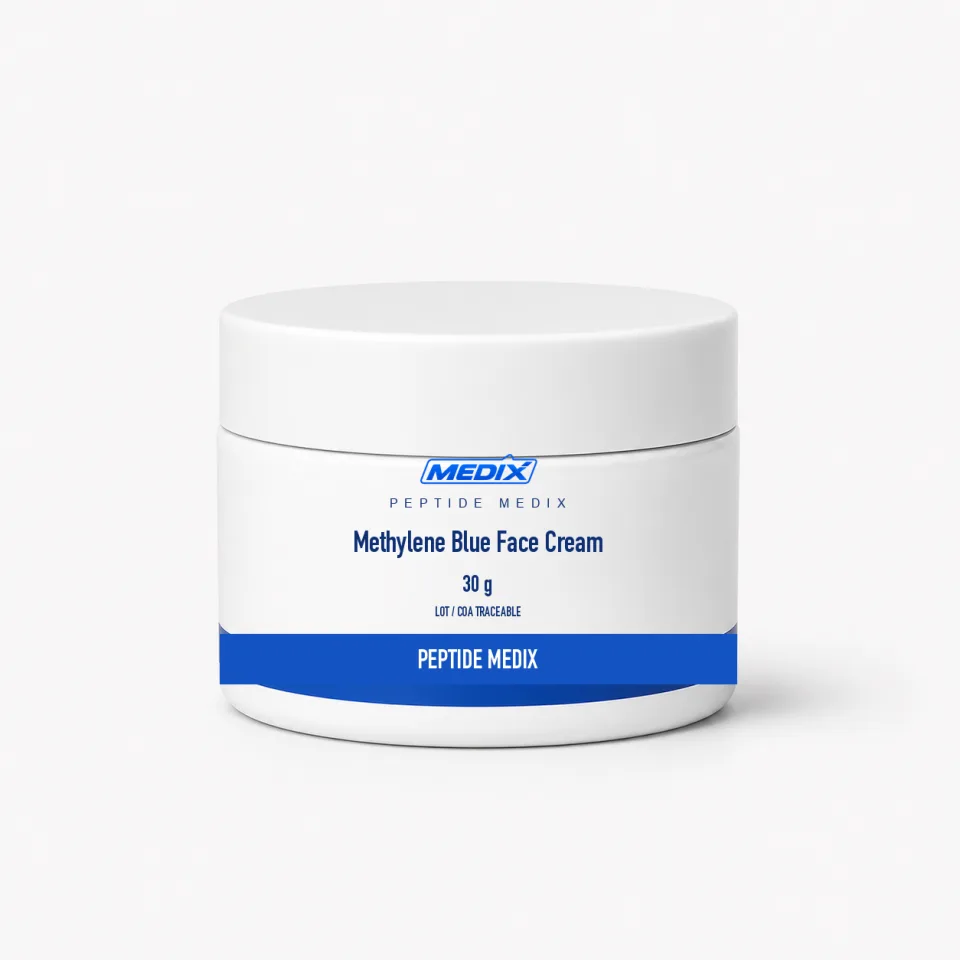
Methylene Blue Face Cream
Non-staining methylene blue cream, 30 g, for mitochondrial skin-model studies
In stock1 format available
€51
This listing is currently unavailable. Contact us and we will tell you when it is back or suggest an equivalent.
Ask about this listing or request its COA- FormEmollient cream in a 30 g screw-top jar
- Research areasFibroblast oxidative stress, cellular senescence models, mitochondrial function in skin
For laboratory research use only. Sold exclusively for in-vitro laboratory research by qualified professionals. Not for human or veterinary use, and not a medicine, food, cosmetic or dietary supplement. Terms and Conditions
Overview
Key facts
Few dyes have as long a scientific pedigree as methylene blue, a phenothiazine that became the first entirely synthetic compound used as a medicine and is still a go-to redox indicator.
- CAS number
- 61-73-4
- Molecular formula
- C16H18ClN3S
- Molecular weight
- 319.85 g/mol
- Form
- Emollient cream in a 30 g screw-top jar
- Storage
- Cool and dark, ideally 2–8 °C; keep the jar closed
- Available size
- 30 g
For research use only. Not for human consumption.
Few dyes have as long a scientific pedigree as methylene blue, a phenothiazine that became the first entirely synthetic compound used as a medicine and is still a go-to redox indicator. Cell biologists are interested in how it behaves at low concentration, where it serves as an alternative electron carrier: it takes electrons from NADH and passes them further along the mitochondrial respiratory chain, sidestepping poorly functioning complexes. In cell models this has been linked to lower reactive oxygen species and longer fibroblast lifespan in culture.
In this 30 g cream, methylene blue sits in an emollient base at a low concentration that leaves no tint — intentionally well under the roughly 0.05% at which the dye visibly colours skin blue. Staying below that threshold is what makes it usable in skin models, where visible colour would otherwise disturb photographic and colorimetric measurements.
As a small molecule, not a peptide, methylene blue is included here as a companion to our copper-peptide and cosmetic-peptide formats. Each jar carries a lot number and is shipped from our EU warehouse, for laboratory research only.
Specifications
Supply & purity
- Form
- Emollient cream in a 30 g screw-top jar
Additional detail
- Available size
- 30 g
- Active
- Methylene blue (methylthioninium chloride)
- Active concentration
- Sub-staining, tint-free level; exact figure printed on the lot label
- CAS number (active)
- 61-73-4
- Molecular formula (active)
- C16H18ClN3S
- Molecular weight (active)
- 319.85 g/mol
- Compound class
- Phenothiazine dye; redox-active small molecule
- Mechanism studied
- Alternative electron carrier in the mitochondrial electron transport chain
- Research areas
- Fibroblast oxidative stress, cellular senescence models, mitochondrial function in skin
- Vehicle
- Emollient cream base, no added fragrance
- Storage
- Cool and dark, ideally 2–8 °C; keep the jar closed
- Handling note
- Methylene blue stains textiles and porous surfaces even at low concentrations
Questions about Methylene Blue Face Cream
What does the cream contain?
Methylene blue — a redox-active small molecule of the phenothiazine class — in an emollient base at a low, non-tinting concentration; the precise figure for your jar appears on its lot label. Only one size is available: 30 g.
Will skin or surfaces turn blue?
The concentration is held under the level (about 0.05%) at which skin visibly stains. Even so, methylene blue marks fabric, paper and porous materials it touches, so wear gloves, protect your bench and clean up spills quickly.
What makes methylene blue interesting for skin models?
At low levels it can shuttle electrons within the mitochondrial respiratory chain. Studies in cultured human fibroblasts have described lower reactive oxygen species and delayed markers of senescence under such conditions — observations made in vitro, in particular models.
Does this count as a peptide product?
No. Methylene blue (CAS 61-73-4) is a small synthetic molecule. We list it as a companion to our copper-peptide and cosmetic-peptide topicals, and documentation on the active ingredient can be requested.
How should I store and sample the jar?
Keep it closed, cool and dark — ideally in the fridge. Take portions with a clean spatula rather than reusing tools, weigh amounts for quantitative work, and note lot number and opening date so measurements can be traced to that fill.
Related