- HPLC purity ≥98%, with a COA for each lot on request
- Certificate of analysis tied to your lot number
- Tracked EU delivery, dispatched the next working day
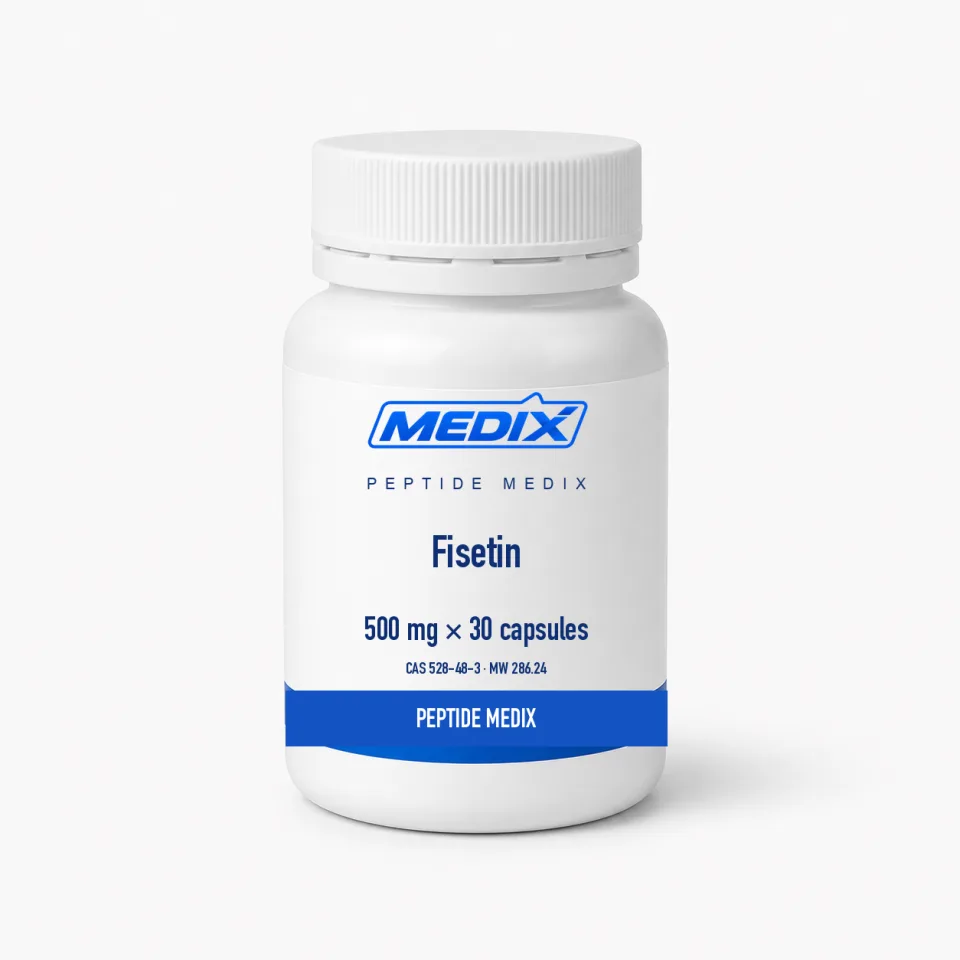
Fisetin
Plant flavonol researched as a senolytic in models of cellular ageing
In stock1 format availableCAS 528-48-3
€42
This listing is currently unavailable. Contact us and we will tell you when it is back or suggest an equivalent.
Ask about this listing or request its COA- FormYellow crystalline powder in oral research capsules, sealed bottle with desiccant
- Mol. weight286.24 g/mol
- Research areasCellular senescence and senolytics, Nrf2 and antioxidant response, sirtuin signalling, neuroprotection models
For laboratory research use only. Sold exclusively for in-vitro laboratory research by qualified professionals. Not for human or veterinary use, and not a medicine, food, cosmetic or dietary supplement. Terms and Conditions
Overview
Key facts
Fisetin is a natural flavonol (3,3',4',7-tetrahydroxyflavone) present in strawberries, apples, persimmons, grapes and onions, generally in very small amounts.
- CAS number
- 528-48-3
- Molecular formula
- C15H10O6
- Molecular weight
- 286.24 g/mol
- Purity
- ≥98% by HPLC; lot-matched COA available
- Form
- Yellow crystalline powder in oral research capsules, sealed bottle with desiccant
- Storage
- Room temperature or cooler, dry, sealed and protected from light
- Available size
- 500 mg · 30 capsules
For research use only. Not for human consumption.
Fisetin is a natural flavonol (3,3',4',7-tetrahydroxyflavone) present in strawberries, apples, persimmons, grapes and onions, generally in very small amounts. What we supply is a purified, yellow crystalline powder filled at 500 mg per capsule — far beyond dietary intake, which is why fisetin features mainly in cell and rodent research rather than nutrition studies.
As with most flavonoids, it dissolves poorly in water and is heavily conjugated once absorbed, so bioavailability dominates the literature and matters in the lab too: stocks are generally made up in DMSO, and formulation research frequently uses lipid or cyclodextrin carriers. Every lot is assayed chromatographically against a ≥98% specification, and its certificate of analysis is available.
Specifications
Identity
- CAS number
- 528-48-3
- Molecular formula
- C15H10O6
- Molecular weight
- 286.24 g/mol
Supply & purity
- Form
- Yellow crystalline powder in oral research capsules, sealed bottle with desiccant
- Purity
- ≥98% by HPLC; lot-matched COA available
- Solubility
- Practically insoluble in water; soluble in DMSO, ethanol and alkaline aqueous buffers
Additional detail
- Content per capsule
- 500 mg fisetin
- Available counts
- 30 capsules
- Chemical name
- 3,3',4',7-tetrahydroxyflavone
- Chemical class
- Flavonol (flavonoid polyphenol)
- Natural sources
- Strawberry, apple, persimmon, grape, onion — typically at milligram-per-kilogram levels
- Research areas
- Cellular senescence and senolytics, Nrf2 and antioxidant response, sirtuin signalling, neuroprotection models
- Storage
- Room temperature or cooler, dry, sealed and protected from light
Questions about Fisetin
What is fisetin?
A flavonol, 3,3',4',7-tetrahydroxyflavone, that occurs naturally in strawberries, apples and other plants. Researchers know it best as a senolytic candidate — a compound investigated for reportedly clearing senescent cells preferentially, both in culture and in aged animals.
How pure is it, and can I see the COA?
Purity is ≥98% by HPLC, and the lot's certificate — covering identity, method and measured purity — is available on request. Flavonoids of botanical origin differ considerably between suppliers, so review the COA before building a study around a particular lot.
Why do fisetin papers focus so much on bioavailability?
It is barely water-soluble and, after absorption, is quickly glucuronidated and sulfated, so the free aglycone is only briefly present in pharmacokinetic studies. Much recent work therefore concentrates on formulation — liposomes, cyclodextrins and nanoparticles designed to increase measured exposure.
How is it prepared for in vitro experiments?
Since it is practically water-insoluble, labs usually make a concentrated DMSO stock, freeze light-protected aliquots at −20 °C and dilute into medium right before use. Include vehicle controls and watch for precipitation and for autoxidation artefacts typical of polyphenols in culture media.
What are the storage conditions for the capsules?
Keep the closed bottle at or below room temperature, dry and away from heat and direct light, leaving the desiccant inside. Under these conditions fisetin is stable; if the powder darkens noticeably, it may have oxidised, and the lot should be checked against its COA before further use.
Related