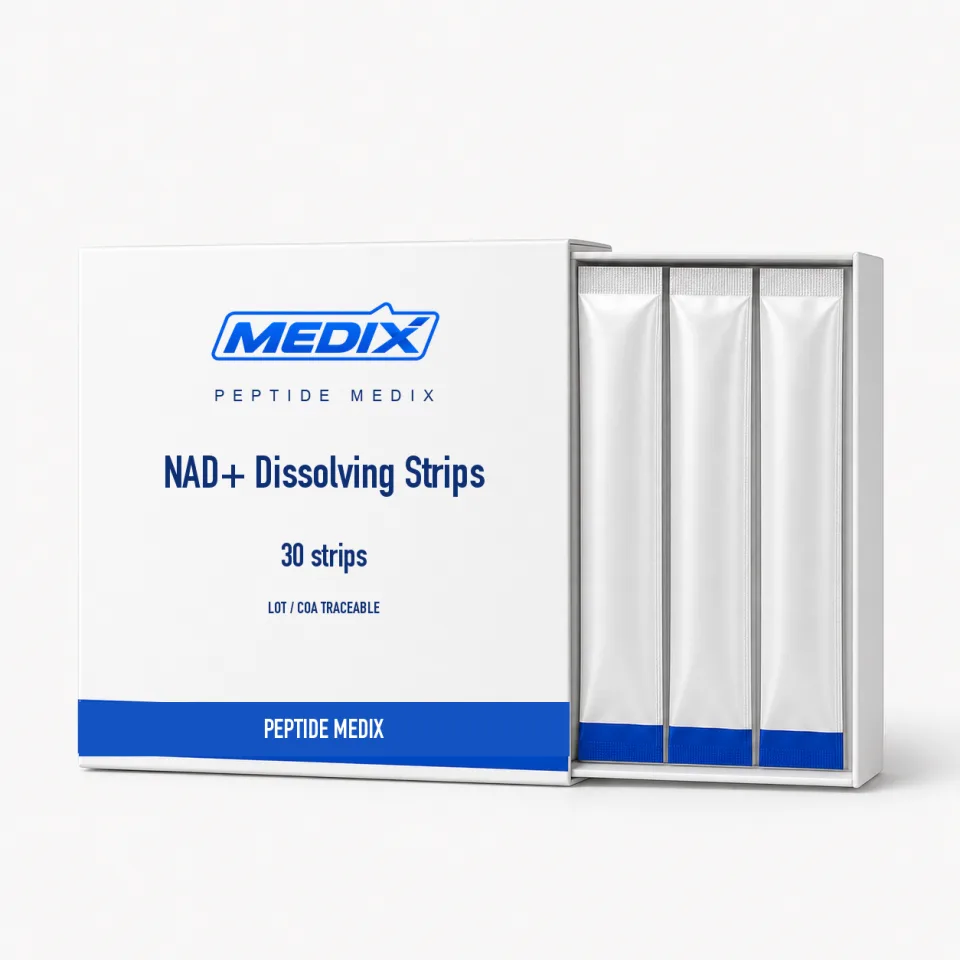
- NAD+ input assayed to ≥99% (HPLC), documented per lot
- Certificate of analysis tied to your lot number
- Tracked EU delivery, dispatched the next working day
NAD+ Dissolving Strips
Pre-dosed NAD+ thin-film strips — 30 per sealed tin
In stock1 format available
€63
This listing is currently unavailable. Contact us and we will tell you when it is back or suggest an equivalent.
Ask about this listing or request its COA- Research areasFormat comparison studies, NAD-dependent enzyme work, cellular energy research
For laboratory research use only. Sold exclusively for in-vitro laboratory research by qualified professionals. Not for human or veterinary use, and not a medicine, food, cosmetic or dietary supplement. Terms and Conditions
Overview
Key facts
These strips deliver nicotinamide adenine dinucleotide in a quickly dissolving thin film instead of as lyophilised powder.
- Purity
- ≥99% by HPLC on the NAD+ used; lot-matched COA
- Storage
- Cool, dry place in the sealed tin, protected from light and humidity
- Available size
- 30 strips
For research use only. Not for human consumption.
These strips deliver nicotinamide adenine dinucleotide in a quickly dissolving thin film instead of as lyophilised powder. A sealed tin holds 30 pre-dosed strips. The point of the film is that reconstitution disappears altogether — no diluent, septum or syringe, and none of the error that comes from weighing or pipetting tiny masses.
The film is a water-soluble polymer matrix, from the same family of hydrophilic film-formers used throughout oral thin-film technology, loaded with the coenzyme and cast to a controlled thickness so each strip contains a consistent amount. Placed in an aqueous medium, it breaks up within seconds and releases its contents into solution.
For research groups the benefits are reproducibility and portability. Strips help when a protocol needs repeated identical additions, when you want to avoid opening a large powder vial over and over, or when comparing delivery formats of one compound is itself the experiment. The NAD+ in the film meets the same ≥99% HPLC standard as our vial product, and a Certificate of Analysis is available for each lot.
What sets this listing apart
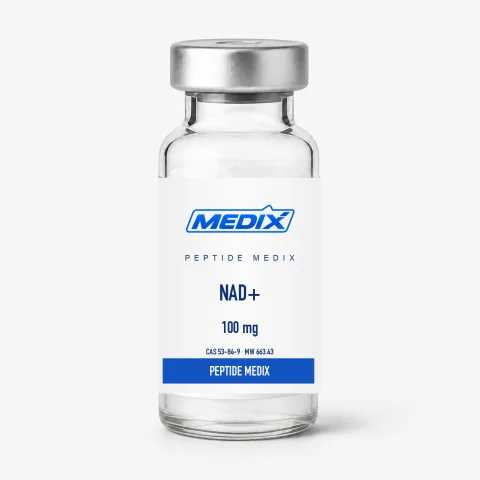
NAD+ Dissolving Strips – dissolving strips. Other NAD+ listings differ in format, fill or combination partners; the specification and COA always refer to the listing you order.
Same compound, other listings
Specifications
Supply & purity
- Purity
- ≥99% by HPLC on the NAD+ used; lot-matched COA
Additional detail
- Format
- Fast-dissolving oral-film-type thin strips
- Pack size
- 30 strips per sealed tin
- Active compound
- NAD+ (nicotinamide adenine dinucleotide, oxidized)
- NAD+ CAS number
- 53-84-9
- NAD+ molecular formula
- C21H27N7O14P2
- NAD+ molecular weight
- 663.43 g/mol
- Matrix
- Water-soluble film-forming polymer base
- Dispersion
- Disperses rapidly in water and aqueous buffers
- Reconstitution
- None required — the strip is the delivered unit
- Storage
- Cool, dry place in the sealed tin, protected from light and humidity
- Handling note
- Handle with clean dry forceps; films soften with moisture and skin contact
- Research areas
- Format comparison studies, NAD-dependent enzyme work, cellular energy research
Questions about NAD+ Dissolving Strips
What exactly are these strips?
Thin films of water-soluble polymer, each carrying a pre-set amount of NAD+, packed thirty to a sealed tin. They provide the coenzyme with no reconstitution, diluent or syringe work at all.
How many come in one tin?
30 film strips. The tin is the main protection against moisture, so closing it again after every removal is the most important handling rule for this format.
Has the NAD+ in the film been analysed?
Yes — HPLC confirms ≥99% purity, and the lot's Certificate of Analysis, covering identity and purity of the coenzyme, can be viewed before you buy.
Strip or vial: what's the trade-off?
A vial gives you bulk powder to weigh or dissolve, with complete control over concentration. A strip gives you a fixed, pre-measured unit and no liquid handling. You exchange control for convenience and unit-to-unit consistency.
Could the film matrix affect my assay?
The polymer dissolves into the medium together with the coenzyme. It is inert in most cell-free and cell-culture work, but assays sensitive to viscosity, surfactants or polymer background should be validated with a blank-strip control.
What storage conditions are best?
A cool, dry spot for the sealed tin, away from light and humidity. Thin films have a large surface for their mass and pick up moisture easily, so don't refrigerate them unless they are in a desiccated container — otherwise condensation forms when you open it.
Related