- HPLC purity ≥99%, with a COA for each lot on request
- Certificate of analysis tied to your lot number
- Tracked EU delivery, dispatched the next working day
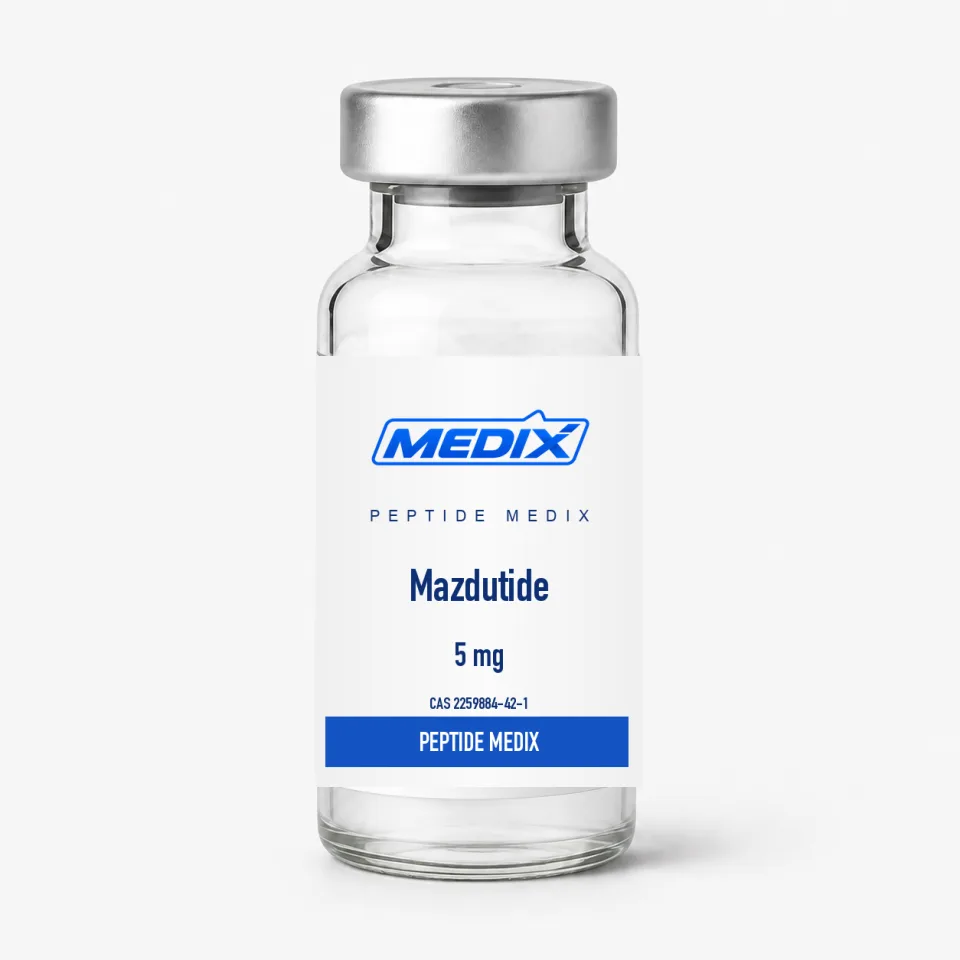
Mazdutide
Dual GLP-1/glucagon receptor agonist peptide modelled on oxyntomodulin
In stock3 formats availableCAS 2259884-42-1
€97Range €97 – €293
This listing is currently unavailable. Contact us and we will tell you when it is back or suggest an equivalent.
Ask about this listing or request its COA- FormLyophilized powder, sealed glass vial with flip-off seal
- Research areasEnergy expenditure, hepatic substrate handling, incretin-glucagon receptor balance
For laboratory research use only. Sold exclusively for in-vitro laboratory research by qualified professionals. Not for human or veterinary use, and not a medicine, food, cosmetic or dietary supplement. Terms and Conditions
Overview
Key facts
What makes mazdutide valuable to researchers is the natural blueprint behind it.
- CAS number
- 2259884-42-1
- Purity
- ≥99% by HPLC; lot-matched COA available
- Form
- Lyophilized powder, sealed glass vial with flip-off seal
- Storage
- −20 °C, sealed and protected from light and moisture
- Available sizes
- 5 mg · 10 mg · 20 mg
For research use only. Not for human consumption.
What makes mazdutide valuable to researchers is the natural blueprint behind it. Survodutide and retatrutide are designed scaffolds; mazdutide instead keeps the receptor balance that evolution already gave oxyntomodulin, so it lets you test whether an oxyntomodulin-like ratio performs differently from an engineered one. It is used in cAMP potency panels, in hepatocyte and adipocyte assays, and in rodent energy-balance studies that track glucagon-driven energy expenditure and GLP-1-driven reduction in food intake side by side.
Its template, oxyntomodulin, is a 37-amino-acid product of proglucagon — glucagon's complete sequence plus an eight-residue basic extension at the C-terminus. It naturally activates both the glucagon and GLP-1 receptors but disappears within minutes. Mazdutide stabilises that design with protease-resistant substitutions and a fatty side chain for reversible albumin binding; it is registered as CAS 2259884-42-1 and appears in papers as IBI362 and LY3305677. When compiling references, search under all three identifiers, as early publications mostly use the development codes. Vials of 5 mg, 10 mg and 20 mg are available; reconstitute in bacteriostatic water or a dilute alkaline or phosphate buffer, keep the lyophilised cake at −20 °C and solutions at 2–8 °C.
Specifications
Identity
- CAS number
- 2259884-42-1
- Peptide class
- Acylated oxyntomodulin analog; dual GLP-1 / glucagon receptor agonist
Supply & purity
- Form
- Lyophilized powder, sealed glass vial with flip-off seal
- Purity
- ≥99% by HPLC; lot-matched COA available
- Available sizes
- 5 mg, 10 mg, 20 mg
- Solubility
- Bacteriostatic water; dilute alkaline or phosphate buffers also used
Handling & storage
- Storage (lyophilized)
- −20 °C, sealed and protected from light and moisture
- Storage (reconstituted)
- 2–8 °C, protected from light; use within the study window
Additional detail
- Also cited as
- IBI362 and LY3305677 in the research literature
- Structural notes
- Proglucagon-family backbone with protease-resistant substitutions and a lipid side chain for albumin binding
- Research areas
- Energy expenditure, hepatic substrate handling, incretin-glucagon receptor balance
Questions about Mazdutide
Which natural peptide is mazdutide modelled on?
Oxyntomodulin — a proglucagon-derived hormone that activates both GLP-1 and glucagon receptors. Stabilising substitutions plus a fatty-acid side chain give mazdutide a working life that native oxyntomodulin lacks.
Are IBI362 and LY3305677 the same substance?
Yes — both development codes refer to mazdutide in the pharmacology literature. Search all three names when gathering references, because older papers frequently mention only a code.
Mazdutide or survodutide — how do they differ?
Each activates glucagon and GLP-1 receptors, but they descend from separate design lines and have different receptor potency ratios. Labs frequently test them together precisely to see whether that ratio changes the metabolic phenotype.
Which analytical documents are supplied?
We HPLC-test every lot to ≥99% and confirm identity by mass spectrometry; the certificate for your lot is available and refers to the vial number you receive, keeping your data traceable to that material.
What storage conditions apply?
Unopened lyophilised vials: −20 °C, out of light and moisture. Reconstituted solution: 2–8 °C in the dark, used up within your documented study window. Aliquot so you don't cycle it through freezing and thawing.
Related