- HPLC purity ≥99%, with a COA for each lot on request
- Certificate of analysis tied to your lot number
- Tracked EU delivery, dispatched the next working day
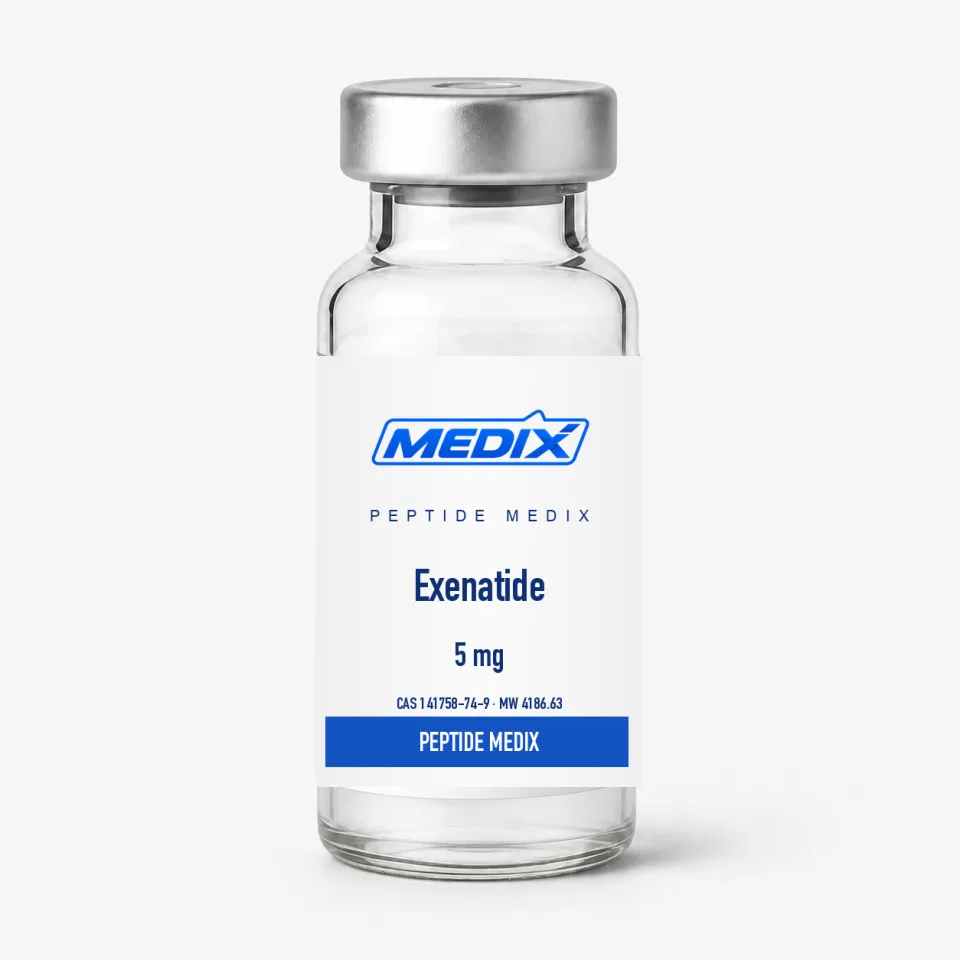
Exenatide
Synthetic exendin-4 — a 39-amino-acid GLP-1 receptor agonist
In stock2 formats availableCAS 141758-74-9
€72Range €72 – €123
This listing is currently unavailable. Contact us and we will tell you when it is back or suggest an equivalent.
Ask about this listing or request its COA- FormLyophilized white to off-white powder, sealed glass vial
- Mol. weight4186.63 g/mol
- Research areasGLP-1 receptor pharmacology, islet beta-cell biology, gastric emptying, neuroprotection models
For laboratory research use only. Sold exclusively for in-vitro laboratory research by qualified professionals. Not for human or veterinary use, and not a medicine, food, cosmetic or dietary supplement. Terms and Conditions
Overview
Key facts
Exenatide is synthetic exendin-4, a 39-residue peptide first found in the saliva of the Gila monster (Heloderma suspectum).
- CAS number
- 141758-74-9
- Molecular formula
- C184H282N50O60S
- Molecular weight
- 4186.63 g/mol
- Amino acid sequence
- His-Gly-Glu-Gly-Thr-Phe-Thr-Ser-Asp-Leu-Ser-Lys-Gln-Met-Glu-Glu-Glu-Al…
- Purity
- ≥99% by HPLC; lot-matched COA available
- Form
- Lyophilized white to off-white powder, sealed glass vial
- Storage
- −20 °C, sealed and protected from light and moisture
- Available sizes
- 5 mg · 10 mg
For research use only. Not for human consumption.
Exenatide is synthetic exendin-4, a 39-residue peptide first found in the saliva of the Gila monster (Heloderma suspectum). About half of its sequence matches mammalian GLP-1, but position two carries glycine instead of alanine, which makes it highly resistant to dipeptidyl peptidase-4. Thanks to this one change, exendin-4 stays active far longer than native GLP-1 — the reason it became the benchmark agonist of incretin pharmacology.
At the bench, exenatide is the standard tool for interrogating the GLP-1 receptor. Researchers use it to generate agonist concentration–response curves, to confirm receptor expression in transfected cells and isolated islets, and as the positive control for benchmarking newer analogues like semaglutide, liraglutide and the multi-receptor agonists. Its truncated fragment exendin(9-39) is the corresponding antagonist, and the two are commonly used together.
Specifications
Identity
- CAS number
- 141758-74-9
- Molecular formula
- C184H282N50O60S
- Molecular weight
- 4186.63 g/mol
- Amino acid sequence
- His-Gly-Glu-Gly-Thr-Phe-Thr-Ser-Asp-Leu-Ser-Lys-Gln-Met-Glu-Glu-Glu-Ala-Val-Arg-Leu-Phe-Ile-Glu-Trp-Leu-Lys-Asn-Gly-Gly-Pro-Ser-Ser-Gly-Ala-Pro-Pro-Pro-Ser-NH2
- Chain length
- 39 amino acids, C-terminal amide
- Peptide class
- GLP-1 receptor agonist (incretin mimetic), non-acylated
Supply & purity
- Form
- Lyophilized white to off-white powder, sealed glass vial
- Purity
- ≥99% by HPLC; lot-matched COA available
- Available sizes
- 5 mg, 10 mg
Handling & storage
- Storage (lyophilized)
- −20 °C, sealed and protected from light and moisture
- Storage (reconstituted)
- 2–8 °C, protected from light; use within the study window
Additional detail
- Molecular target
- GLP-1 receptor, a class B G-protein-coupled receptor
- Research areas
- GLP-1 receptor pharmacology, islet beta-cell biology, gastric emptying, neuroprotection models
Questions about Exenatide
How is exenatide different from native GLP-1?
Exendin-4 is about 53% identical to GLP-1 in sequence but has glycine at position two instead of alanine. That swap prevents cleavage by dipeptidyl peptidase-4, so the peptide survives much longer in biological samples — which is why time-course studies prefer it to native GLP-1.
What is the origin of the exendin-4 sequence?
It was discovered in the saliva of the Gila monster, Heloderma suspectum. Our material, however, is entirely synthetic — made by solid-phase peptide synthesis and purified by preparative HPLC, without any animal-derived starting material.
Which purity data and documents are supplied?
Every lot is HPLC-tested to ≥99% purity, with mass spectrometry confirming identity, and its certificate of analysis is available. The COA refers to the vial number you receive, keeping the purity data traceable to your material.
Is a corresponding antagonist available?
Yes. The shortened fragment exendin(9-39) binds the GLP-1 receptor without activating it and is the customary antagonist control. Testing agonist and antagonist side by side is the accepted way to show an effect really runs through the GLP-1 receptor.
How should it be stored and handled?
Store the unopened lyophilised vial at −20 °C, shielded from light and humidity. Reconstituted solution can be kept at 2–8 °C for short periods, or aliquoted and frozen for longer. Don't shake it, and use low-binding plastics when working at low concentrations.