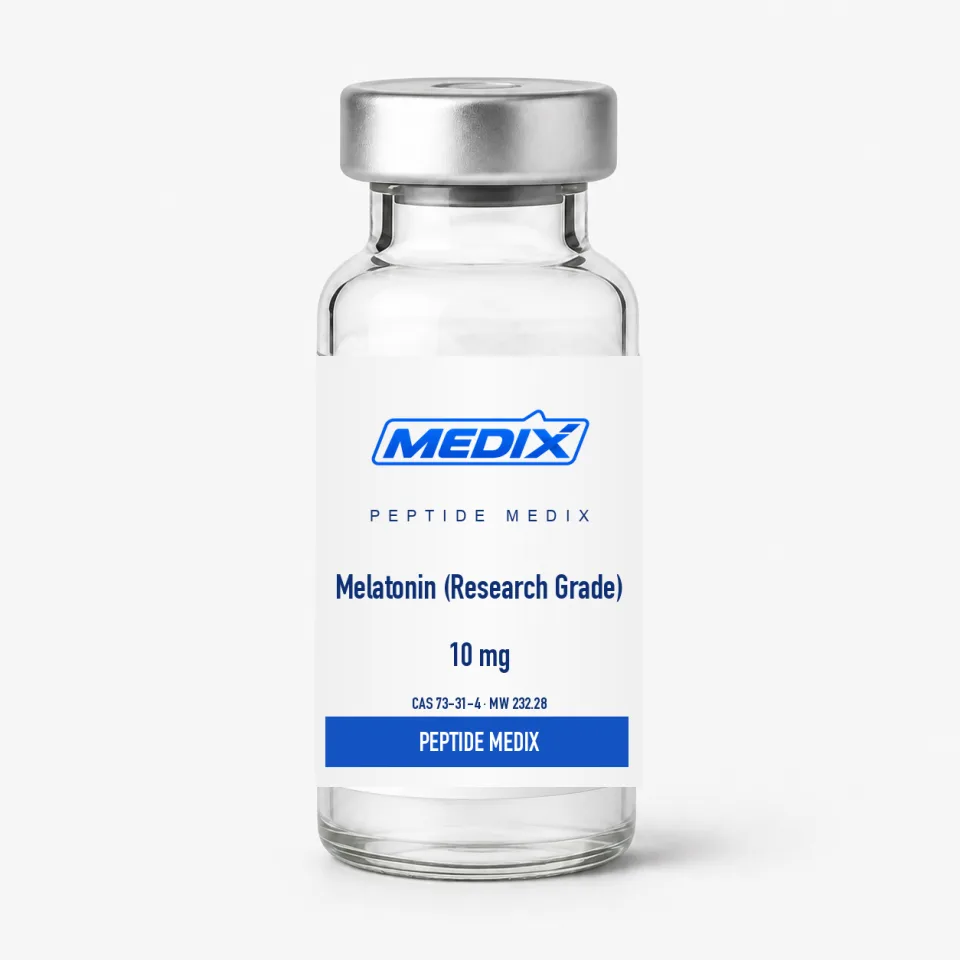
- HPLC purity ≥99%, with a COA for each lot on request
- Certificate of analysis tied to your lot number
- Tracked EU delivery, dispatched the next working day
Melatonin (Research Grade)
Research-grade N-acetyl-5-methoxytryptamine in 10 mg and 50 mg vials
In stock2 formats availableCAS 73-31-4
€34Range €34 – €68
This listing is currently unavailable. Contact us and we will tell you when it is back or suggest an equivalent.
Ask about this listing or request its COA- FormCrystalline powder in a sealed glass vial
- Mol. weight232.28 g/mol
- Research areasCircadian rhythm and chronobiology, sleep-onset physiology, oxidative stress, mitochondrial function, seasonal and reproductive biology
For laboratory research use only. Sold exclusively for in-vitro laboratory research by qualified professionals. Not for human or veterinary use, and not a medicine, food, cosmetic or dietary supplement. Terms and Conditions
Overview
Key facts
Melatonin (N-acetyl-5-methoxytryptamine) is an indoleamine that the pineal gland makes from tryptophan via serotonin; arylalkylamine N-acetyltransferase and acetylserotonin O-methyltransferase catalyse the last two steps.
- CAS number
- 73-31-4
- Molecular formula
- C13H16N2O2
- Molecular weight
- 232.28 g/mol
- Purity
- ≥99% by HPLC; lot-matched COA available
- Form
- Crystalline powder in a sealed glass vial
- Available sizes
- 10 mg · 50 mg
For research use only. Not for human consumption.
Melatonin (N-acetyl-5-methoxytryptamine) is an indoleamine that the pineal gland makes from tryptophan via serotonin; arylalkylamine N-acetyltransferase and acetylserotonin O-methyltransferase catalyse the last two steps. The suprachiasmatic nucleus controls its production, and light hitting the retina shuts it off — which is why blood levels climb after nightfall and drop sharply at dawn. This close link to the light–dark cycle has made melatonin a standard reference compound in chronobiology.
What we sell here is the small molecule itself, not a peptide: research-grade powder in sealed vials of 10 mg or 50 mg. Melatonin signals through two Gi-coupled receptors, MT1 and MT2, which lower cyclic AMP, and it also binds quinone reductase 2 (once called MT3). Separately from any receptor, its indole ring directly scavenges reactive oxygen and nitrogen species, so the literature falls neatly into receptor-based chronobiology on one side and redox studies on the other.
What sets this listing apart
Melatonin (Research Grade) – vial, 10/50 mg. Crystalline powder in a sealed glass vial. Other Melatonin listings differ in format, fill or combination partners; the specification and COA always refer to the listing you order.
Same compound, other listings
Specifications
Identity
- CAS number
- 73-31-4
- Molecular formula
- C13H16N2O2
- Molecular weight
- 232.28 g/mol
Supply & purity
- Form
- Crystalline powder in a sealed glass vial
- Purity
- ≥99% by HPLC; lot-matched COA available
- Available sizes
- 10 mg, 50 mg
- Solubility
- Sparingly soluble in water; readily soluble in ethanol or DMSO for stock preparation
Additional detail
- Chemical name
- N-acetyl-5-methoxytryptamine
- Compound class
- Indoleamine; tryptophan-derived pineal hormone (small molecule, not a peptide)
- Biosynthetic origin
- Tryptophan to serotonin to N-acetylserotonin to melatonin, via AANAT and ASMT
- Molecular targets studied
- MT1 and MT2 G-protein-coupled receptors; quinone reductase 2 (MT3 site)
- Research areas
- Circadian rhythm and chronobiology, sleep-onset physiology, oxidative stress, mitochondrial function, seasonal and reproductive biology
- Storage (powder)
- −20 °C, sealed, desiccated and protected from light
- Storage (in solution)
- 2–8 °C in amber or foil-wrapped vessels; aliquot frozen stocks
Questions about Melatonin (Research Grade)
Should melatonin be classed as a peptide?
No. It is a small tryptophan-derived indoleamine of roughly 232 g/mol — about a tenth the size of a typical research peptide. We list it with sleep-related peptides such as DSIP because their research areas overlap, not because the structures are related.
Which vial sizes and what purity?
10 mg and 50 mg vials of research-grade powder, HPLC-tested to ≥99%. A certificate covering purity and identity accompanies each lot; quote the lot number on your vial when asking for it.
What's the best way to dissolve it?
It dissolves only sparingly in water. Standard practice is a concentrated ethanol or DMSO stock diluted into aqueous buffer shortly before use, keeping the final solvent level low enough not to disturb the assay. Confirm solubility in your particular buffer.
Why keep it in the dark?
Its indole ring is light-sensitive and measurably degrades under ordinary lab lighting, and solutions oxidise faster than dry powder. Store it sealed, cold and dark, use amber or foil-wrapped vessels for solutions, and log light exposure where quantitative precision matters.