- HPLC-assayed purity of ≥99%
- Certificate of analysis tied to your lot number
- Tracked EU delivery, dispatched the next working day
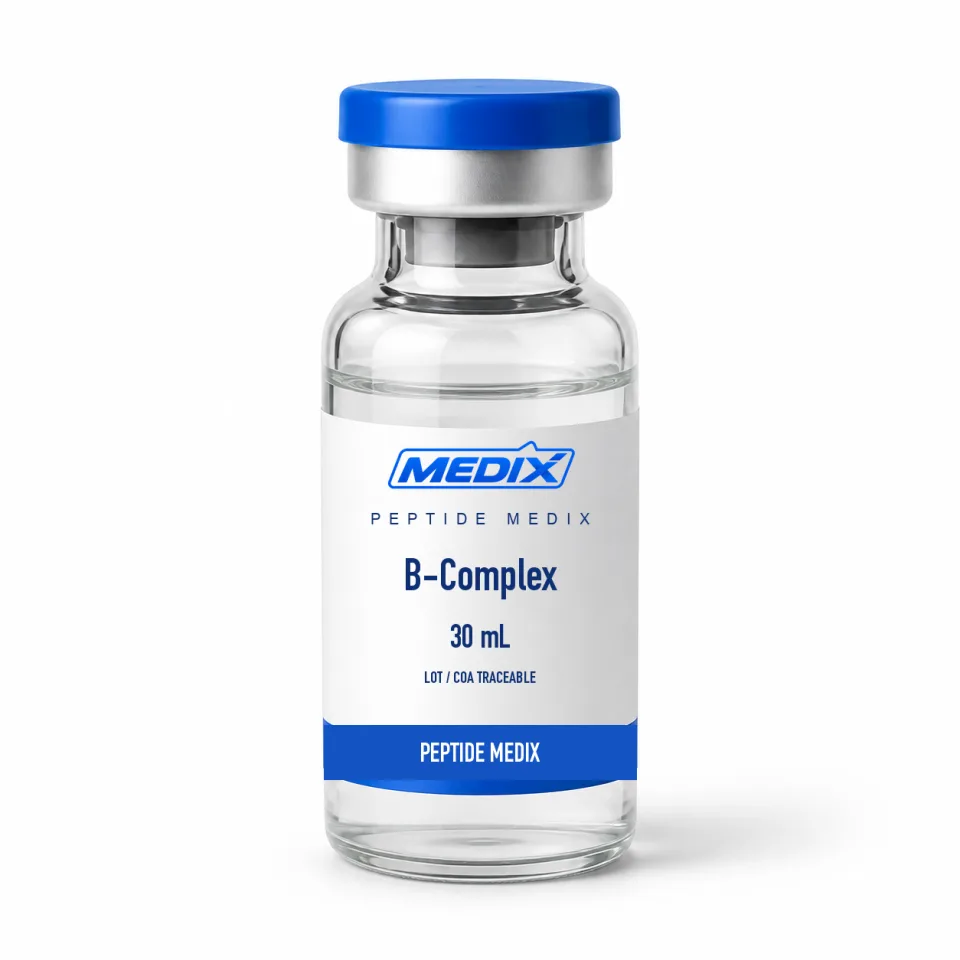
B-Complex
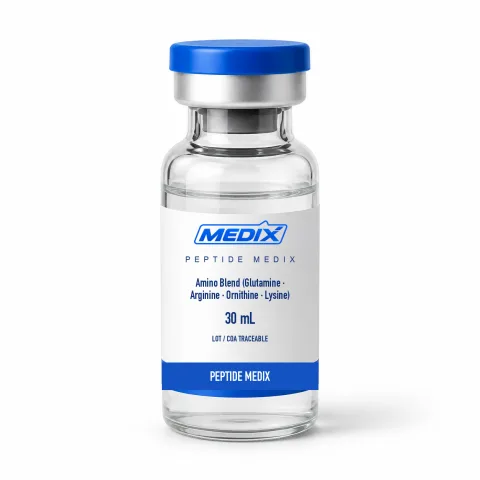
B-vitamin solution (B1, B2, B3, B6) in a 30 mL research vial
In stock1 format available
€42
This listing is currently unavailable. Contact us and we will tell you when it is back or suggest an equivalent.
Ask about this listing or request its COA- Research areasCarbohydrate catabolism, NAD salvage pathway, flavin-dependent enzymes, amino acid metabolism
For laboratory research use only. Sold exclusively for in-vitro laboratory research by qualified professionals. Not for human or veterinary use, and not a medicine, food, cosmetic or dietary supplement. Terms and Conditions
Overview
Key facts
This solution brings four water-soluble B vitamins together in one 30 mL vial: thiamine (B1) 100 mg/mL, niacinamide (B3) 100 mg/mL, riboflavin-5-phosphate — the phosphorylated, active form of B2 — 2 mg/mL, and pyridoxine (B6) 2 mg/mL.
- Storage
- 2–8 °C, protected from light; do not freeze
- Available size
- 30 mL
For research use only. Not for human consumption.
This solution brings four water-soluble B vitamins together in one 30 mL vial: thiamine (B1) 100 mg/mL, niacinamide (B3) 100 mg/mL, riboflavin-5-phosphate — the phosphorylated, active form of B2 — 2 mg/mL, and pyridoxine (B6) 2 mg/mL. Combining them mirrors their biology: they function as linked cofactors within the same catabolic routes, not as independent molecules.
Every vitamin supplies its own coenzyme. Thiamine is converted to thiamine pyrophosphate, needed by pyruvate dehydrogenase, alpha-ketoglutarate dehydrogenase and transketolase. Niacinamide feeds the salvage pathway that produces NAD+ and NADP+, tying the preparation directly to sirtuin and PARP studies. Riboflavin-5-phosphate is FMN and the precursor to FAD — the flavin cofactors of respiratory complexes I and II. Pyridoxine is turned into pyridoxal-5-phosphate, which more than a hundred amino acid-metabolising enzymes depend on.
The solution is supplied ready to use, with a Certificate of Analysis for each lot. Riboflavin is highly light-sensitive, so keep the vial protected from light for as long as it is in use.
Specifications
Supply & purity
- Solubility
- All components are water-soluble vitamins already in solution
Additional detail
- Vial size
- 30 mL
- Thiamine (B1)
- 100 mg/mL
- Niacinamide (B3)
- 100 mg/mL
- Riboflavin-5-phosphate (B2)
- 2 mg/mL
- Pyridoxine (B6)
- 2 mg/mL
- Coenzyme forms studied
- Thiamine pyrophosphate, NAD+/NADP+, FMN and FAD, pyridoxal-5-phosphate
- Research areas
- Carbohydrate catabolism, NAD salvage pathway, flavin-dependent enzymes, amino acid metabolism
- Appearance note
- The yellow color comes from the riboflavin component
- Photosensitivity
- High — riboflavin degrades rapidly under light; keep shielded
- Storage
- 2–8 °C, protected from light; do not freeze
- Documentation
- Lot-matched Certificate of Analysis available
Questions about B-Complex
What does the vial contain?
A 30 mL vial provides thiamine 100 mg/mL, niacinamide 100 mg/mL, riboflavin-5-phosphate 2 mg/mL and pyridoxine 2 mg/mL. They are combined because the coenzymes they generate work at connected points in the same metabolic pathways.
Why use riboflavin-5-phosphate instead of plain riboflavin?
Riboflavin-5-phosphate is FMN, the active form that is already phosphorylated, and it dissolves in water far better than free riboflavin. That solubility is the practical reason it is chosen for mixed liquid preparations, where ordinary riboflavin would come out of solution.
What is the link to NAD+ research?
Niacinamide is the immediate NAD+ precursor in the salvage pathway, where NAMPT and NMNAT regenerate the coenzyme. Labs investigating sirtuins, PARPs or the dynamics of the NAD+ pool frequently treat niacinamide supply as one of their input variables.
What makes the solution yellow?
Riboflavin-5-phosphate — flavins are strongly yellow chromophores. If the colour fades, that is a helpful visual sign that the vial has been exposed to light and may have lost some riboflavin.
How do I store the vial?
Refrigerate at 2–8 °C in its carton, shielded from light, and never freeze it. Riboflavin is among the most light-sensitive vitamins, making light the principal risk to this preparation.
Related